


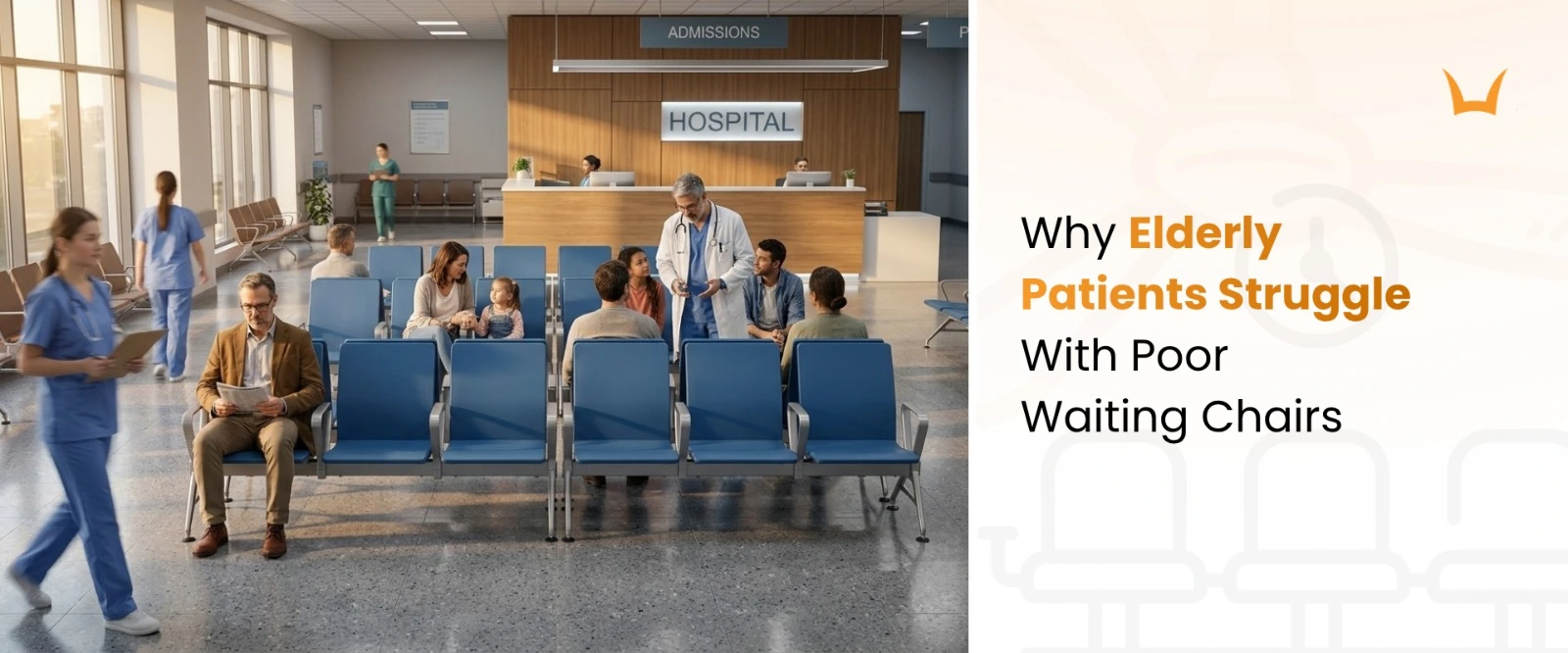
Why Elderly Patients Struggle With Poor Waiting Chairs
- The Elderly Body and the Seat Surface
- Hard Seat Edges Affect Circulation Faster Than Most People Realise
- Armrests That Look Useful but Are Not
- Stability Matters More Than Comfort for Many Elderly Patients
- Seat Height and Depth Are Often Wrong for Elderly Proportions
- How Syona Waiting Chairs Address These Needs
- Seating That Works for Elderly Patients Works for Everyone
For hospital administrators, clinic owners and healthcare facility planners
Elderly patients make up a significant portion of hospital visitors. They come with knee pain, lower back stiffness, reduced grip strength and a real worry about falling. The waiting chair they sit in needs to work for all of that. Most hospital waiting chairs do not.
Most waiting chairs are structurally solid. The problem is they were never designed with an elderly body in mind. They were built for average adults, and an elderly person is not an average adult sitting in an average way.
For a younger person, a hard chair is an inconvenience. For an elderly patient with joint pain and circulatory issues, the same chair is a real problem that shows up within the first twenty minutes.
The Elderly Body and the Seat Surface
One thing that changes with age is the natural fat padding over the sit bones, which cushions contact between the body and the seat. As this padding thins, pressure from a firm surface is transferred more directly to the bone. A seat that a younger person finds acceptable can begin causing discomfort for an elderly person within fifteen to twenty minutes. Most hospital waiting chairs reach this discomfort faster than administrators realise, and older patients are usually the first to experience it.
Many elderly patients develop a natural forward curvature in the upper back. Standard backrests are built for a straight spine. For someone whose back curves forward, a flat backrest either digs into the wrong spot or leaves a gap behind the lower back with no contact at all.
Arthritis in the hips, knees and lower back means the body cannot hold one position for long. In a hard chair with no contouring, the only relief is to keep adjusting. That constant movement is exhausting, and it is caused entirely by the chair.
Hard Seat Edges Affect Circulation Faster Than Most People Realise
Many elderly patients are managing diabetes, blood pressure or heart conditions, all of which affect blood flow to the lower legs. A hard, straight seat edge pressing against the underside of the thigh makes this worse, restricting circulation faster than it would for a healthier, younger patient.
After thirty to forty minutes, the legs feel heavy and the feet may swell. Getting up is noticeably harder than sitting down was. The patient walks into the consultation carrying discomfort the chair created.
A seat edge that curves gently downward at the front, rather than cutting straight across, keeps pressure off the underside of the thigh and helps circulation stay reasonable through a long wait.
Armrests That Look Useful but Are Not
Grip strength drops with age. Rising from a seat means pushing down through the palms. If the armrest is too narrow, too smooth or positioned too far back, the hand slides and the patient is left relying entirely on stiff knees and hips to get up.
Most waiting chair armrests are designed to separate seats, not to support rising. Narrow, smooth-topped, placed at the wrong height. An elderly patient who tries to use them to push up finds there is nothing there to actually hold.
A useful armrest needs to be wide enough for a flat palm, solid enough not to flex under full weight, and at a height where the elbow can extend. Not complicated requirements. Rarely prioritised.
Stability Matters More Than Comfort for Many Elderly Patients
Falls are a serious concern for elderly people and most are very aware of this. Before sitting in an unfamiliar chair, they check whether it will shift, whether it feels solid, whether they can get back up. This caution comes from real experience.
A chair that shifts when they lower into it creates hesitation. Some prefer to stand rather than risk it. Those who sit often perch at the edge with no back support. Others sit fully and then feel they cannot get up without help.
A chair that remains stable under weight gives elderly patients the confidence to sit comfortably, a standard that quality hospital visitor chair manufacturers should always meet.
Seat Height and Depth Are Often Wrong for Elderly Proportions
Elderly patients are often shorter than the adult a standard seat height is designed for. When the feet do not rest flat, the full weight of both legs hangs from the thighs, adding to seat pressure and making the body less stable. Getting up from this position is harder and less safe.
Seat depth matters equally. Too deep and the patient must choose between back support and the ability to rise. Too shallow and the lower back has no contact. Neither works for someone sitting for an extended period with joint pain.
How Syona Waiting Chairs Address These Needs
Syona waiting chairs are designed around the physical needs of actual users. The contoured backrest follows the natural spine shape. For elderly patients with age-related upper back curvature, this means actual back contact rather than a gap or a pressure point in the wrong place.
The moulded seat surface distributes weight more broadly, reducing concentrated pressure on the sit bones. The seat edge curves gently at the front rather than cutting straight across, keeping circulation better through longer waits.
Pressure die-cast aluminium armrests are wide enough for a flat palm and positioned where the elbow can extend when pushing up. Solid under full body weight. For an elderly patient, rising becomes straightforward rather than uncertain.
Gang seating configurations keep each chair fixed. Syona manufactures waiting chairs in different seating capacities, including four-seat configurations, for healthcare spaces that require stable, shared-frame seating. An elderly patient lowering into the seat does not have to deal with a chair that shifts under them.
Seating That Works for Elderly Patients Works for Everyone
Elderly patients are a central part of the daily hospital population. Their specific physical needs are consistently unmet by standard commercial waiting chairs.
Circulation-friendly seat edges, solid armrests for rising, stable frames and appropriate seat dimensions all directly affect how an elderly patient experiences the wait. These are not extras. They are the basics of seating that actually serves this patient group.
If your hospital or clinic serves a significant number of elderly patients, talk to Syona's team about waiting area seating built for their specific needs. Seating that works well for elderly patients works well for every patient.
Are your waiting chairs designed to support elderly patients safely and comfortably?
Elderly patients need more than just a place to sit. Poorly designed waiting chairs can lead to discomfort, circulation issues, and difficulty in sitting and standing. The right seating improves safety, supports posture, and makes long waiting periods easier for both patients and attendants.
Explore Syona’s waiting chairs designed for real healthcare environments, with ergonomic support, stable construction, and features that assist elderly users. For bulk requirements, connect with our team to get the right solutions and pricing tailored to your facility.