


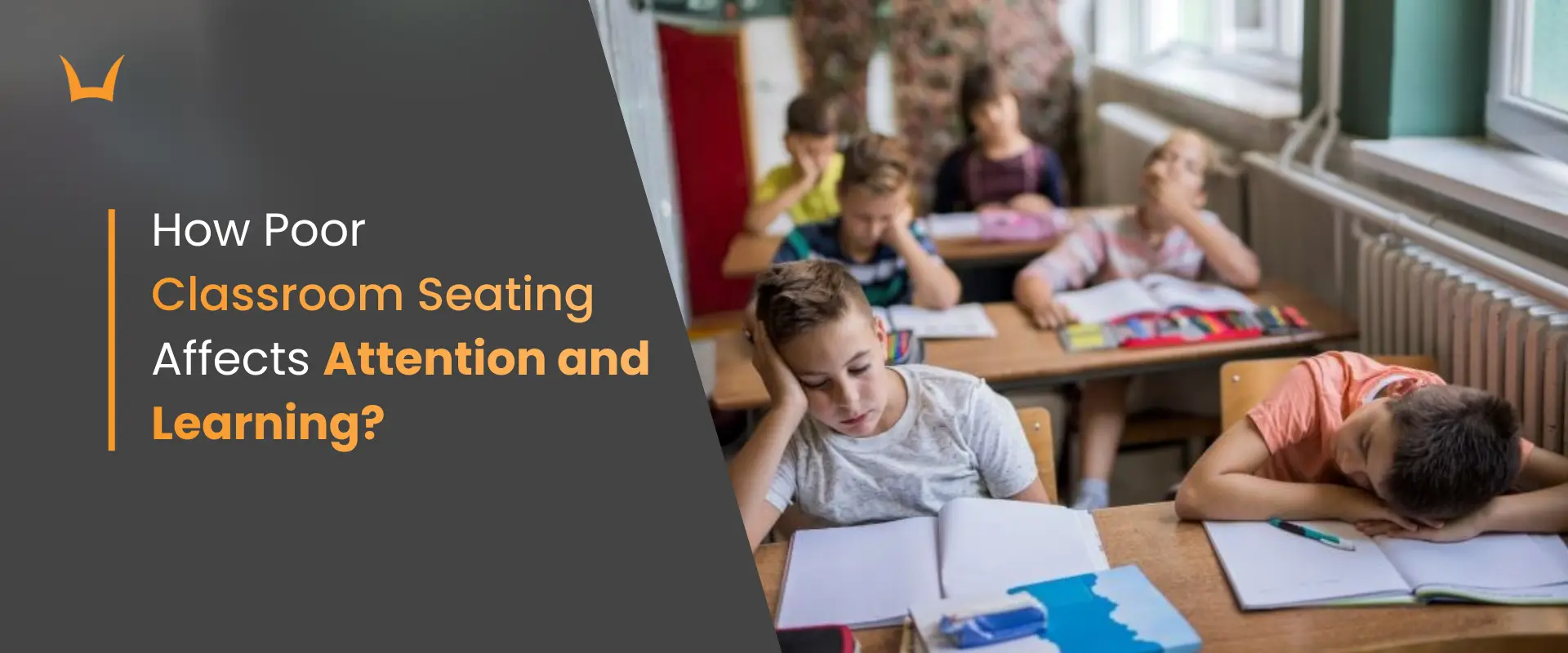
How Poor Classroom Seating Affects Attention and Learning
- When the School Day Is Long, the Chair Matters More
- A Chair Built for No One in Particular Helps No One in Particular
- The Writing Pad Is Where Attention Breaks Most Often
- Classroom Clutter Competes with Concentration Every Single Period
- What the Right Seating Actually Does Inside a Classroom
- Furniture Is a Teaching Tool. It Just Does Not Look Like One
For school management, college administrators, academic directors and parents
Think about the last time you sat in an uncomfortable chair for three hours straight.
You probably remember very little of what happened in that room. Not because the content was unimportant. Because your body kept pulling your mind away from it.
Now imagine that is your student. Every day. Six to eight hours. In furniture that was never really designed for learning.
Schools invest significantly in teachers, books and digital tools. Yet the classroom chairs students sit in from 8 AM to 3 PM are often the last thing on the list.
That chair is in contact with the student for more hours each day than any teacher, screen or textbook. What it does to the body, it does to the mind.
Here is what that actually looks like in a classroom.
When the School Day Is Long, the Chair Matters More
A student does not sit for forty minutes and go home. The school day runs six to eight hours, covering lectures, note-taking, group work and examinations.
Physical discomfort across that many hours does not stay physical. The brain and body share resources. When the body is under consistent low-level stress from a poor seating position, the brain operates on reduced capacity.
Signals from an aching lower back, numb legs or a stiff neck are quiet but constant. They compete with the teacher's voice. They compete with the content on the board. And they usually win.
Mental fatigue in a long school day is often not about the subject being too hard. It is about the body being too uncomfortable for the mind to stay present.
A Chair Built for No One in Particular Helps No One in Particular
Most schools use a single chair size across multiple class groups.
A Class 4 student and a Class 9 student sitting in the same chair is not a practical solution. It is a compromise that helps neither.
For the younger student, feet dangling without floor contact puts pressure on the underside of the thighs. The body becomes restless trying to find stability. For the older student, a smaller chair forces the knees up and the spine into an unnatural curve.
In both cases the student is physically misaligned. A student who is physically misaligned cannot hold their posture, cannot hold their pen correctly and cannot hold their attention on the lesson.
Posture is not a discipline issue. It is a design issue. Students sit the way their chair allows them to, not the way a poster on the wall tells them to.
The Writing Pad Is Where Attention Breaks Most Often
Students spend a large portion of the school day writing. Notes during lectures, answers during tests, assignments across subjects.
When the seat surface is completely flat, pressure builds at the base of the spine. The body looks for relief through constant small movements. Each one is a micro-interruption in concentration. Nobody notices them individually. Together they add up to a class worth of lost focus.
The writing pad design either compounds this or corrects it. A pad that sits at the wrong angle, is positioned too far from the body or shifts under pressure forces the student to lean forward, twist their wrist or grip the pen harder than necessary.
When the physical act of writing demands extra effort, less mental energy remains for the actual thinking the student is supposed to be doing.
During an examination, a student's full cognitive energy should go toward recalling and answering. Not toward managing an unstable writing surface.
Classroom Clutter Competes with Concentration Every Single Period
When furniture has no provision for bags, books and belongings, students make do with the floor and the desk.
Bags on the floor block the row. Books piled on the desk crowd the workspace. Getting to a book mid-class becomes a small disruption that affects the student on both sides. Entering and leaving the row at the end of the period becomes an event.
None of this is dramatic. No single incident stands out. But the classroom never fully settles into the kind of quiet that deep attention requires.
When every belonging has a place and students can access what they need without disturbing anyone, the physical environment stops competing with the lesson and starts supporting it.
Bulky furniture that restricts movement within the classroom adds to this. Students who have to squeeze past each other, knock into desks or navigate a cluttered aisle bring physical disruption into what should be a focused space.
What the Right Seating Actually Does Inside a Classroom
Ergonomic classroom seating is not a premium category. It is a correction of the problems standard seating creates.
A seat shaped with a gentle slope at the front edge lets blood circulate more freely through long periods of sitting. The leg heaviness that sets in by the second period arrives later, if at all. The student stays physically comfortable for a longer stretch of the day.
A backrest that follows the spine's natural curve takes the load off the lower back muscles. The student does not have to actively work to sit upright. The chair holds them. Their attention is free to go toward the lesson.
A writing surface that is properly positioned and does not wobble makes note-taking effortless. Writing happens in the background. Thinking stays in the foreground, which is exactly how it should work.
When chairs are available in height variants matched to different age groups, every student sits with their feet flat on the floor, their thighs supported and their spine in a position it can sustain across a full school day without effort.
The goal of good classroom seating is for the student to forget they are sitting. When that happens, learning can take over completely.
Furniture Is a Teaching Tool. It Just Does Not Look Like One.
Every decision a school makes about its learning environment communicates something to students.
Good seating tells students the institution has thought carefully about the conditions in which they are expected to perform. Poor seating sends the opposite message, quietly, every single day.
Improving student attention does not always begin with a new method or a new curriculum. Sometimes the most direct path is through the chair.
Syona writing pad chairs are built precisely for this. With age-appropriate height variants, a waterfall seat edge, a contoured backrest and a stable writing surface, every design decision works toward one outcome: a student who is physically settled enough to stay mentally present.
Is your classroom furniture helping students focus?
Comfortable seating plays a key role in student attention. Syona writing pad chairs are designed to support posture, comfort, and better focus during long classes. Contact our team to learn more.