


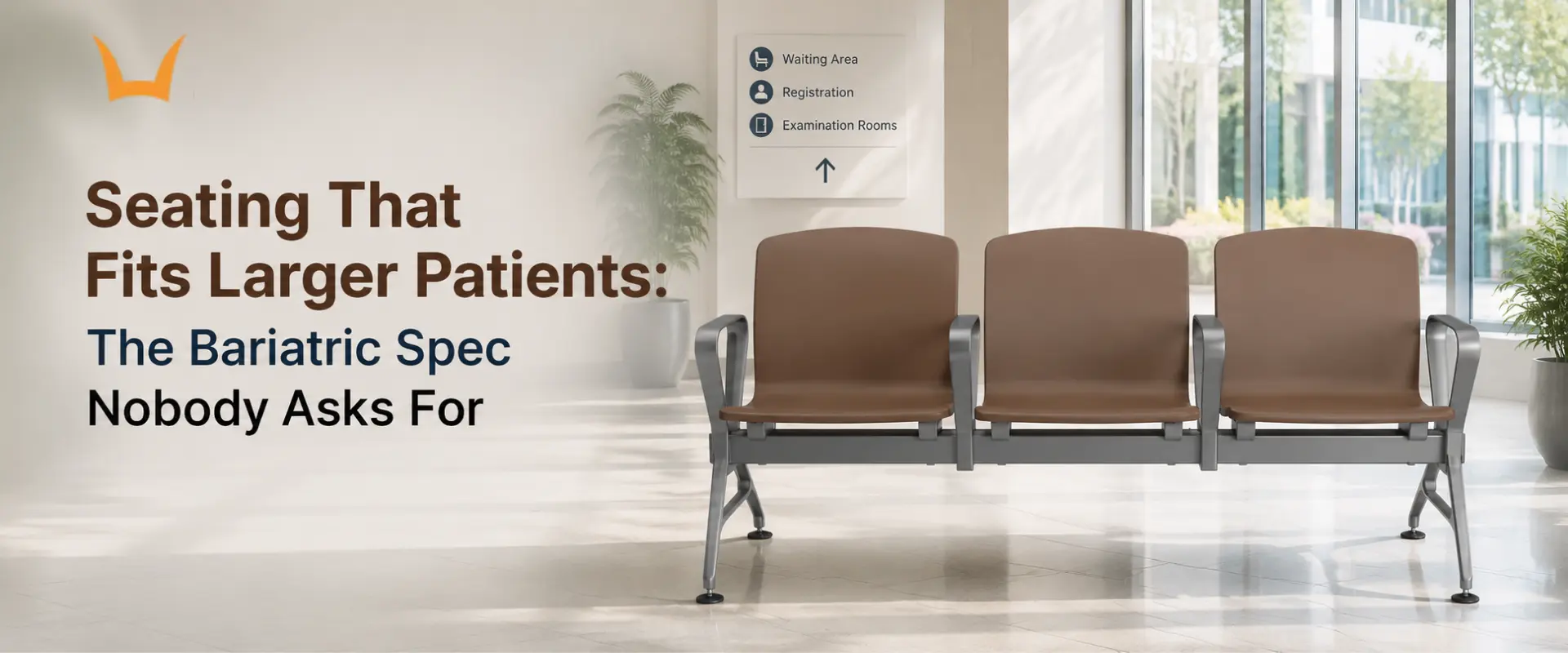
Seating That Fits Larger Patients: The Bariatric Spec Nobody Asks For
- Bariatric Chairs vs. Inclusive Waiting Room Seating
- Four Measurements for Bariatric Waiting Room Chairs
- Armrest Clearance in Bariatric Seating for Waiting Areas
- Wider Seats for Larger Patients Inside a Standard Row
- Load Rating and Build in Chairs for Larger Patients
- Cleaning and Infection Control in Waiting Room Seating
- Planning Bariatric Seating for Your Waiting Area
A patient arrives early for an OPD appointment and looks along the row of linked waiting room seating. The armrests are too close together for the middle seats, so it has to be the end one, perched on the front edge. Nothing in that room is broken. Every chair meets its spec. The spec was written for an average build and never looked at again.
What this guide covers: the four measurements that decide whether someone can sit, why the armrest is usually the problem, how to build wider seats into a normal row, and why the answer is layout rather than a special chair.
Bariatric Chairs vs. Inclusive Waiting Room Seating
Most advice on this subject is about the ward chair, the recliner used for long, supervised sits. That is a different product for a different room.
A waiting area does not need a special bariatric chair. It needs seats that fit the people who use the building. A doorway is built wide enough for everyone rather than having a second, wider door for some visitors, and seating works the same way. Seen like that, this is not a specialist purchase.
Four Measurements for Bariatric Waiting Room Chairs
Seat width. A standard public seat is about 430 to 480 mm across. The bariatric target is 610 to 762 mm, or 24 to 30 inches. This is not about extra comfort. Below a certain width, a larger person cannot get into the seat at all.
Seat depth. Larger users tend to carry weight in front of the hips, so a shallow seat leaves the back unsupported and pushes all the pressure onto the front edge. A deeper seat spreads the weight instead.
Seat height. Syona's guidance for hospitals and clinics is 430 to 460 mm. For heavier users, the higher end is better, because standing up from a low seat is where knees and hips take the most strain.
Armrest clearance. This is the one people miss, and it is not the same thing as seat width.
Armrest clearance in bariatric seating for waiting areas
On a single chair, an armrest helps you. On a linked row, it sets how wide the seat really is.
Take a three seat beam of about 1.9 metres, which is a common size. Split across three seats, the armrests sit about 630 mm apart. Take off the width of the armrests and you are left with roughly 570 mm of clear space. That is wider than the seat itself, and still short of the 610 mm target. So the beam is three seats wide, and a larger patient cannot use any of the three.
So the aim is not to strip armrests out. Armrests are what a heavier person pushes against to stand up, and standing up is the riskiest moment of the visit. The aim is to open up the space between them at a few points in the room.
Wider seats for larger patients inside a standard row
The answer is to change the layout, not to order a different kind of chair.
Syona's Venus range covers both cases in the same style. Venus Prime is the visitor chair with armrests, and Venus Pride is the armless version of the Venus Prime chair. Placing a run of Venus Pride chairs within the seating layout gives you positions with no armrest restricting the width, next to armrest seats for everyone who wants something to push up from. Because both come from the same range, the wider positions look like part of the room rather than a chair brought in from somewhere else.
Where they go matters as much as how many. Set each armless position next to an armrest chair rather than in a block of its own, so anyone using one still has an arm within reach on one side when they stand, and spread those pairs around the room.
Gang beam seating can carry wider positions too, but that depends on the beam length and the seat spacing on each variant, so ask what a two seat and three seat run measure before you plan around them.
Load rating and build in chairs for larger patients
Width lets someone sit down. The build decides whether the seat is safe once they have.
Beam seating has an advantage separate chairs do not. The weight goes into one strong beam and down through the floor glides, instead of into four thin legs under each seat. Syona builds the Venus and Jupiter Awe and Jupiter Ace rows on a die cast aluminium beam and leg frame, with an engineering polymer seat that bends under weight and springs back rather than cracking. The Jupiter Awe seat has a steel insert for extra stiffness. Standalone chairs do not have that beam behind them, so if wider positions are made up of separate chairs, the tested rating for those chairs is the figure that matters.
Now the honest part, and it is true of every maker. Waiting room seating is usually rated for general commercial use, and a weight limit per seat is often not published. Do not guess one from the look of the frame, and do not read it from the warranty, which tells you how long a chair lasts and nothing about what it holds. Ask for the tested rating for the exact seat and beam you are ordering.
Cleaning and infection control in waiting room seating
A wider seat can mean a larger seating surface to clean between patients, which matters in a room where regular cleaning is already part of the routine. Engineering polymer provides a smooth, easy-to-clean surface, although the recommended cleaning products and procedures should still be followed.
The chair's contact points with the floor matter too, particularly in a busy waiting area where seats may be moved or repositioned regularly. Choosing suitable chair legs and floor glides for the flooring can help reduce unnecessary marking or scratching as the seating is used.
Planning bariatric seating for your waiting area
As healthcare seating suppliers, we can help once you tell us the room size, how many people sit at once, and how many users may require wider seating. Our team can then set the armrest layout, decide where the wider seats go, and confirm the tested rating. Start with a bulk enquiry and send the floor plan, and it is worth reading our standard dimensions guide first.
Bariatric waiting room chairs: common questions
How many bariatric capable seats does a waiting area need?
There is no set rule, so decide on one rather than leaving it to chance. A good starting point is at least one wider seat in every section, checked against the patients you actually see.
Do gang seating beams need fixing to the floor?
Ask, especially if you expect heavier users. Beam seating is made to stand on floor glides, but fixing may be advised depending on how long the row is, what the floor is, and how the ends get used.
Plan Waiting Room Seating That Fits More People
A waiting room should accommodate different body sizes without making anyone feel like an exception. The right combination of seat width, clearance, height, armrest positioning and tested load capacity can make a significant difference to how practical and accessible the seating arrangement is.
Syona offers visitor chairs and beam seating that can be arranged across healthcare, clinic and commercial waiting areas. By combining armrest and armless positions within the same seating range, you can create wider seating options while keeping the overall room visually consistent.
For larger waiting areas, our team can also review your room dimensions, seating capacity and layout requirements to help determine where wider positions should be placed and which seating configuration is appropriate.