


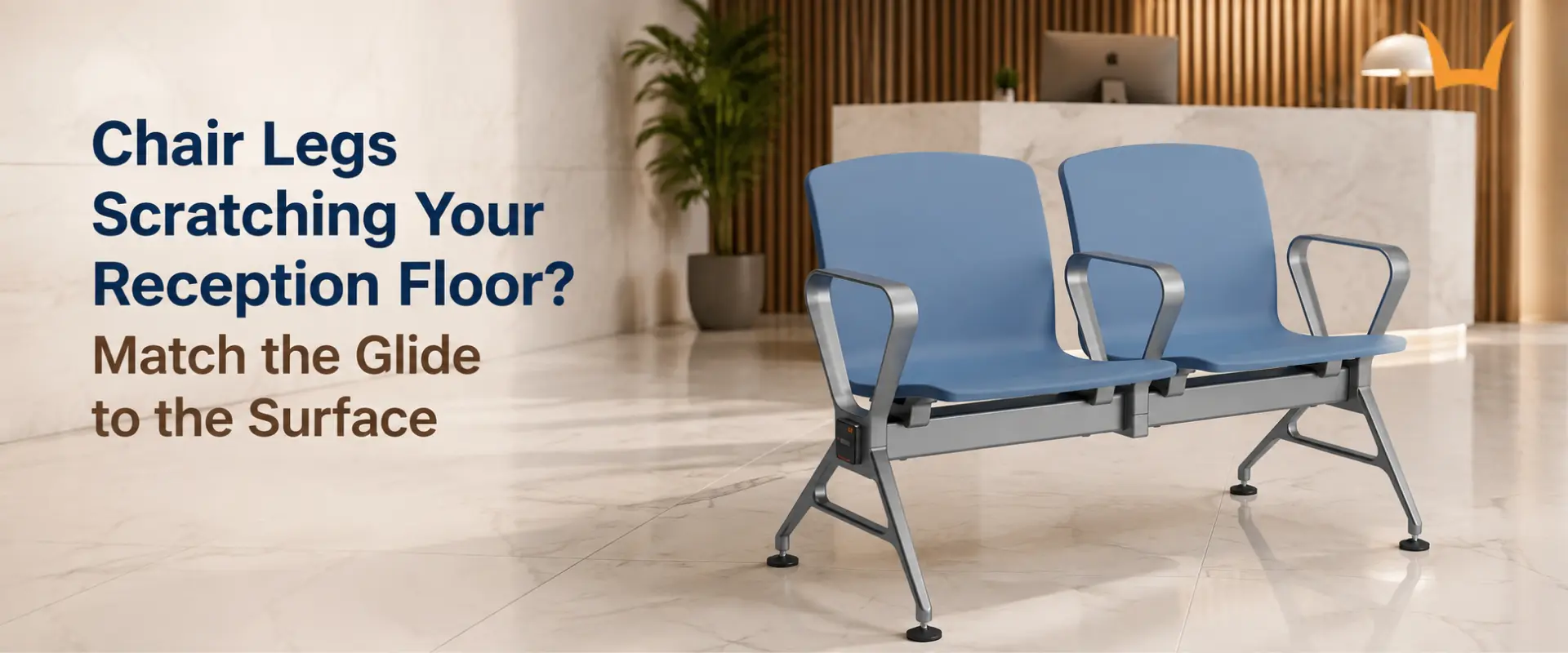
Chair Legs Scratching Your Reception Floor? Match the Glide to the Surface
- Why Chair Leg Glides Fail: Hardness Works Both Ways
- Chair Glides for Tile Floors and Other Hard Surfaces
- Chair Glides for Wooden Floors, Vinyl and Laminate
- Floor Glides for Chairs on Carpet
- Grit Under the Glide Is What Actually Scratches
- Stick-On Pads vs. a Built-In Contact Point
- How Syona Waiting Seating Meets the Floor
- Glide and Floor at a Glance
- Chair Leg Glides: Common Questions
- Specifying Seating for Your Floors
Faint grey arcs appear under the waiting chairs a month after a reception is finished. The chairs are new, the tile is newer, and neither is at fault.
The damage happens at a contact patch smaller than a coin, where the weight of a seated person meets the floor through whatever the leg ends in. Get that contact right and heavy commercial seating sits on a delicate floor for years without leaving a trace. Get it wrong and the lightest chair in the building writes circles into the surface.
This guide covers why the same chair suits one floor and damages another, what to fit on tile, timber, vinyl, carpet and stone, why grit matters more than material, and what to specify so the problem never starts.
Why chair leg glides fail: hardness works both ways
Floors and glides sit on a hardness scale, and trouble starts when the two are mismatched in either direction.
Put something hard, such as a bare nylon or steel foot, on something soft like vinyl or timber, and the foot wins. It scores and dents. Put something grippy, such as a rubber foot, on a hard polished surface like tile, and the grip that felt reassuring now drags and scuffs, leaving dark marks whenever the chair is pushed rather than lifted.
The aim is not the toughest glide or the softest. It is the one whose hardness and grip suit the floor it will actually stand on. That is why a single glide type across a mixed floor building is almost always wrong somewhere.
Chair glides for tile floors and other hard surfaces
On tile, stone and polished concrete, scratching is less of a risk than sliding and scuffing. Hard nylon or PTFE moves smoothly, resists wear and takes heavy loads without deforming, which makes it the default for hard floors.
Rubber has a narrower job here. It belongs where a chair must not move at all, such as a fixed row against a wall. In a busy waiting area it works against you, because a foot that grips gets dragged instead of lifted, and dragging is what leaves the marks. Tile also shows every grey scuff, so the contact point needs keeping clean whichever material you choose.
Chair glides for wooden floors, vinyl and laminate
On timber the priority flips from movement to protection. Felt or a soft PTFE glide cushions the contact and slides without scoring. Keep metal and hard rubber off wood entirely, since one scratches and the other scuffs and can leave residue on a finished surface.
Felt has a limit worth knowing. It is quiet and gentle, but it wears through quickly under constant use and traps grit, so it suits a lightly used office far better than a public entrance.
Vinyl and laminate behave like a softer, more chemically sensitive version of timber. Soft glides protect them, and rubber is the specific thing to avoid, because some rubber compounds react with vinyl and leave permanent staining that no glide will lift.
Floor glides for chairs on carpet
Carpet needs a glide that rides on top rather than sinking in, which is where hard nylon or metal earn their place. Metal is the most durable option available and repositions cleanly on carpet, but it is also the most dangerous thing you can put on a finished hard floor, so it stays on carpet and in heavy duty settings only.
Grit under the glide is what actually scratches
Here is what material choice alone will not fix. In most buildings the culprit is not the glide, it is what is caught underneath it.
A grain of hard sand lodged in a soft felt pad becomes a cutting tool, and every slide of the chair turns that trapped particle into a blade against the floor. This is why felt at a dusty entrance can scratch worse than a bare leg would.
So the answer is partly maintenance. Wipe contact points when the floor is cleaned, check the feet every few months, and replace any that are worn, split or packed with debris. A perfect glide left to collect grit stops being a perfect glide.
Stick on pads versus a built in contact point
The right material fitted the wrong way falls off, and a chair with a missing glide is a chair scratching the floor on a bare leg.
Adhesive and nail on pads suit light domestic use, but they need a clean dry surface to hold and they are the first thing to shed under constant sitting and rising. In a public building they also get pushed out of place by cleaning equipment. For seating that is used all day, the contact point needs to be part of the chair rather than stuck to it.
How Syona waiting seating meets the floor
Syona's ranges are built differently by product, which is worth considering before you specify. The Jupiter Awe range uses an aluminium die cast frame with a built-in level adjuster at each leg, allowing each foot to be adjusted independently so the chair sits level on uneven floors. The Venus Gang range uses an engineering polymer body with pressured die cast aluminium armrests, offering a different approach to durability through strength and flexibility rather than adjustable floor contact.
In both cases, the way the chair meets the floor contributes to its stability and suitability for the installation. For seating intended for larger patients, the floor contact points and overall frame construction should be considered alongside the tested load rating rather than treated as separate specifications.
When ordering, include the floor surface for each area so the appropriate seating configuration can be confirmed before delivery.
Glide and floor at a glance
| Material | Best floors | Avoid on | Main trait |
|---|---|---|---|
| Felt | Timber, laminate | Busy or dusty entrances | Soft and quiet, wears fast |
| Nylon or PTFE | Tile, stone, hard floors | Soft timber | Low friction, slides and lasts |
| Rubber | Slippery tile, fixed rows | Timber, vinyl | Anti slip, can scuff and stain |
| Metal | Carpet, heavy duty use | Any hard or delicate floor | Toughest, scratches finishes |
Chair leg glides: common questions
Are chair leg glides the same as floor protectors?
Two names for the same job. A glide, sometimes sold as a floor protector, is the part fitted at the bottom of a chair leg so the leg never touches the floor directly. It spreads the load, controls how the chair moves and takes the wear that would otherwise land on your floor.
Can one glide type cover a whole building?
Rarely, once there is more than one floor type. Tile, timber, vinyl and carpet each want something different, so a choice that suits the tiled reception can quietly damage the timber floored offices.
What should we ask a seating supplier about floor contact?
Three things. What the foot is made of, whether it can be specified for your floor type, and whether replacements are available separately. The third matters most over the years a chair stays in service, because a foot you cannot replace becomes a chair you have to replace.
Specifying Seating for Your Floors
The right chair-foot combination helps protect the floor while keeping waiting seating stable and easy to maintain. For a commercial space, choosing the seating with the floor surface in mind from the start is simpler than dealing with scratches, scuffs or unstable chairs later.
If you are planning new waiting seating, our waiting seating suppliers can help you choose the right seating for your space.
Choose Waiting Seating That Works With Your Floor
The right waiting chair should protect more than the people sitting in it. The way its legs meet the floor can affect stability, movement and the condition of your flooring over years of commercial use. Tile, timber, vinyl, laminate and carpet each have different requirements, so floor compatibility is worth considering before you place an order.
Syona offers commercial waiting and visitor seating designed for demanding workplace and public environments. From built-in floor contact points to adjustable feet on selected seating ranges, our designs are made with practical use, stability and long-term durability in mind.
Whether you are furnishing a reception, healthcare waiting area, office or other commercial space, share your floor type and seating requirements with Syona so the right configuration can be considered from the beginning.