


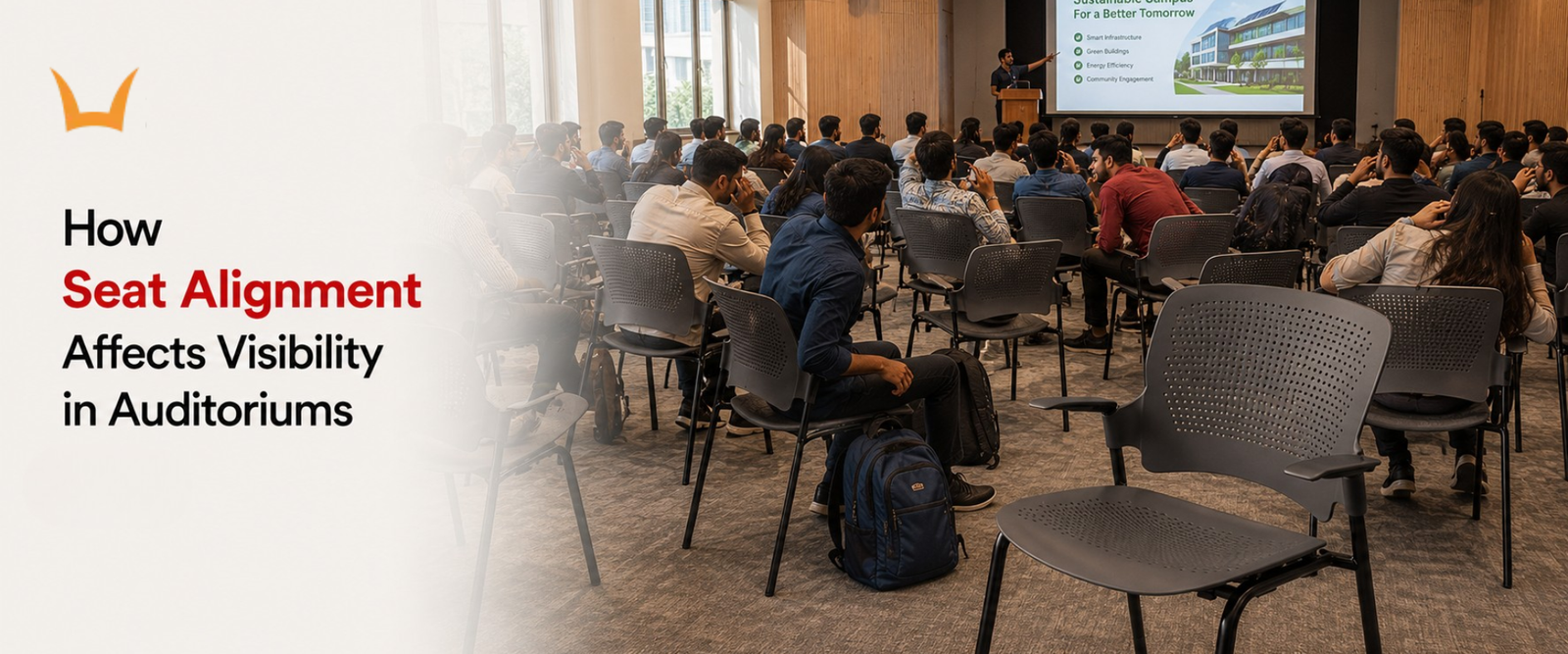
How Seat Alignment Affects Visibility in Auditoriums
- Why the Chair Is the Centre of the Visibility Question
- Back Height Is the Biggest Visibility Factor
- Shoulder Profile Controls Side Visibility
- Seat Width Decides Row Layout and Visibility Spread
- How Chair Depth Controls Row Spacing
- Row Alignment and Seat Positioning Matter Too
- A Note on Hall Factors
TLDR
- The chair decides what others can see
- Back height affects every row behind
- Shoulder profile changes side visibility
- Seat width controls the row layout
- Row spacing protects clear sightlines
Introduction
Most discussions about visibility in auditoriums focus on the hall. The tiered floor. The stage height. The screen position. These factors matter, but they are not the only ones.
The chair itself plays a much bigger role than most planners realise. At Syona Roots, we design auditorium seating for halls across India, and we see the same pattern repeatedly. Halls with poor visibility almost always have one thing in common. The seating choice was made without thinking about how the chair affects everyone around it.
This blog explains how chair level decisions directly control auditorium seat alignment visibility, and what to look for before you buy.
Why the Chair Is the Centre of the Visibility Question
Every audience member in a hall is affected by the chairs around them. The chair in front decides what they can see of the stage. The chair next to them decides their lateral view. The chair they sit in decides how the audience behind them experiences the show.
This means the chair is not just a personal comfort item. It is part of a connected system where one wrong choice multiplies across hundreds of seats. The right chair improves visibility for the whole hall. The wrong chair quietly damages it from the inside out.
Hall design factors like pillars, stage height, and lighting equipment all play a role too. But none of them have the multiplying effect of the chair. The chair is the only factor that touches every audience member simultaneously.
Back Height Is the Biggest Visibility Factor
The back of the chair is what the row behind looks at all event long.
Tall chair backs may feel premium and supportive, but they create real visibility problems for the row behind. The audience in row two has to lean or tilt their head to see past row one. Multiply this across ten rows and the back of the hall ends up watching a sea of headrests instead of the stage.
A well designed auditorium chair keeps the back height supportive enough for the user but low enough to preserve sight lines for the row behind. Our Syona Roots chairs use this balance carefully. The back height supports the shoulder blades without rising into the line of sight for the audience behind.
This is one of the most important details to before upgrading auditorium seating. Sit in the chair, then have someone sit in the row behind. Their view should remain clear over your head with a small comfort margin. If their view is blocked, the chair is wrong for the hall.
Shoulder Profile Controls Side Visibility
The width of the chair at shoulder height affects how easily the audience next to you can see across the hall.
A chair with bulky wing panels or thick padding at shoulder level acts like a wall between adjacent seats. The audience member next to you loses part of their horizontal view, especially if your shoulders fill that profile. Across a full row, this adds up to lost visibility for centre seats trying to see across.
Our chairs use a clean shoulder profile without bulky side panels. The frame supports the back without extending sideways into the visual field of the next user. This small design choice has a real impact on how the whole row experiences a wide event with stage action happening at both ends.
Seat Width Decides Row Layout and Visibility Spread
The width of each chair seat decides how many chairs fit in a row and how the row aligns with the stage.
Wider chairs feel more comfortable individually but reduce the number of seats per row. This forces planners to add more rows, which pushes the back rows further from the stage. Visibility at the back drops as a result.
Narrower chairs allow more seats per row, fewer rows overall, and a shorter distance from front to back. The whole hall feels closer to the stage and visibility improves for everyone.
The sweet spot is a chair that gives genuine comfort without being wider than necessary. Our auditorium chairs are sized to balance personal comfort with hall planning efficiency. This is why the same hall fitted with our chairs can often accommodate more seats with better visibility than the same hall fitted with bulky alternatives.
How Chair Depth Controls Row Spacing
The depth of the chair, measured from the front edge of the seat to the back, controls how much space each row needs.
Deep chairs need wider row spacing to give knees and feet enough room. This eats into the depth of the hall, pushing back rows further away from the stage.
Compact chair depth allows tighter row spacing without losing leg comfort, which keeps the back rows closer to the stage. Visibility improves because the back row is physically nearer.
Our Syona Roots chairs are designed with a compact depth that supports comfortable seating without forcing wider row gaps. The result is a hall that uses its floor space efficiently while keeping every audience member within reasonable distance from the action.
Row Alignment and Seat Positioning Matter Too
Beyond chair design, the way seats are aligned across the hall directly affects visibility. Straight rows are simple to install but can place audience members directly behind the person in front of them. Staggered seating positions each chair slightly offset from the row ahead, creating a clearer line of sight toward the stage.
Curved row layouts can also improve visibility by angling audience members toward the focal point of the room rather than forcing everyone to face straight ahead. In large auditoriums, especially those with permanent fixed seating layouts, these alignment decisions work alongside chair design to create consistent sightlines across every section of the hall.
At Syona Roots, seating layouts are planned with both chair dimensions and row positioning in mind, helping institutions achieve better visibility without sacrificing capacity or comfort.
A Note on Hall Factors
Hall factors like pillars, stage height, and lighting equipment also affect visibility, but they are fixed costs. Pillars cannot be moved easily. Stages cannot be raised quickly. Lighting equipment is positioned once and rarely changed.
The chair is the only variable you control fully at the time of decision. This makes it the most powerful tool you have for shaping audience visibility.
A hall with imperfect architecture can still deliver good visibility with the right chairs. A hall with perfect architecture can still disappoint with the wrong chairs. The chair gives you the upper hand.
Conclusion
Visibility in an auditorium is not determined solely by the building itself. The seating system has a direct impact on how comfortably and clearly audiences engage with a performance, presentation, or event. Small design decisions made during the seating selection stage can influence sightlines across every row and shape the overall audience experience for years to come.
At Syona Roots, we design auditorium seating with the wider hall environment in mind, helping institutions create spaces that feel comfortable, efficient, and visually accessible for every attendee. Choosing the right seating is not just about filling a hall. It is about ensuring every seat delivers a better view of what matters most.
Looking for institutional chairs designed for clear visibility across every row?
Syona Roots, one of India's auditorium chair suppliers, makes institutional chairs with carefully balanced back height, shoulder profile, seat width, and depth. Built to support the user without taking visibility from the audience around them.