


How Poor Auditorium Seating Ruins Audience Experience
- The Body Suffers Before the Mind Notices
- Sightlines That Push the Body Into Unnatural Positions
- The Quiet Killer in the Room: Noise
- How Audience Behaviour Changes With Bad Seating
- The Long Tail of a Bad Seating Decision
- Why Low Cost Seating Costs the Most in the End
- What an Audience Actually Pays For
TLDR
- Bad seats kill audience focus fast
- Pain ruins even great events
- Sightlines decide viewing satisfaction
- Noisy chairs break the moment
- Audience leaves with the wrong memory
Introduction
A great event lives or dies in the first thirty minutes. The lights, the sound, the speaker may all be perfect. But if the audience is sitting on the wrong chair, none of it matters.
Poor auditorium chairs for colleges work against every other investment in a venue. It silently breaks focus, drains energy, and turns paid visitors into reluctant ones. Worst of all, the venue rarely sees the damage until it is already done.
This blog walks through the real impact of bad seating, one layer at a time.
The Body Suffers Before the Mind Notices
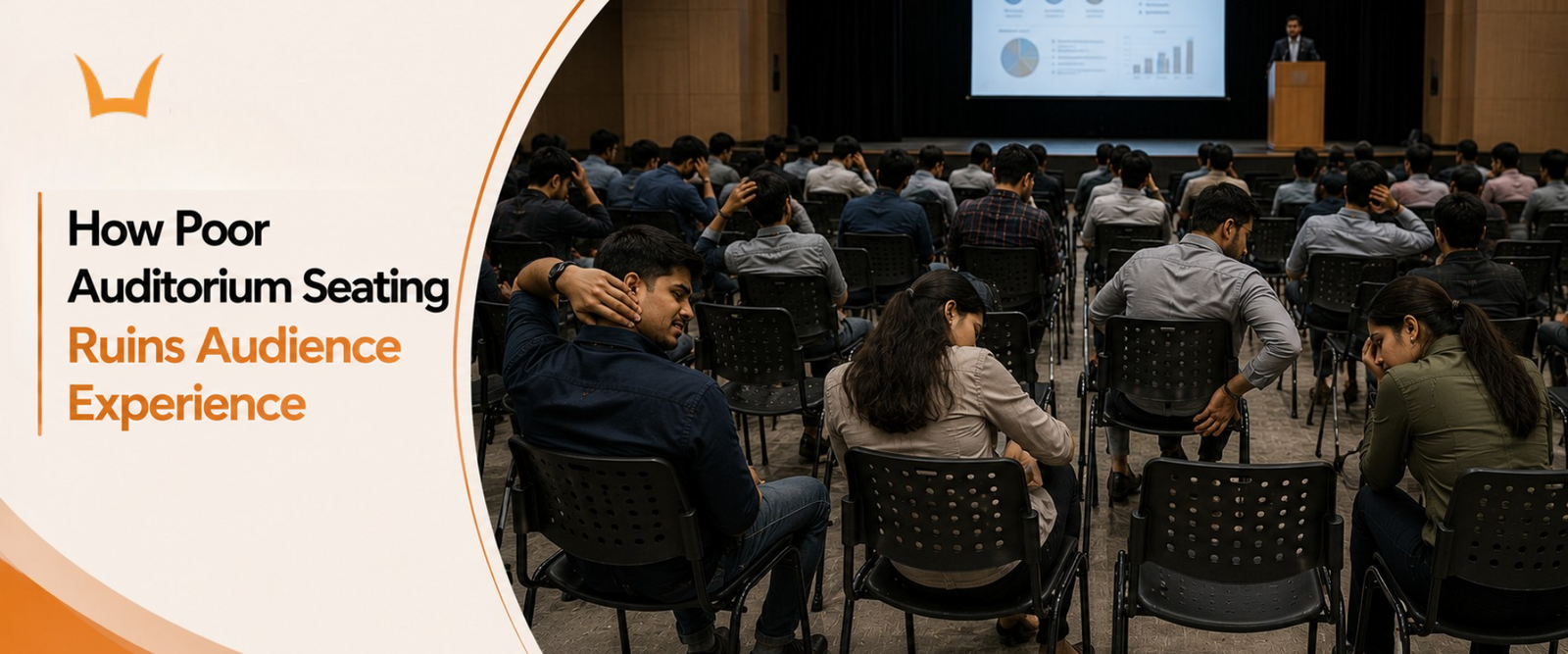
The first hour of an uncomfortable event happens in the body, not the head. The audience is still listening, still watching, but already losing the battle below the surface.
Hard seats cut off blood flow to the legs. Thin foam stops giving support after a while. Backs without proper lumbar curves slump forward. The body begins making small adjustments every few minutes just to find relief.
By the time the mind realises something is wrong, the body has been suffering for thirty minutes. The audience never blames the chair. They just say the event felt long.
Sightlines That Push the Body Into Unnatural Positions
Auditorium seating only works when every seat has a clear view of the stage. When seats are placed flat or in rows that block one another, the body starts twisting to compensate, which is why auditorium chairs and seminar chairs follow different design rules.
Some attendees lean to one side. Others sit forward. Some keep tilting their head to see past the person in front. None of these positions are natural. All of them strain the neck, shoulders, and lower back.
Bad sightline design does not just hurt the eyes. It hurts the whole body for the entire duration of the event. By the end, exhaustion replaces enjoyment.
The Quiet Killer in the Room: Noise
The most underrated problem in a poor auditorium is sound. Cheap chairs make noise. Hinges creak. Loose joints rattle. Plastic seats snap back loudly when an audience member stands up.
In a theatre, this noise is fatal. A quiet moment in a play, a delicate musical note, a powerful pause in a speech, all get crushed by a single squeaking chair. The room loses its silence. The performance loses its grip.
Even worse, the audience starts policing each other with cold looks. Everyone becomes self conscious about moving. The energy of the room shifts from enjoyment to discomfort.
How Audience Behaviour Changes With Bad Seating
Discomfort does not stay quiet. It changes how the audience behaves during the event.
Phones come out more often. Restroom trips multiply. Some leave during interval and never return. Many sit through the rest of the event with arms crossed, waiting for it to end rather than waiting for the next moment.
This shift in behaviour is the warning sign no venue wants. The room may still be full, but the audience is no longer there.
The Long Tail of a Bad Seating Decision
The damage from poor auditorium seating does not end when the event ends. It travels with every audience member who walked out feeling worn down.
Friends get told. Colleagues get warned. Online reviews mention sore backs and uncomfortable chairs. Booking enquiries drop without explanation. Corporate clients quietly choose other venues. Schools pick a different auditorium for their next event.
None of this happens loudly. It happens in the background, slowly, until one day the venue notices its calendar is thinner than it used to be.
Why Low Cost Seating Costs the Most in the End
The math behind cheap auditorium seating looks attractive at the start. Lower price per chair. Smaller upfront budget. Quick installation. The savings feel real.
The problem is that those savings vanish within a few years. Frames crack and need welding. Foam flattens and needs replacement. Fabrics tear and need reupholstery. Mechanisms fail and need new parts. Each repair takes the auditorium offline. Each downtime cancels potential bookings.
Add the lost ticket sales, the negative reviews, and the corporate clients walking away, and the cheap chair turns out to be the most expensive thing in the building. Venues that plan long term source directly from experienced auditorium chair suppliers who engineer for durability rather than minimum cost.
What an Audience Actually Pays For
Audiences do not just pay for the event. They pay for the entire experience around it. The parking. The walk in. The seat. The view. The mood. The way the room handles them as guests.
When the chair fails, the entire experience feels cheap. Even a brilliant performance gets remembered with a sour note. The seat is not just furniture. It is the silent host of the event.
A good auditorium chair does the opposite. It disappears. The audience forgets they are sitting. They focus on the stage, the screen, the speaker. They walk out feeling lighter than they came in.
This is the gift of right seating. This is the cost of wrong seating.
Conclusion
Poor auditorium seating ruins more than comfort. It ruins focus, mood, performance impact, and venue reputation, all at once. The damage starts small but grows steadily across every event held in that hall.
Choosing the right auditorium seating is not a furniture decision. It is a venue decision. It decides how audiences feel, what they remember, and whether they come back.
The chair the audience sits on says everything the venue does not.
Worried that your auditorium seating is letting your audience down?
Poor auditorium seating affects far more than physical comfort. It shapes audience focus, emotional connection, event quality, and how people remember the venue afterwards. From blocked sightlines to noisy chairs and poor support, small seating problems quietly damage the entire experience over time.
Investing in high-quality auditorium seating from Syona helps create a space where audiences stay engaged, comfortable, and fully connected to the performance from beginning to end. Because nothing destroys a powerful speech faster than two hundred people silently adjusting their spine every three minutes.