


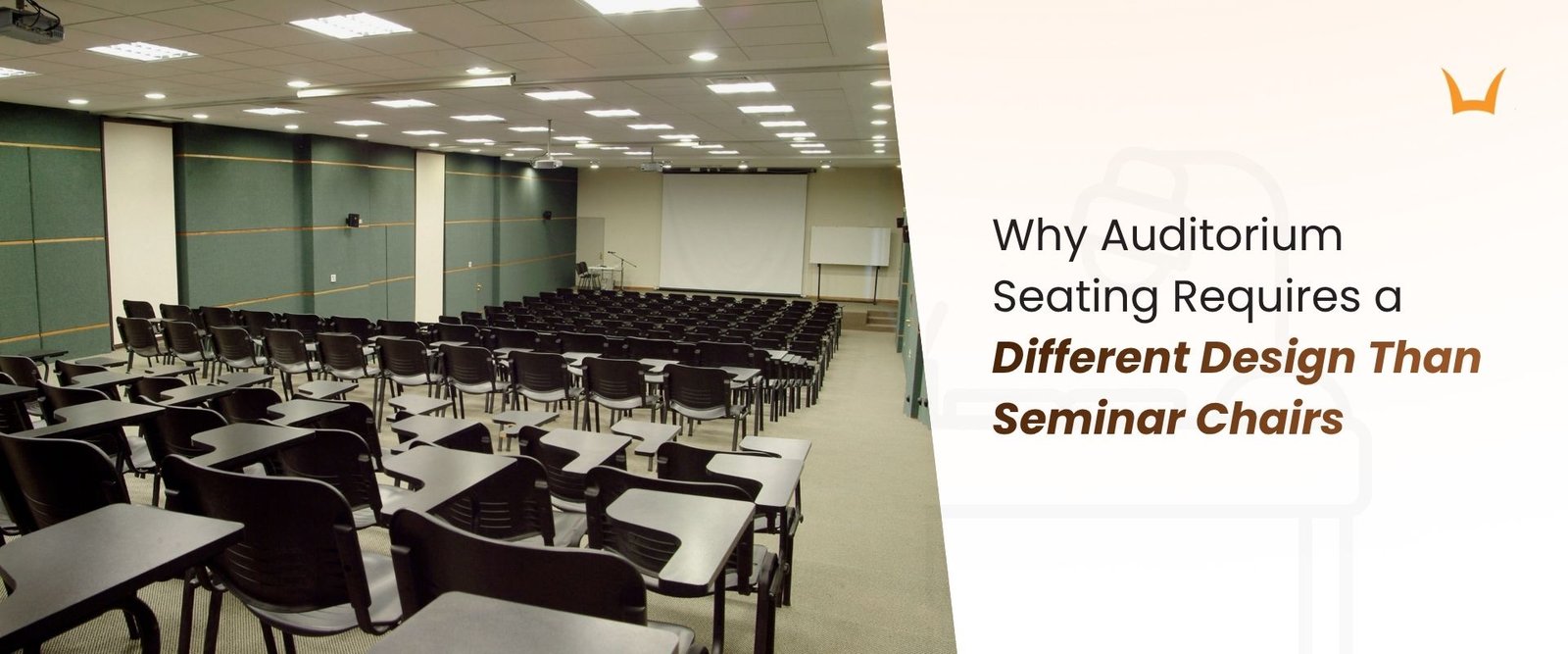
Why Auditorium Seating Requires a Different Design Than Seminar Chairs
- Two Rooms, Two Very Different Goals
- What Makes Auditorium Chair Design Different?
- How Auditorium Seating Layout Affects Chair Selection
- What Makes Seminar Chairs Different?
- Auditorium Seating vs Seminar Chairs: Key Differences
- How to Choose Auditorium Furniture Based on Room Purpose
- Syona's Auditorium and Seminar Hall Seating Options
A chair that works well in a seminar room may not be the right choice for an auditorium. Long events, crowded rows and limited viewing angles place different demands on seating. Meanwhile, seminar participants need space for writing and discussion.
Good auditorium seating design accounts for these differences before the chairs are arranged. The aim is to choose seating that works with the room, rather than adjusting the room around unsuitable furniture.
Two Rooms, Two Very Different Goals
Auditoriums are generally designed for larger audiences attending lectures, ceremonies, performances and college events. Seating capacity, stage visibility and access between rows influence how the space is planned.
Seminar halls usually accommodate smaller groups for training, presentations and discussions. Participants may need writing surfaces and arrangements that encourage interaction.
The seminar hall and auditorium difference becomes less distinct in educational institutions where one hall serves several purposes. A college auditorium used for lectures, for example, may need the same writing facilities as a seminar room.
What Makes Auditorium Chair Design Different?
Fixed Auditorium Seating and Permanent Installation
Traditional auditoriums often use fixed auditorium seating systems, with chairs secured to the floor in organised rows. This keeps the arrangement consistent and reduces the work involved in preparing the hall for each event.
Permanent seating is practical in dedicated performance halls where the stage position and audience arrangement rarely change.
However, fixed auditorium seating is not essential for every auditorium. Educational institutions may prefer movable chairs when a hall is also used for examinations, meetings or other activities.
Tiered Seating for Clear Sightlines
In a tiered seating arrangement, successive rows are positioned at higher floor levels. This helps people seated towards the back see the stage over those in front.
Effective tiered auditorium seating design considers floor elevation, seat height and the viewing angle from different positions.
Even with raised flooring, poorly positioned chairs can affect visibility. Institutions should assess the view from the front, middle and rear rows before finalising the arrangement.
Acoustic-Friendly Seating Materials
Seating materials can influence how sound travels inside an auditorium. Upholstered chairs may absorb some sound, depending on their padding, fabric and construction, while hard seating surfaces generally reflect more sound.
However, auditorium acoustics also depend on the ceiling, walls, flooring and sound system. Chair materials should be considered as part of the overall room design.
For educational auditoriums, durability, ventilation and ease of cleaning are also important when selecting seating materials.
Seat Comfort and Access Between Rows
Long lectures and ceremonies require chairs with suitable back support and enough space for attendees to sit comfortably.
Insufficient legroom, poor back support and restricted movement can affect the audience experience in auditoriums, particularly during longer events.
For movable auditorium seating chairs, seat dimensions and row spacing are important. Attendees should have enough room to reach their seats, stand up and move between rows without unnecessary difficulty.
The layout should also provide clear access routes, particularly in auditoriums where large groups enter or leave at the same time.
How Auditorium Seating Layout Affects Chair Selection
The seating arrangement should suit the stage position, floor dimensions and activities held in the room.
Straight-row seating: Common in school and college auditoriums, this arrangement places chairs facing the stage. Larger halls may divide the rows into blocks with multiple aisles. Fixed and movable chairs can both be suitable.
Curved seating: Rows arranged in a gentle curve can help orient the audience towards the presentation area. Chair width and the available floor space determine how practical this arrangement will be.
Classroom-style seating: In lecture halls, students may need to write while facing the speaker. Chairs with writing pads can suit auditorium classroom seating without requiring separate desks.
The chosen layout must also allow appropriate circulation and accessible seating. Chair dimensions should be checked against the actual floor plan before purchasing.
What Makes Seminar Chairs Different?
Writing Pad Chairs for Notes and Laptops
Seminar participants frequently work with notebooks, handouts and digital devices. An integrated writing pad provides a convenient surface without requiring a separate table.
The pad's dimensions and stability matter, particularly when laptops are used. A surface suitable for a notebook may not accommodate every laptop comfortably.
Writing pad chairs are also useful in academic lecture halls where students need to follow presentations and take notes.
Seminar Seating Flexibility for Different Activities
A training room may need forward-facing rows for a presentation and a U-shaped arrangement for a group discussion.
Movable chairs support seminar seating flexibility, allowing the room to accommodate different session formats.
Unlike permanent auditorium installations, these arrangements can be changed without altering the floor or removing fixtures.
Lightweight Frames and Chair Storage
Chairs used in training rooms are often moved regularly. A manageable weight helps staff reposition them without unnecessary effort.
Some models are designed for stacking or compact storage, although this depends on the chair's construction.
However, stacking is not always the most practical option, and institutions should consider the limitations of stackable chairs in seminar halls before choosing them.
For institutional use, the frame should also withstand frequent handling. Lightweight construction alone does not indicate whether a chair is suitable for daily use.
Auditorium Seating vs Seminar Chairs: Key Differences
| Feature | Auditorium Seating | Seminar Chairs |
|---|---|---|
| Primary use | Lectures, ceremonies and performances | Training, workshops and discussions |
| Arrangement | Fixed or organised movable rows | Frequently rearranged |
| Floor | Level, sloped or tiered | Usually level |
| Writing surface | Optional | Often required |
| Main design focus | Visibility, comfort and audience access | Writing support, movement and handling |
| Installation | May be permanently fixed | Generally freestanding |
These seminar chair differences are useful when comparing seating options, although certain models can serve both settings.
How to Choose Auditorium Furniture Based on Room Purpose
Before purchasing chairs, institutions should review the floor plan, expected audience size and activities scheduled in the hall.
For dedicated auditoriums, check the view from different rows, seating comfort and access routes. If permanent installation is planned, the chair design must be compatible with the floor structure.
For seminar rooms, assess writing pad usability, frame stability and the space required for different arrangements.
Multipurpose college halls need particular attention. A chair that works for a lecture may also need to accommodate examinations or training sessions. Choosing a suitable movable model can avoid the restrictions of a permanent layout.
Syona's Auditorium and Seminar Hall Seating Options
Syona Roots offers auditorium and seminar hall chairs for schools, colleges, training rooms and academic auditoriums. Its Venus range includes models with different features for institutional seating.
Institutions looking for school and college auditorium chair manufacturers can explore seating options designed for educational environments.
The Venus WP2 features a high-density fibreboard writing surface and a contoured backrest, making it an option for lecture and training environments.
The Venus WP1 adds an under-seat book rack, providing storage for students' learning materials.
For seminar halls where participants carry bags and frequently use writing surfaces, the Venus WP1 Pro includes a bag hook and tilting writing board.
These models are worth considering for educational halls that need writing facilities alongside organised seating. Institutions should compare their dimensions and features with the available floor space rather than treating them as replacements for every type of fixed auditorium chair.
Conclusion
Auditorium and seminar seating have different requirements, but the right chair depends on how the room is used. Visibility and audience access matter in auditoriums, while writing support and rearrangement are often more important in seminar halls.
Explore Syona Roots' auditorium and seminar hall chairs to compare seating options for your institution.
Planning a New Auditorium or Upgrading an Existing One?
Choosing the right auditorium seating helps institutions make better use of their available space while accommodating different events and audience requirements. Syona offers auditorium seating options for educational institutions, with models suited to different seating arrangements and classroom needs.