


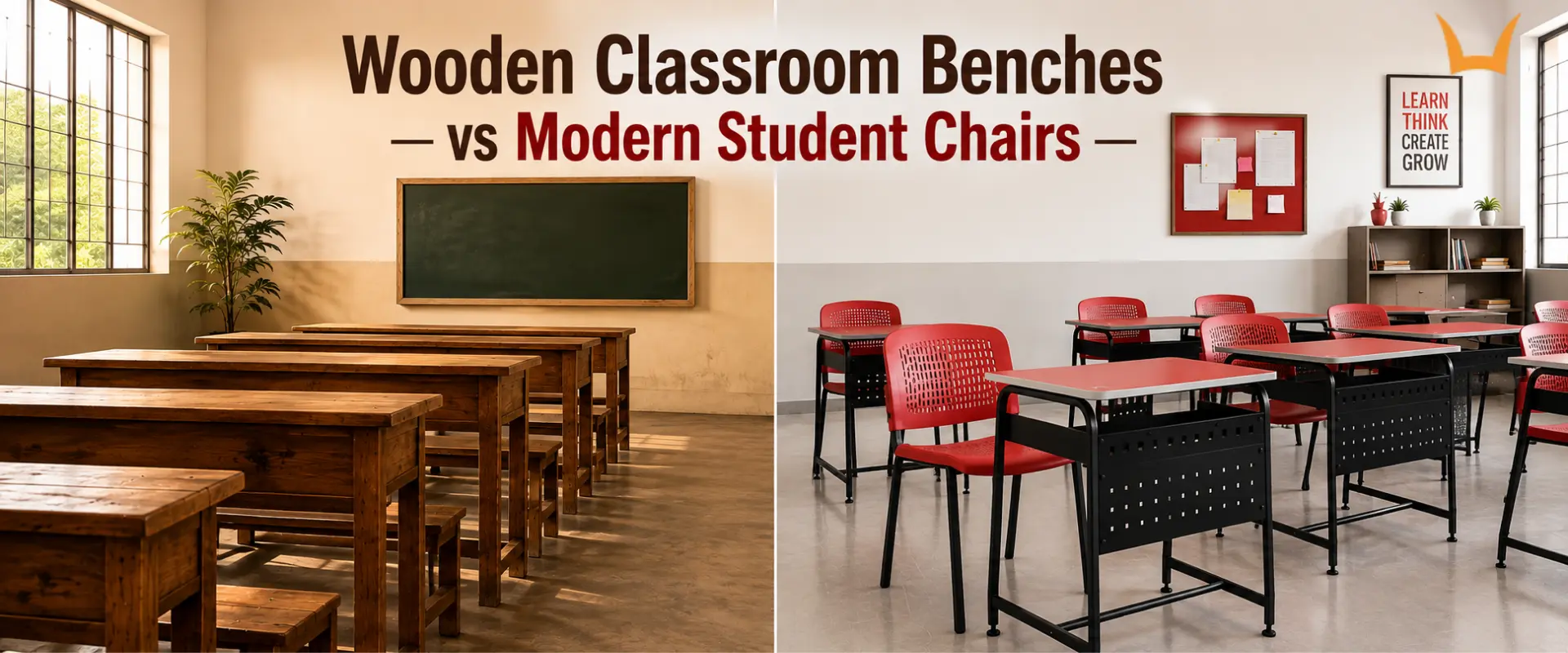
Wooden Classroom Benches vs Modern Student Chairs
- What the Choice Actually Turns On
- Where the Wooden Bench Still Holds Up
- What a Modern Student Chair Changes
- Bench and Chair Compared
- Which Chair Suits Which Room
- Making School Furniture Last in Indian Conditions
- Frequently Asked Questions
- Choosing What Your Classrooms Actually Need
For decades, the wooden classroom bench was the standard choice, so schools had little reason to compare it with anything else. Today, modern student chairs made from engineering polymer offer a different approach, often combining individual seating with an integrated writing surface. For schools replacing older furniture, the choice now comes down to comfort, durability, hygiene, space and ease of maintenance.
This guide compares the two options across durability, space use, comfort and flexibility, and looks at where each works best.
What the choice actually turns on
The debate over classroom benches and chairs is not about looks. It is about how children sit for six hours a day, how quickly staff can clean and rearrange a room, and how many years the furniture survives before it is replaced.
A bench seats several students on one shared frame. An individual chair gives each student their own seat, and a writing pad model gives them their own work surface too. Frame the decision around daily use rather than habit and the trade offs come out clearly.
Where the wooden bench still holds up
The wooden classroom bench earned its place for real reasons, and two of them still stand.
The first is density. A shared bench fits more students into a hall than individual chairs with circulation space around them, which matters when a room is already at capacity. The second is upfront cost per student, particularly when benches are made locally in bulk.
Past those two points the case thins quickly. A wooden student bench is heavy enough that rearranging a room is a two person job. It is vulnerable to termites, and it swells or warps through the monsoon, so it needs polishing and repair on a cycle. Edges roughen and splinter with age. A shared seat also fixes every child in one position regardless of height, and offers no back support at all. A traditional wooden student chair used with a separate desk solves the sharing problem but carries the same weight and upkeep.
What a modern student chair changes
A modern student chair is designed around the individual rather than the row, and that changes how a classroom works.
Each student gets a contoured backrest shaped to support the spine through a full timetable rather than a flat plank. On writing pad models the desk folds into the chair, so a single unit replaces a bench and a desk. The material does the rest: a moulded polymer shell will not swell in damp weather, holds no interest for termites, and wipes clean rather than absorbing spills into a grain.
Weight is where staff notice the difference. A student can lift and move their own chair, so a room shifts from rows to groups between lessons instead of staying in whatever layout it was built in.
Bench and chair compared
| Wooden bench | Modern student chair | |
|---|---|---|
| Students per room | Higher, shared seating packs in tightly | Lower, each seat needs its own space |
| Layout changes | Fixed, moving it takes two people | Flexible, a student can move their own seat |
| Posture | One shared position for every height | Individual backrest, matched to age group |
| Upkeep | Polishing, termite treatment, repairs | A wipe down |
| Monsoon and heat | Swells, warps, splinters over time | Holds shape and finish |
| Desk needed | Yes, separate | No on writing pad models |
Which chair suits which room
Rather than choosing one model for a whole campus, match the chair to what each room has to do.
Everyday classrooms. The Venus WP2 is the sensible default, with a contoured ergonomic backrest and a high density fibre writing pad, light enough for younger students to handle themselves.
Rooms where students carry books. The Venus WP1 adds a book rack under the seat, which keeps bags off the floor and aisles clear in crowded rooms.
Coaching centres and training halls. The Venus WP1 Pro suits back to back sessions, with a tilting writing board that stays comfortable through long note taking and a bag hook to keep the walkway free.
Labs, libraries and exam halls. Venus Pride or Venus Prime can be a practical fit for spaces that need comfortable, versatile seating across different activities throughout the day.
Primary and Middle School Classrooms. The Eris range comes in different sizes: Type A for Classes 1–2, Type A+ for Classes 3–5, Type B for Classes 6–9, and Type C for Class 10 and above. This helps schools choose seating suited to each age group.
Making school furniture last in Indian conditions
Indian conditions decide how long classroom furniture survives, and they are unforgiving. Monsoon humidity works on joints and finishes, summer heat dries and cracks, dust settles into every grain and seam, and termites do the rest.
Engineering polymer sidesteps all four. It holds its shape when the air turns damp, gives termites nothing to work with, and cleans up with a cloth rather than a sanding block. Syona backs its student chair frames with a seven year warranty on that basis.
Replaceability matters just as much over a decade. Writing pads take the heaviest wear on any student chair, and because these are separate high density fibre boards, a worn pad can be changed without scrapping the chair underneath it. Across hundreds of seats, that is the difference between a repair and a reorder.
Frequently asked questions
Are writing pads available for left handed students?
Ask before you order. Writing pad chairs are usually built with the pad on the right, which leaves left handed students writing across their body all day. Most manufacturers can supply a proportion of left hand units in a bulk order, and getting that split right at the point of purchase is far easier than fixing it afterwards.
Do student chairs come in different sizes for different age groups?
Seat height and pad height that suit a class of sixteen-year-olds will not suit a class of eight-year-olds, whose feet should still reach the floor. Confirm which size variants are available and specify them by room rather than ordering one size for the whole school.
How many chairs will fit where a bench row used to go?
Fewer, in most rooms. Individual seating needs circulation space that a shared bench does not, so a straight swap can reduce capacity. Plan the layout before ordering rather than counting seat for seat.
Choosing what your classrooms actually need
The move from wooden benches to student chairs can give schools more flexibility in how classrooms are arranged and maintained. Benches can still make sense where space and initial cost are the main priorities, while modern student chairs can offer greater flexibility and easier individual seating.
When planning new classroom seating, consider the room size, number of students, age groups and how the furniture will be used. As student chair manufacturers and suppliers, Syona can help you choose suitable seating options based on these requirements.
Choose Classroom Seating Built for Everyday School Life
Choosing between wooden classroom benches and modern student chairs is about more than replacing old furniture. The right seating needs to suit students' age, classroom layout, daily timetable and the conditions the furniture will face throughout the school year.
Syona offers student seating designed for Indian classrooms, coaching centres, laboratories, libraries and training spaces. From writing-pad chairs and book-rack models to age-specific classroom seating, the range gives schools options for different teaching environments and student requirements.
If you are upgrading classrooms or furnishing a new school, choosing the right seating by room and age group can improve flexibility while making everyday cleaning, rearrangement and maintenance easier.