


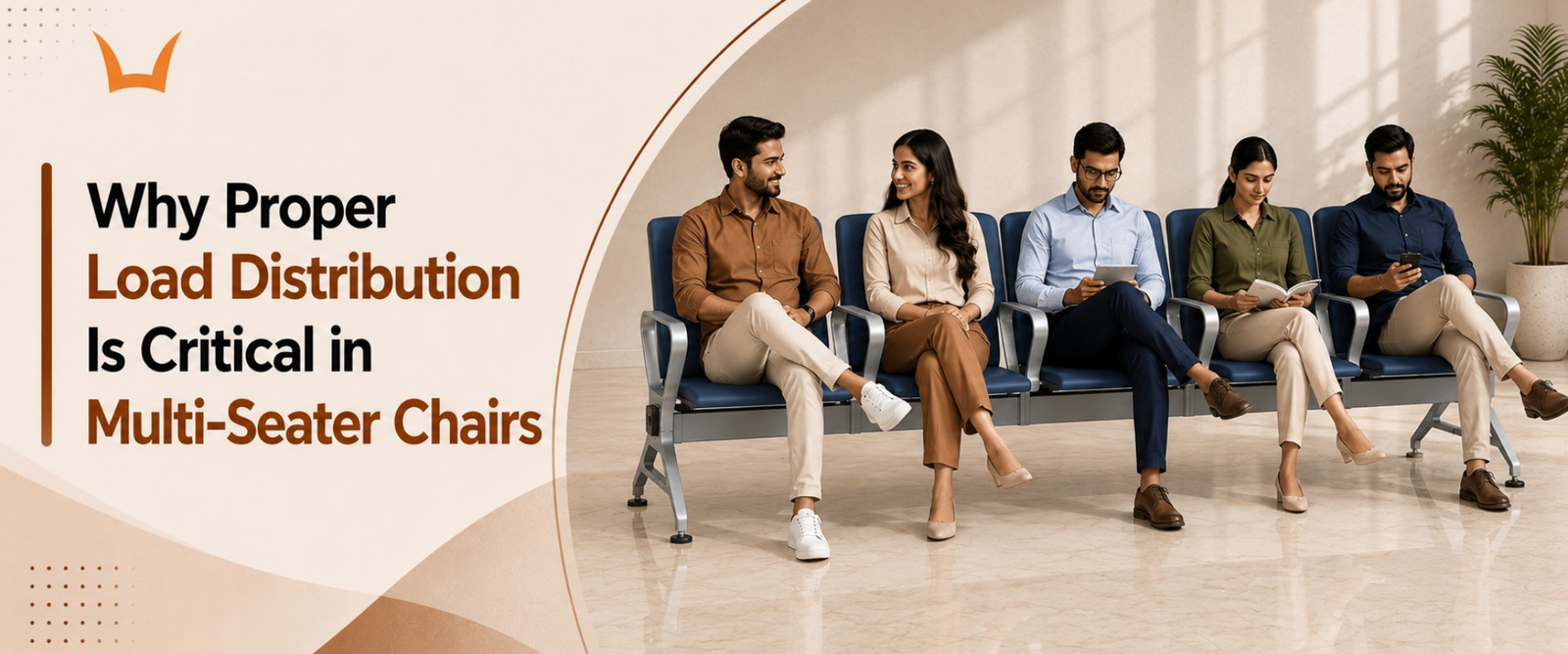
Why Proper Load Distribution Is Critical in Multi-Seater Chairs
- What Load Distribution Really Means
- What Goes Wrong When Load Is Not Distributed Properly
- How Smart Design Spreads the Load
- The Hidden Cost of Bad Load Design
- What Buyers Should Check Before Choosing
TLDR
- Bad load flow breaks chairs fast
- One heavy seat affects them all
- Smart design spreads pressure even
- Wrong balance causes wobble and fail
- Real safety lives in the engineering
Introduction
A chair is not just a seat. It is a small machine that takes weight, pressure, and motion every minute it is used. In multi-seater waiting chairs , this job becomes harder. Many users sit, shift, and lean at the same time. The chair must handle all of it without giving up.
This becomes especially important in healthcare environments, where hospital visitor seating faces continuous daily use from patients, attendants, and visitors during long operating hours.
This is where load distribution comes in. It decides whether your multi-seater chair lasts a year or a decade. It decides if it stays safe under heavy public use or fails when you least expect.
Most buyers focus only on weight capacity. But weight capacity is just half the story. The real story is how that weight is shared across the chair.
What Load Distribution Really Means
Load distribution is the way pressure flows through the chair when people sit on it. Every kilogram of body weight has to go somewhere. It travels from the seat to the frame, through the joints, down the legs, and into the floor.
In a single chair, this path is short and simple. In a multi-seater chair, the path is longer and more complex. Weight from one seat affects the seats next to it. The whole chair becomes one connected system.
Good load distribution helps spread pressure evenly across the chair structure. Poor load distribution places excessive stress on certain weak points, which can gradually lead to structural damage or reduced stability over time.
The maths is simple. The engineering is not.
What Goes Wrong When Load Is Not Distributed Properly
Uneven Pressure on the Frame
Public seating fills up randomly. Sometimes only one seat is used. Sometimes all are full. Sometimes a heavier user sits at the edge. The chair must handle every case.
A poorly designed chair cannot. It pushes most of the load onto one or two stress points. Those points get tired fast. Welds crack. Brackets bend. The chair gives up long before its time.
Sagging and Bending Over Time
A weak load path causes slow damage. The frame may not break right away. But it starts to bend a little under daily pressure.
Months go by. The bend grows. Seats start tilting forward. The beam begins to dip. The whole chair feels softer and less stable. By the time anyone notices, the damage is done.
This kind of failure is silent. And it is the most common one in cheap chairs.
Risk of Tipping and Sudden Failure
The worst case is a sudden collapse. When weight falls in the wrong place on a poorly built chair, the structure can give way without warning. Users get hurt. Trust in the venue drops.
Tipping is another silent threat. Uneven load makes the chair unstable. A child standing on one edge or a heavy user shifting suddenly can flip the entire unit.
Good load distribution prevents both of these. Bad load distribution invites them.
How Smart Design Spreads the Load
The Beam That Shares the Pressure
The main beam runs across the chair like a steel spine. Its job is to take pressure from each seat and spread it across the whole length. A thick, well welded beam refuses to bend even when seats fill unevenly.
This is why beam quality is the first thing to check. The beam decides whether weight gets shared or stuck in one place. It also plays a major role in the overall structural strength and long-term durability of multi-seater chairs .
Brackets That Carry Force Down
Each seat is held to the beam by a bracket. Brackets are the bridge between the user and the rest of the chair. They take the weight and push it down through the frame.
Strong brackets stay tight under heavy use. Weak ones loosen, twist, and break. A chair with poor brackets can never share load properly, no matter how strong the beam.
Base That Holds the Whole Unit Steady
The base is the final stop in the load path. It receives all the pressure from the beam and brackets. It must spread that pressure evenly across the floor.
Wide bases keep the unit grounded. Narrow or uneven bases let the chair rock. A solid base also stops vibration and keeps every seat firm even when only one is in use.
This type of stable seating layout also supports smoother movement and organised waiting areas, especially in places where multi-seater seating improves crowd control by reducing chaos and keeping visitor flow structured.
The Hidden Cost of Bad Load Design
Bad load design does not just break chairs. It costs money in many quiet ways.
Repair bills add up fast. Replacement orders come sooner than expected. Staff spend hours fixing wobbles, tightening bolts, and reporting damage. Insurance claims rise when users get hurt.
Reputation also takes a hit. A waiting area with broken seats sends a clear message. Visitors notice. Patients feel uneasy. Business clients lose confidence. The cheap chair becomes the expensive mistake.
Good load distribution prevents all of this. The savings show up year after year.
What Buyers Should Check Before Choosing
Skip the brochure. Test the chair with your own hands.
Press hard on one end seat while another is empty. A well built chair stays firm and level. A weak one tilts toward the loaded side.
Push down on the centre of the beam. There should be no bending or creaking. If the beam flexes too much, the load path is weak.
Check the brackets. They should be thick, evenly placed, and tightly bolted to the beam. Loose brackets are a clear warning sign.
Look at the base. Wide feet on solid ground beat narrow feet on small contact points. Stability tells you everything about load handling.
Ask the maker about the total weight rating. Then ask what happens when only one seat is used. A reputable manufacturer will explain the engineering. A weak one will dodge the question.
Conclusion
Multi-seater chairs live or die by their load design. Strong materials matter. Smart joints matter. But what ties it all together is how weight moves through the structure.
A chair with proper load distribution stays steady, safe, and strong for years. A chair without it fails quietly, then suddenly, then expensively.
For any public space that takes seating seriously, load distribution is not a detail. It is the difference between safety and risk.
Need multi-seater chairs that can handle continuous public usage every day? Explore durable and comfortable seating solutions designed for waiting areas, commercial spaces, institutions, hospitals, and other high-traffic environments where strength, stability, and long-term performance matter.
Built to Handle Real World Public Use
Need multi-seater chairs that can handle continuous public usage every day? Syona Roots designs seating systems with strong beam construction, balanced load distribution, and durable structural support built for high-traffic environments. From hospitals and institutions to waiting halls and commercial spaces, Syona multi-seater chairs are made to stay stable, comfortable, and reliable through years of heavy daily use.