


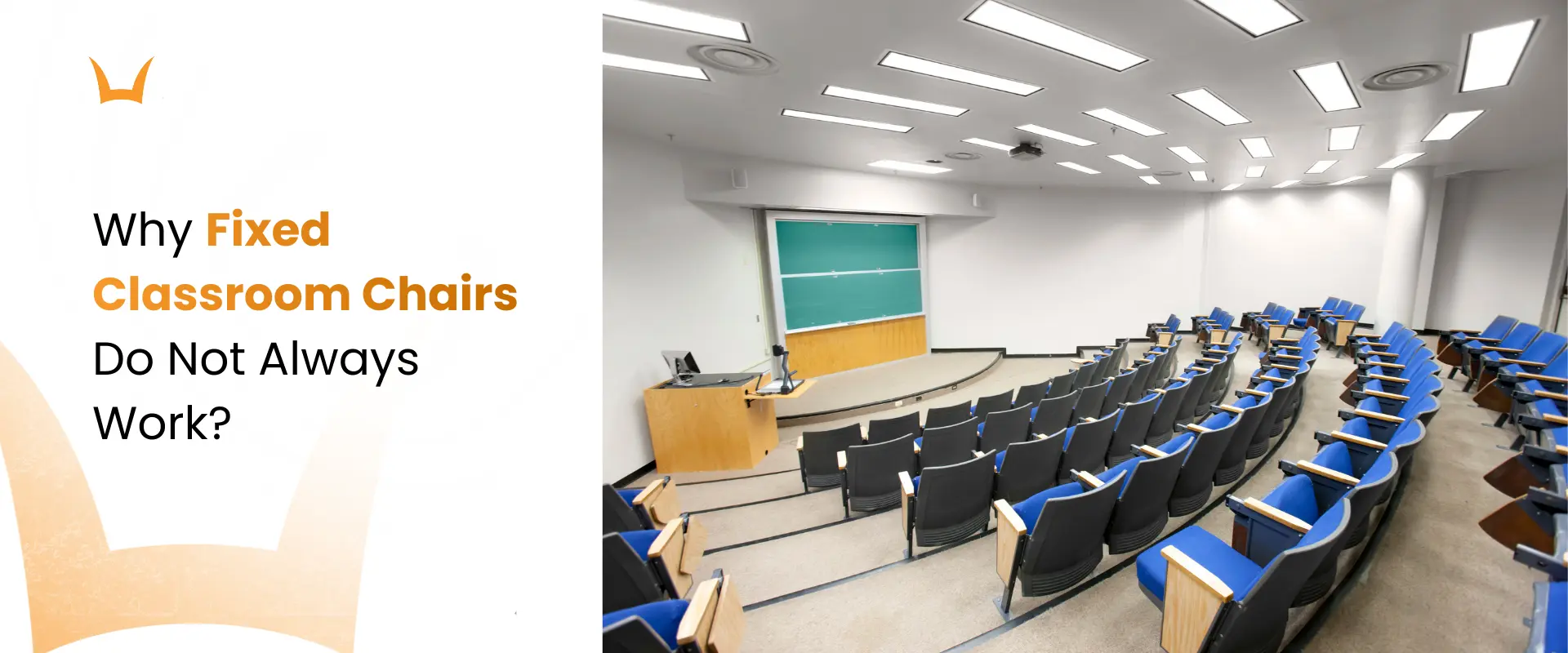
Why Fixed Classroom Chairs Do Not Always Work
- A School Day Includes Several Different Activities
- Examinations Show the Limits of Fixed Seating
- Fixed Furniture Restricts Group Activities
- Bulky Seating Shrinks Classroom Space
- Furniture Designed for the Whole School Day
- Why Classroom Furniture Needs to Evolve
For school management, academic administrators, institutional planners and parents
The fixed classroom chair was designed for a classroom that no longer exists.
Fifty years ago, the classroom was simple. A teacher stood at the front and spoke. Students sat in rows and listened. A chair that kept students in one place and facing one direction was all that was needed.
Today that description covers maybe twenty percent of what actually happens in a school day. The rest involves writing, reading independently, working in groups, preparing for examinations and participating in discussions. Each of these is a different activity. Each places different demands on the space and the people in it.
The fixed chair has not changed much. The classroom has changed enormously. That gap is the problem this blog is about.
A chair designed for one activity in one kind of classroom will always struggle when asked to serve six different activities in a classroom that looks nothing like the original.
A School Day Is Not One Activity. It Is Several.
Ask a teacher how many different things happen in a typical classroom day and the list is longer than most school furniture was designed to handle.
A morning lecture requires students to sit still, face forward and take notes intermittently. A reading period requires a more relaxed, sustained posture with the book held at a comfortable angle. A group discussion requires students to turn toward each other, shift positions and engage actively. An examination requires complete focus, a stable writing surface and physical stillness for up to three hours.
These are not minor variations of the same activity. They are genuinely different physical and mental states. And the chair a student is sitting in affects how well they can enter each of those states.
A fixed chair that works reasonably for one of these activities will be working against the student in several of the others.
Most school timetables cycle through all of these in a single day. The student does not get to change the chair between periods.
Examinations Show the Limitations of Fixed Seating Most Clearly
Consider what an examination actually requires from a student physically.
They need to sit in the same position and write continuously for two to three hours. The writing surface must be stable. The seat must stay comfortable well into the second hour. The body should not become a distraction from the thinking happening in the mind.
A fixed writing pad set at one standard angle and one standard height is not equipped to meet these needs for every student. A student whose writing arm ends up at an unnatural height spends energy compensating for the chair rather than focusing on the paper. A seat that becomes uncomfortable after forty minutes makes the second half of a three-hour exam a test of endurance as much as knowledge.
In an examination hall, the quality of the seating is not a background concern. It is directly connected to how clearly a student can think and write under pressure.
Schools invest considerable effort in examination preparation. The physical setup of the examination itself, starting with what the student is sitting on, deserves the same thought.
Fixed Furniture and Group Activities Do Not Get Along
Modern teaching approaches increasingly involve students working together. Group discussions, collaborative projects, peer review sessions, circle discussions — these are part of everyday classroom life in schools across India.
All of them require the classroom layout to change.
With fixed or very heavy chairs, changing the layout is disruptive. Moving chairs across a classroom creates noise, takes time and breaks the flow of the lesson. In smaller classrooms, it may barely be possible at all. Teachers often skip the layout change entirely and try to conduct group activities in a forward-facing row arrangement, which defeats the purpose.
The result is that the physical environment ends up limiting the teaching method. The teacher designs activities around what the furniture allows rather than what the students need.
Furniture should expand the range of what is possible in a classroom. When it restricts that range instead, it has quietly become part of the problem.
Bulky Fixed Seating Shrinks the Classroom
Fixed chairs, particularly the traditional bench and desk combination, are large relative to the space they occupy. In a room designed for forty students, furniture that cannot be reconfigured or compactly stored leaves very little usable floor space for anything other than sitting in rows.
This affects more than layout flexibility. Students in tightly packed rows have almost no personal space. Retrieving a book from a bag, moving to a different seat or simply adjusting position requires navigating around neighbouring students and desks. Over a long school day, these small physical inconveniences accumulate.
When a school is also running remedial sessions, extracurricular activities or after-school programmes in the same classrooms, the inability to quickly clear or reconfigure the space creates real operational problems.
A classroom that cannot be adapted to different uses is only partially serving the institution that paid for it.
What Changes When the Furniture Is Designed for the Whole School Day
Seating that is designed for the full range of classroom activity does several things differently.
It is light enough to be repositioned quickly without disrupting the class. A teacher can move from lecture layout to group work to examination rows in minutes rather than creating a ten-minute operational pause.
Writing pad chairs with a stable, well-positioned writing surface support examination and classwork conditions properly, so students are not fighting the furniture at the moment when their concentration matters most.
Chairs that come in sizes matched to different age groups mean every student starts each activity already physically settled, rather than spending the first ten minutes of each period adjusting to seating that was clearly designed for someone else.
Compact, well-designed seating reclaims floor space. That space can be used for movement, project materials, accessible storage or simply a classroom that does not feel crowded from the moment students walk in.
None of these are cosmetic improvements. Each one directly affects how effectively a teacher can teach and a student can learn across a full school day.
The Classroom Has Moved On. The Furniture Should Too.
There is nothing wrong with a chair being fixed in design. The problem is when that single fixed design is treated as a complete solution for every student, every activity and every kind of learning that now happens in a modern Indian classroom.
Schools that are investing in better teaching methods, updated curricula and more engaged learning approaches will find that the furniture either supports those investments or quietly works against them.
Syona classroom and writing pad chairs are built for exactly this. Lightweight enough to be repositioned, sized across age groups, with a stable writing surface and a seat design that holds up across the full range of classroom activity, from morning lecture to afternoon examination.
Syona classroom and writing pad chairs are built for exactly this. Lightweight enough to be repositioned, sized across age groups, with a stable writing surface and a seat design that holds up across the full range of classroom activity, from morning lecture to afternoon examination.
Does your classroom furniture support modern teaching methods?
Today’s classrooms involve lectures, writing sessions, exams, and group discussions throughout the day. Seating that is flexible, comfortable, and properly designed can make it easier for teachers to manage different activities while helping students stay focused. Syona classroom and writing pad chairs are designed to support the full range of classroom learning with stable writing surfaces, comfortable seating, and lightweight designs. Contact the Syona team to explore seating solutions suitable for your school or educational institution.