


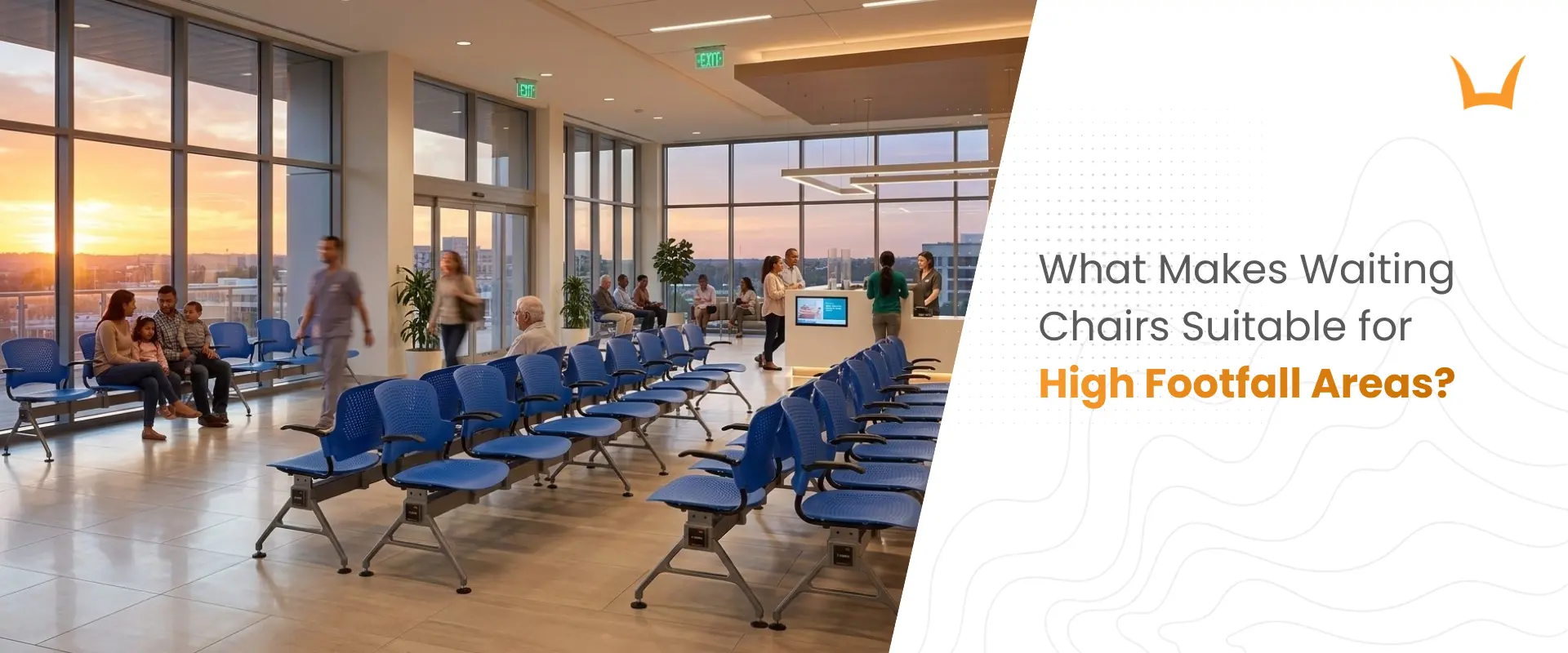
What Makes Waiting Chairs Suitable for High Footfall Areas
- The Frame and Joints Have to Be Built Seriously
- If It Cannot Be Cleaned Quickly, It Will Not Stay Clean
- Unstable Chairs Create Daily Operational Problems
- Cheap Chairs Are Never Actually Cheap
- Poor Seating Sends a Message Whether You Intend It or Not
- Get the Specification Right Before You Get the Chair
- Why Syona Works for High Footfall Environments
For facility managers, procurement teams, architects and operations heads
A railway station at peak hour. An airport terminal during boarding rush. A government office on a public service day. A hospital waiting lobby. A corporate headquarters reception. A university admission block on the first day of term.
What do all of these spaces have in common?
Hundreds of people sitting, standing and moving through the same area every single day. And usually, the same set of chairs handling all of it.
That is high footfall. Not a one-time crowd. A daily, relentless cycle of use that most chairs are simply not built to handle.
Choosing the wrong chair for a high footfall space does not just cause discomfort. It creates maintenance problems, safety risks and costs that keep coming back.
So what should you actually look for? Let us go through it one point at a time.
The Frame and Joints Have to Be Built Seriously
This is where most cheap chairs fail first.
In a shopping mall service desk or a busy corporate reception, chairs go through hundreds of use cycles daily. People sit down hard. They shift weight. They stand up quickly.
Low-grade frames develop loose joints within months. Once a joint starts going, the whole chair becomes unstable. And an unstable chair in a crowded public space is a liability, not just an inconvenience.
Strong frame construction and reinforced joints are not a premium feature. They are the baseline requirement for any chair going into a high footfall environment.
Powder-coated steel and stainless steel frames handle repeated daily stress without degrading. They do not flex, wobble or come apart under real-world commercial use. That structural reliability is what keeps your seating functional for years, not months.
If It Cannot Be Cleaned Quickly, It Will Not Stay Clean
Think about a busy retail service centre or an admission office during peak season.
Chairs are being used constantly. Spills happen. Surfaces get dirty. The cleaning team does not have thirty minutes per chair. They have seconds.
Fabric surfaces absorb everything and become impossible to properly clean over time. Corners that are difficult to reach collect dust and bacteria. Once the surface itself starts holding grime, no amount of cleaning effort fixes it.
In any high traffic space, a chair that cannot be wiped clean in under a minute is already a hygiene problem waiting to happen.
The right surface is smooth, non-porous and stain resistant. It does not trap spills or require special products to maintain.
Anti-rust coating on metal parts matters too. In coastal cities or humid regions across India, untreated metal frames start corroding within a year. That means replacement cost and downtime that nobody planned for.
Unstable Chairs Create Daily Operational Problems
Here is something that happens in every waiting area with loose individual chairs.
They drift. They shift. They end up in positions that nobody planned.
In a university lobby or a busy telecom service centre, chairs that move around block walkways, disrupt layout and have to be constantly corrected by staff who have better things to do.
And then there is the noise. Metal chairs that screech when someone shifts weight. That sound in a quiet corporate reception or a bank branch is noticed by every single person in the room.
Fixed or linked seating systems solve both problems. Rows stay exactly where you place them. No drifting. No noise. No daily rearrangement.
Gang seating configurations let you fit more seating into a limited floor area without cluttering movement paths. But waiting chair layout and patient flow play an equally important role in how efficiently a space functions.
Cheap Chairs Are Never Actually Cheap
Every procurement team has bought a chair that looked like a great deal at the time.
Six months later the joints are loose. A year in and the surface is scratched and stained. Two years in and half the row needs replacing. What starts as a cost problem quickly turns into a safety concern.
Now add the staff time spent managing wobbly chairs. Emergency orders placed at higher cost. The look of a tired, worn-out waiting area that visitors notice immediately.
A low-cost chair that needs replacing every two years costs far more than a commercial-grade waiting chair that lasts seven. The maths is not close.
Commercial-grade build quality, backed by a multi-year warranty, is a smarter long-term calculation.
Modular replacement options matter too. If one seat in a linked row gets damaged, you replace just that unit. Replacing an entire row because one seat failed is a cost that good procurement should never have to absorb.
Poor Seating Sends a Message. Whether You Intend It or Not.
Walk into any office, institution or public facility and the waiting area tells you something immediately.
Worn-out chairs, wobbly armrests and stained surfaces communicate that the organisation does not pay attention to the details that visitors experience first.
For a corporate office, that first impression can undermine the brand before a single conversation has happened. For an educational institution, it reflects on how the campus is managed. For a government or retail facility, it directly affects how people feel about their wait before they have even been attended to.
People do not separate their experience of the chair from their experience of your facility. The two are the same thing in their mind.
The reverse is also true. A clean, stable, well-maintained waiting area signals that the organisation takes its operations seriously. It reduces perceived waiting time. It makes the overall experience feel more professional.
High footfall seating is not just about durability. It is also about what your space communicates to every single person who passes through it.
Get the Specification Right Before You Get the Chair
High footfall is not just a description of how many people use a space.
It is a performance requirement. Every chair you place in that space needs to meet it.
Structural strength, easy cleaning, stability, hygiene-friendly surfaces, space-efficient layout and long-term cost value are not optional. They are what makes a chair actually work in a demanding environment.
Why Syona Works for High Footfall Environments
Syona waiting chairs are designed from the ground up for commercial use. Here is what that means in practice:
- Engineering polymer seat and back shells built for high load cycles without deforming
- Pressure die cast aluminium armrests at the points of highest daily contact
- Strategic perforations across seating surfaces for airflow, practical for India's warm climate
- Gang seating from 2 to 5 seaters for organised, space efficient layouts
- Easy clean surfaces built for fast routine maintenance
- Multi-year warranty so your investment is backed beyond the delivery date
No unnecessary complexity. Just commercial grade quality built for the spaces that actually need it.
Planning a Better Waiting Area?
Explore Syona waiting chair solutions designed for high-traffic environments like hospitals, offices, airports, and public spaces. Built for durability, easy maintenance, and long-lasting comfort.