


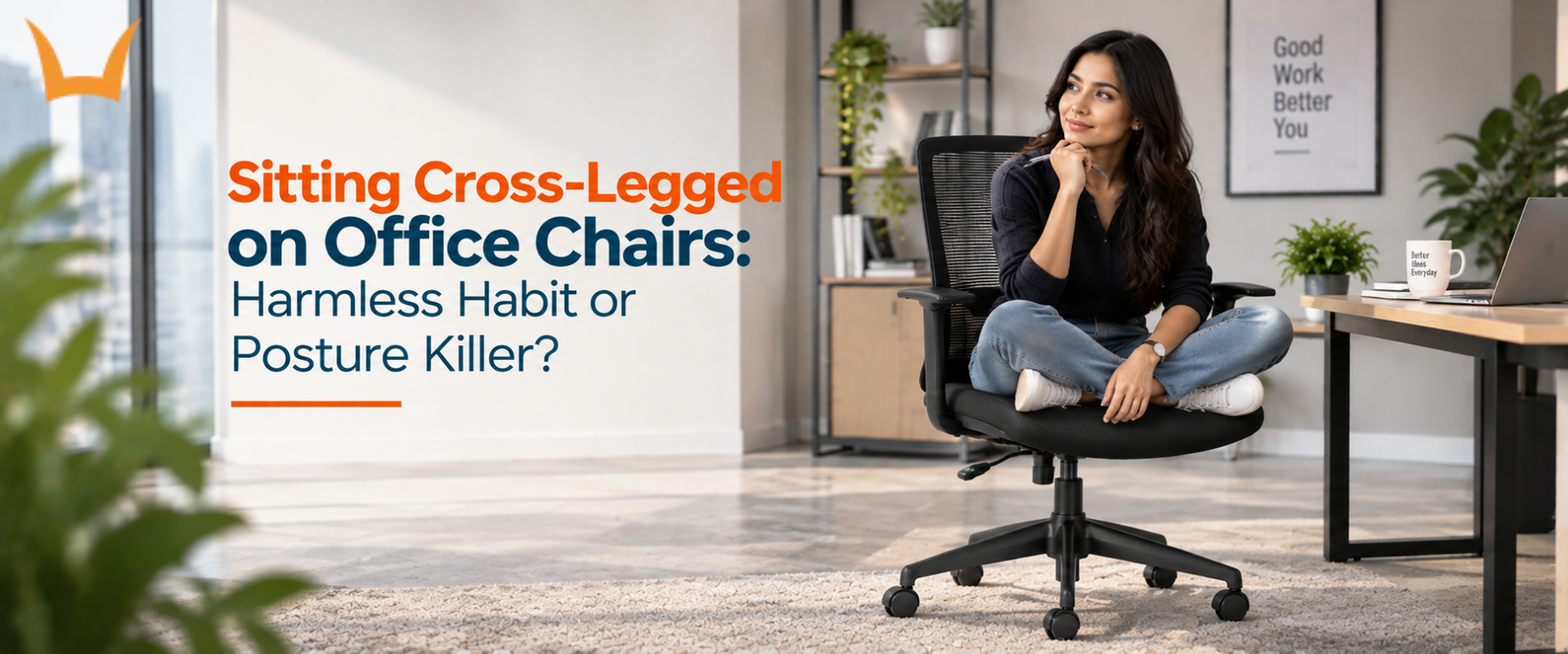
Sitting Cross-Legged on Office Chairs: Harmless Habit or Posture Killer?
- First, Which Cross-Legged Position Do You Mean?
- Does Sitting Cross-Legged Damage Your Back?
- How Different Cross-Legged Sitting Positions Affect Comfort
- Is Your Chair Making Ordinary Sitting Uncomfortable?
- How Long Can You Sit Cross-Legged on a Chair?
- Choosing an Office Chair to Sit Cross Legged
- When Should You Get Individual Advice?
- Explore Office Seating with Syona
Cross your legs at your desk, and someone will probably tell you to “sit properly.” But sitting cross-legged on an office chair is not automatically harmful, and occasional leg crossing has not been established as a cause of permanent posture damage. What matters is whether the position feels comfortable, whether your chair supports you and how often you move.
That does not mean ignoring a numb foot or an aching knee. It means responding to discomfort without treating every change in sitting position as a mistake.
You do not need to sit perfectly still to sit well.
First, Which Cross-Legged Position Do You Mean?
“Sitting cross-legged” describes several positions, and they place your legs differently.
| Position | What it involves |
| One knee over the other | One thigh rests across the opposite leg |
| Ankles crossed | Feet remain below the seat, with ankles overlapping |
| Both legs folded on the seat | Hips turn outwards and knees bend, with both feet brought onto the chair |
| One foot tucked underneath | One leg folds beneath the body while the other stays down |
These positions should not be treated as identical. Folding both legs onto a chair requires more seat space and different hip and knee movement than crossing your ankles. When considering advice about sitting on a chair with legs crossed, check which position the advice actually describes.
Does Sitting Cross-Legged Damage Your Back?
Crossing your legs changes how you sit. Your pelvis may tilt, your trunk may shift and pressure across the seat may become less even. These changes are measurable, but they do not automatically mean damage is occurring.
Research comparing people with and without lower back pain has examined how cross-legged sitting affects trunk position, pelvic angle and pressure beneath the body. These findings describe what happens during the position; they do not prove that occasional leg crossing causes lasting back problems.
There is also no single sitting posture proven to prevent pain for everyone. Holding yourself rigidly upright is not a requirement for a healthy back. Clinical discussion encourages a more flexible approach to posture instead of treating normal movement as dangerous.
A change in posture is not the same as an injury.
How Different Cross-Legged Sitting Positions Affect Comfort
The reason to adjust your position is often simple: something starts to feel uncomfortable. The location of that discomfort can help you decide what to change.
A Foot Goes Numb
Tucking a foot beneath your body can place pressure on it. Pins and needles may occur after sitting on part of your body and usually settle once that pressure is removed.
Unfold your legs and allow normal sensation to return before standing. If tingling persists or keeps returning, seek medical advice rather than assuming it is only your sitting habit.
A Knee or Hip Starts to Ache
A deeply folded position may not feel comfortable for your joints. Ease out of it instead of treating the discomfort as a stretch you should maintain.
How easily another person sits with folded legs says little about what will suit you. Your available movement and any existing symptoms matter more.
Your Upper Body Starts Reaching Forward
Bringing your legs onto the seat can change your distance from the desk. If you lose contact with the backrest or stretch towards the keyboard, your leg position may be affecting your whole working setup.
Look at the chair and desk together before deciding that your posture needs correcting.
Is Your Chair Making Ordinary Sitting Uncomfortable?
If you repeatedly pull your feet onto the seat for relief, check what happens when you place them down. The problem may be an adjustment you have overlooked.
- Unsupported feet: Adjust the chair to suit your working height. If your feet cannot rest comfortably on the floor, a stable footrest may help.
- A seat that feels too deep: Check whether you can reach the backrest without the seat edge pressing behind your knees. Use seat depth adjustment if available.
- Awkward armrests: Adjust them so they do not lift your shoulders or prevent you from approaching the desk.
- Limited legroom: Remove bags, boxes and other items that restrict where your feet can go.
Keep the keyboard and mouse within comfortable reach. These changes give you a supported position to return to without requiring you to remain motionless.
How Long Can You Sit Cross-Legged on a Chair?
There is no well-established universal time limit separating safe cross-legged sitting from harmful sitting. A rule such as “ten minutes is fine” would imply more certainty than the evidence provides.
Change position when you feel uncomfortable, and take short, regular breaks to stand or walk. Switching legs adds variety but does not replace movement. Set a reminder if you tend to lose track of time.
Choosing an Office Chair to Sit Cross Legged
A wide seat may look appealing if you like folding your legs, but extra width is only one consideration. The chair also needs to work when your feet are down and you are using the desk normally.
Before buying, check:
- Seat dimensions: Enough usable space without making the seat too deep for ordinary sitting.
- Back support: A backrest you can reach comfortably.
- Armrest clearance: Room to change position without squeezing your legs.
- Stability: A stable chair should remain steady as you move. A chair tested to applicable BIFMA standards can provide additional information about its performance and durability under regular use.
- Intended use: Manufacturer guidance that matches how you plan to use it.
When Should You Get Individual Advice?
Speak to a healthcare professional if sitting repeatedly causes pain, numbness or weakness, or symptoms persist after changing position. If you are recovering from surgery or an injury, follow your clinician’s specific advice about leg positions.
Explore Office Seating with Syona
As office seating suppliers, they offer office and executive seating with features that vary by model. Compare seat dimensions, back support and adjustments against your requirements. Ask about intended use rather than assuming a chair is designed for folded-leg sitting. Where possible, assess a sample with your usual workstation.
Conclusion
A cross-legged posture in an office chair does not deserve an automatic “bad habit” label. Give yourself room to change position, address discomfort and make movement part of the day. A chair that fits your body and desk makes those choices easier.
Find Office Seating That Supports Flexible Sitting
Choose office seating based on how you actually work and move throughout the day. Explore Syona’s office and executive chairs and compare seat dimensions, back support, armrests and available adjustments for your workspace. For bulk requirements, discuss your seating needs and preferred specifications with the Syona team.