


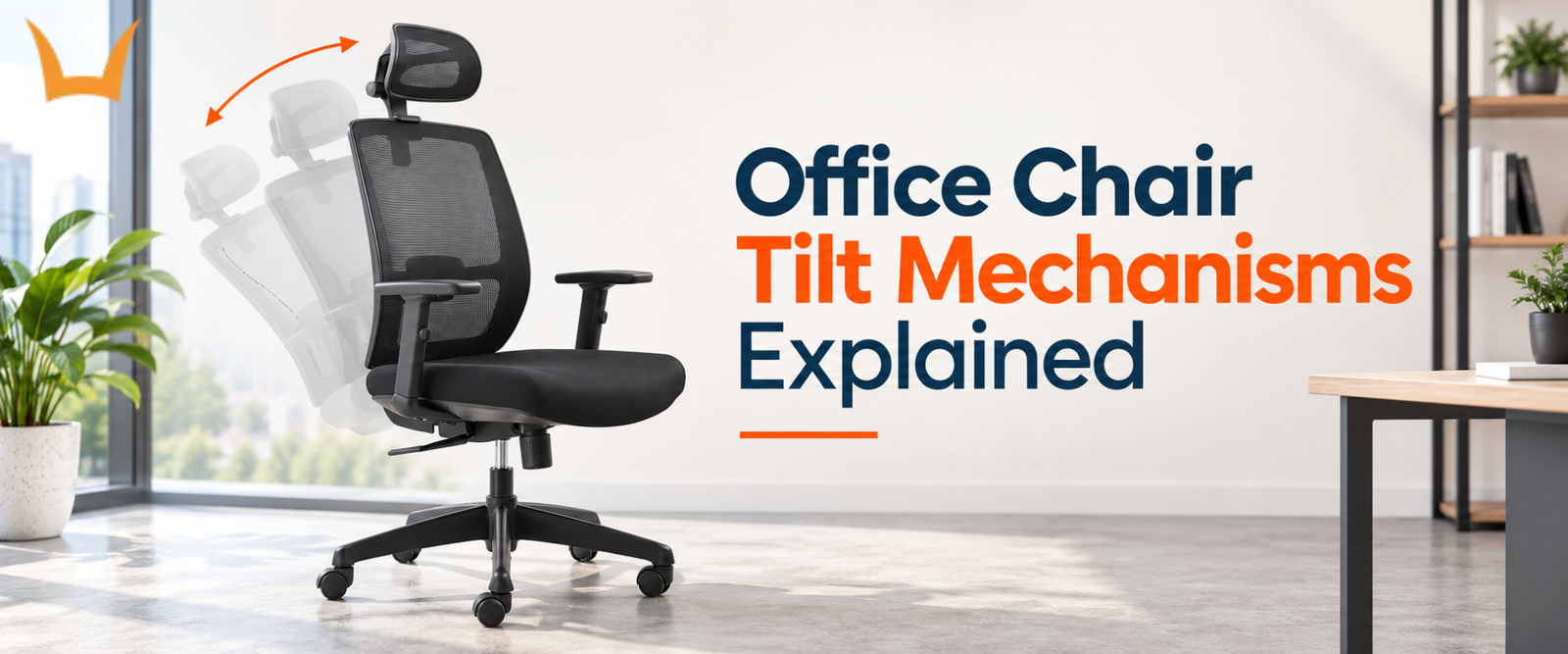
Office Chair Tilt Mechanism Explained: Types and Adjustments
- Main Types of Office Chair Tilt Mechanisms
- Tilt Tension, Tilt Lock and Tilt Limiter Explained
- Which Office Chair Tilt Mechanism Should You Choose?
- How to Adjust Your Office Chair Tilt
- Heavy Duty and Replacement Mechanisms: What to Check
- Explore Office Seating with Syona
How a chair moves matters just as much as how it feels when you first sit down. Whether you are furnishing a single desk or choosing office seating for a whole team, the office chair tilt mechanism controls what happens when you lean back: whether the seat and backrest rock together, move by different amounts or adjust separately.
That explains why reclining can feel quite different from one chair to another. The mechanism shapes the movement, while tension and locking controls let you adjust it. Once you understand these differences, the levers beneath your seat and the terms in a product description become easier to make sense of.
Main Types of Office Chair Tilt Mechanisms
The main distinction is how the seat responds as the backrest reclines. Here is what each design does and what to notice when trying it.
Back Tilt - The Backrest Reclines While the Seat Stays Fixed
A back tilt mechanism allows only the backrest to recline while the seat remains at a fixed angle. This lets you lean back without tilting the seat beneath you. When trying this mechanism, check whether the backrest moves smoothly and whether its recline range feels comfortable.
Centre Tilt: The Seat and Backrest Move Together
Centre tilt allows the seat and backrest to rock backwards as one unit around a pivot near the middle of the seat. The angle between them stays roughly the same.
As you recline, the front edge rises. Depending on your height and seat settings, this may lift your feet or create pressure beneath your thighs. Check how it feels through the reclining range you expect to use.
Knee Tilt: The Seat Front Stays Lower
A knee tilt mechanism places the pivot closer to the front of the seat. Compared with centre tilt, the front edge rises less as you lean back.
This can make it easier to maintain foot support during reclining. However, the chair still needs to suit your height and leg length. “Knee tilt” describes the pivot position, rather than a separate support for your knees.
Synchro Tilt: The Backrest Reclines Further
A synchro tilt mechanism links the seat and backrest but moves them by different amounts. The backrest travels further, opening the angle between your upper body and thighs.
A common backrest-to-seat movement ratio is approximately 2:1, although designs vary. This allows more backrest recline without tipping the seat equally far. During a trial, notice whether the backrest remains comfortably against you as you move.
Independent Tilt: Set Each Angle Separately
Independent, or asynchronous, tilt lets you adjust the seat angle and backrest angle separately. You have more freedom to choose their positions instead of following one linked movement…
The extra controls take some learning. Suppliers sometimes use “multifunction” to describe these mechanisms, but that term can cover other combinations of adjustments. Ask which functions the chair includes.
Tilt Tension, Tilt Lock and Tilt Limiter Explained
These controls sound similar, but each does a different job.
| Control | What it does |
|---|---|
| Tilt tension | Adjusts how much effort you need to lean back |
| Tilt lock | Holds the chair at an available locking position |
| Tilt limiter | Restricts backward travel while allowing movement within the selected range |
Some chairs lock only upright; others offer several locking positions. A product description that simply says “tilt lock” does not tell you how many positions are available.
Seat height and swivel are separate functions. The height lever operates the gas lift, while swivel lets the chair rotate. Neither identifies the type of reclining mechanism fitted beneath the seat.
Which Office Chair Tilt Mechanism Should You Choose?
Choose based on the adjustments you will use. A straightforward rocking movement may be enough for your needs. If you want more backrest movement with less seat tilt, consider a synchro mechanism. Separate angle controls are useful when you want to fine-tune the seat and backrest individually.
Then assess the chair at a desk. Seat depth, lumbar support and armrest height affect comfort alongside the tilt mechanism. Check whether you can reach your work comfortably without moving away from the backrest.
During a trial, look for three things:
- Comfort through movement: Your feet remain supported, and the seat edge does not press uncomfortably beneath your thighs.
- Accessible controls: You can reach the levers and understand what they do.
- A suitable adjustment range: The available settings feel comfortable for your body and working position.
For shared offices, let several employees try the shortlisted chair. This helps reveal whether the controls and fit work for different users before a larger purchase.
How to Adjust Your Office Chair Tilt
Begin with the seat height, making sure your feet have firm support. Sit back against the backrest and release the tilt lock according to the chair’s instructions.
Lean back gently to assess the resistance. If movement takes too much effort, reduce the tilt tension slightly. If you recline too easily, increase it. Make small changes and test between adjustments. Once the resistance feels comfortable, choose whether to leave the movement free, limit its range or use an available locking position.
Avoid forcing a stiff lever. Some mechanisms require a slight movement against the backrest before the lock releases. Control directions vary, so follow the instructions for your model rather than assuming every chair adjusts the same way.
Heavy Duty and Replacement Mechanisms: What to Check
A heavy duty office chair tilt mechanism may be intended for higher loads or demanding use, but the label needs supporting specifications. Check the complete chair’s stated user weight limit and relevant test information.
The seat, gas lift, base and castors also contribute to its capacity. Installing a stronger mechanism alone does not establish a higher weight rating for the chair.
If you need a replacement swivel tilt control mechanism, provide the supplier with the chair model, existing part number and photographs of the assembly. Matching mounting holes is only one consideration. The gas lift connection, backrest fitting and control arrangement must also be compatible.
Ask the supplier to confirm the correct part and installation requirements before ordering. A chair that suddenly drops backwards, develops unusual looseness or fails to hold its position should be inspected before further use.
Explore Office Seating with Syona
Syona’s Mercury Pulse high-back executive chair features a breathable mesh back, a fabric seat, a simple tilt mechanism and adjustable 2D polyurethane armrests. These features align with current modern office furniture that focus on practical workplace comfort. Ask the team to demonstrate its tilt function and adjustments to help you assess your seating comfort. Confirm model specifications, warranty and service support before ordering. For bulk requirements, discuss your workplace seating needs with Syona, an office seating manufacturer.
Conclusion
Understanding the tilt mechanism helps you look beyond cushioning and appearance. Choose a chair whose movement feels comfortable, whose controls are easy to use and whose adjustments suit your desk setup. Those details make a difference each time you sit down to work.
Find the Right Office Chair for Your Workspace
Explore Syona’s office seating options and compare chair features, adjustments and support to find a setup that suits your workplace. For bulk requirements, speak with the Syona team about your seating needs, product specifications and available options.