


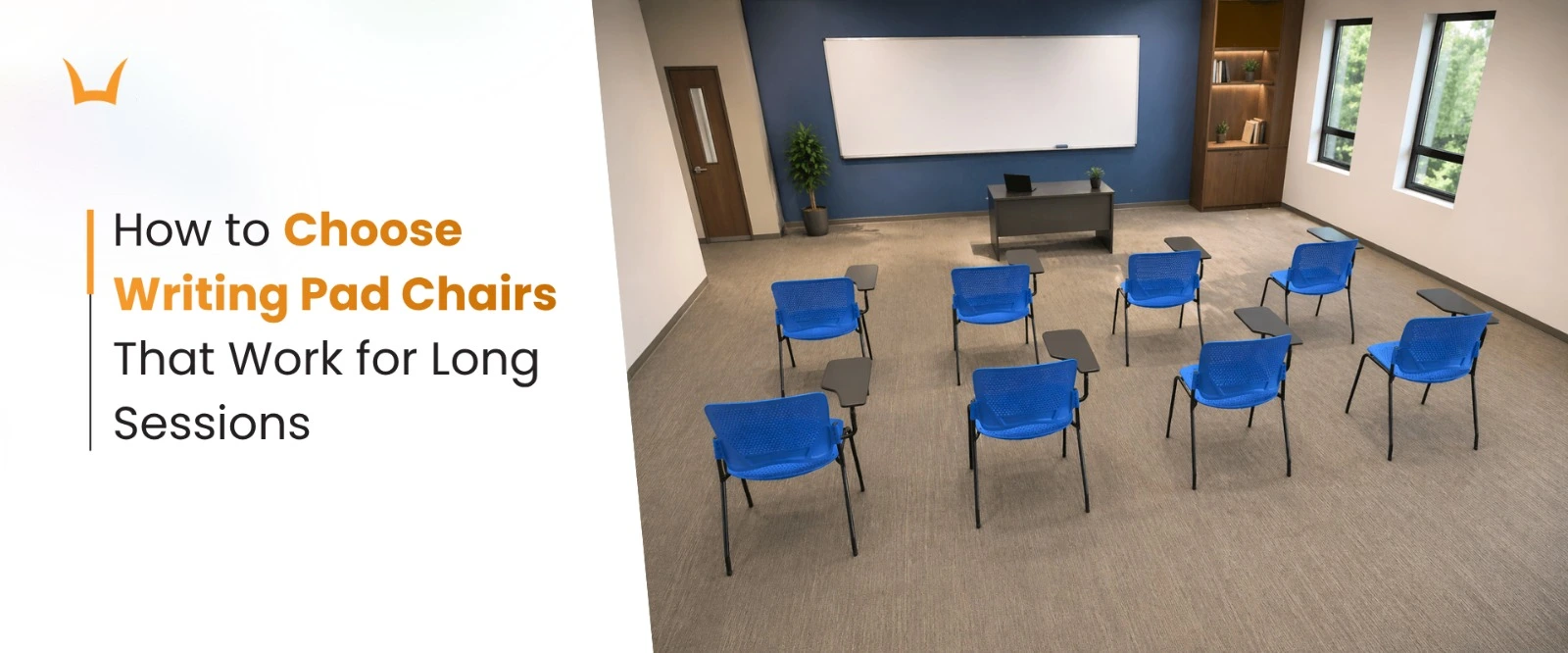
How to Choose Writing Pad Chairs That Work for Long Sessions
- Why Choose a Student Chair with Writing Pad?
- Types of Study Chairs with Writing Pads
- How to Choose the Right Writing Pad Chair
- How Writing Pad Chair Design Affects Student Comfort
- How Comfortable Seating Supports Long Lectures
- Why Institutional-Grade Writing Pad Chairs Matter
- Before You Place That Order
Students in colleges, coaching centres and training institutes often spend several hours attending lectures, taking notes and completing written activities. During these sessions, the design of their classroom chairs can make a noticeable difference to how comfortably they sit and work.
A chair with writing pad provides a personal work surface without requiring a separate desk. However, a poorly sized seat, limited legroom or an awkwardly positioned writing board can make extended sessions uncomfortable.
For institutions choosing new classroom furniture, it is worth looking beyond price and appearance. Seat dimensions, backrest support, writing space and durability all matter when selecting writing pad chairs for regular use.
Why Choose a Student Chair with Writing Pad?
A classroom chair with writing pad combines seating and writing space in one unit, making it practical for classrooms where separate desks may occupy too much floor space.
For institutions considering this arrangement, the advantages of writing pad chairs over desks can help explain when this seating option is more suitable.
This arrangement is particularly useful in coaching centres that conduct several batches throughout the day. Students have individual writing surfaces, while staff can manage seating arrangements without moving separate desks between sessions.
Writing pad chairs are also suitable for lecture halls, seminar rooms and training centres where seating layouts may need to accommodate different group sizes.
Institutions looking for reliable student chair with writing pad manufacturers can explore seating options designed for educational environments.
Types of Study Chairs with Writing Pads
Writing pad chairs come with different features, including attached writing boards, bag holders and book racks. The right choice depends on how students use the chairs during their classes.
Syona offers three study chair options with writing pads for educational and training environments.
Chair with Writing Board
The Venus WP2 features an integrated writing board made from high-density fibreboard. Its backrest is shaped to follow the natural curve of the spine.
This student writing chair is designed for classrooms, training rooms and auditoriums where students need a dedicated surface for note-taking during lectures.
Writing Pad Chair with Bag Hook
The Venus WP1 Pro includes a bag holder and a tilting writing board.
The bag holder provides a place for personal belongings, while the tilting board offers flexibility during writing activities. This model is suitable for coaching centres and seminar halls where students regularly use notebooks and other learning materials.
Writing Pad Chair with Book Rack
The Venus WP1 combines an integrated writing board with a mesh book rack beneath the seat.
Students can keep books and notebooks within easy reach. Its perforated seat and backrest also allow airflow, which can be useful in classrooms where students remain seated for extended periods.
How to Choose the Right Writing Pad Chair
Before selecting a writing pad chair, check whether its dimensions and features suit the students who will use it.
Seat Height and Shape
Students should be able to rest their feet comfortably on the floor, with their thighs adequately supported.
The seat should also be deep enough to support the thighs without pressing against the backs of the knees when students sit against the backrest.
Backrest Support
An ergonomic writing pad chair should provide support around the lower back and allow students to sit comfortably while reading or listening.
Check whether the backrest supports the lower back when students sit upright rather than forcing them to lean forward.
Writing Pad Size and Position
The writing surface should have enough room for a notebook and allow students to write without constantly repositioning their materials.
Check the board's height, width and stability. Students should be able to write without raising their shoulders or leaning forward excessively.
For chairs with tilting boards, check whether the mechanism moves smoothly and stays steady during use.
Legroom and Movement
Check the space around the knees and underneath the writing board. Students should have enough room to sit down, stand up and leave their seats without difficulty.
Frame Strength
Check the frame, reinforced joints and writing board attachments for stability. These parts should remain secure when students write or move in their seats.
Glide feet can also help reduce scraping noise when chairs are moved and protect classroom flooring.
How Writing Pad Chair Design Affects Student Comfort
Poorly designed seating can affect students in ways that become more noticeable as a lecture continues.
Students may frequently change position, struggle to find a comfortable posture or become distracted by discomfort. Repeatedly leaning forward while writing can contribute to neck and shoulder fatigue, while cramped seating can make extended periods of sitting unpleasant.
An unstable chair may also interrupt note-taking, particularly when the writing surface moves under normal pressure.
Before ordering chairs in bulk, institutions should let students try them for a typical class session to check for discomfort or difficulty writing.
How Comfortable Seating Supports Long Lectures
A comfortable writing pad chair allows students to carry out everyday classroom activities with fewer seating-related distractions.
Whether they are listening to a lecture, reading from a textbook or taking notes, students should have enough room to work without repeatedly adjusting their position.
Appropriate seating, combined with a well-planned classroom layout and regular opportunities to move, can make extended learning sessions more manageable.
Why Institutional-Grade Writing Pad Chairs Matter
Unlike chairs used occasionally at home, institutional seating may be occupied by different students across several sessions each day.
Materials therefore need to withstand frequent use, movement and cleaning. Engineering polymer seating components, protective frame finishes and durable writing board surfaces are worth considering when comparing models.
Syona's writing pad chair range includes engineering polymer seating components and high-density fibre writing boards. The Venus WP1 also features a mild-steel mesh book rack.
Institutions should consider how easily chairs can be cleaned, whether replacement parts or servicing are available and what warranty coverage applies.
For larger purchases, evaluating these factors alongside the initial price can help institutions make a more practical long-term decision.
Before You Place That Order
Before finalising a purchase, compare the available chair models against the age group, classroom activities and seating arrangements at your institution.
Where possible, test a sample chair with students of different heights. This can help identify issues with seat dimensions, writing board access or movement that may not be obvious from product photographs.
Explore Syona's available models to choose seating that suits your classroom layout, student needs and daily usage.
Are Your Study Chairs and Writing Pad Chairs Suitable for Your Institution?
Choosing study chairs and writing pad chairs for an institution involves considering more than seating comfort. The number of students, classroom layout, storage requirements and frequency of use all influence which model is suitable.
Syona offers different writing pad chair configurations, including models with integrated writing boards, bag hooks and book racks. Explore the available options to find seating that matches your institution's classroom requirements.