


How Table Leg Design Impacts Load Balance and Durability
- Why Leg Design Decides the Table's Real Working Life
- How the Cross-Frame Leg Design Handles Load
- Why Mild Steel Tube Is the Right Frame Material for Daily Use
- How Engineering Polymer Feet Bushes Complete the Stability Picture
- What the 90 kg Load Capacity Means in Real Use
- How Leg Design Affects Movement and Reconfiguration
- What to Check Before You Buy Any Work Table
TLDR
- Cross-frame design balances load evenly
- Mild steel tube frame lasts daily use
- Polymer feet grip the floor without marking
- 90 kg load capacity covers home needs
- Light frame, heavy support, smart engineering
Introduction
Most people pick a work table based on the top. The size of the surface. The colour. The finish. Almost nobody looks closely at the legs.
This is a costly mistake. The legs decide whether the table holds steady or wobbles. Whether it lasts ten years or starts loosening within two. Whether it handles daily use without flexing, or shows stress within months.
At Syona Roots, we engineered the legs of our work from home table with the same attention as the top. This blog explains how table leg design impacts load balance and durability, using the actual structure of our WFH Table as the working example.
Why Leg Design Decides the Table's Real Working Life
A table top is only as good as what holds it up. A beautiful surface on weak legs becomes a problem within months.
Leg design controls three things. Whether the load on the top spreads evenly across the frame or concentrates on weak points. Whether the structure stays rigid under daily use or starts flexing over time. Whether the connection to the floor remains stable or slowly damages the table and the floor below.
A well engineered leg structure prevents all three problems before they begin.
How the Cross-Frame Leg Design Handles Load
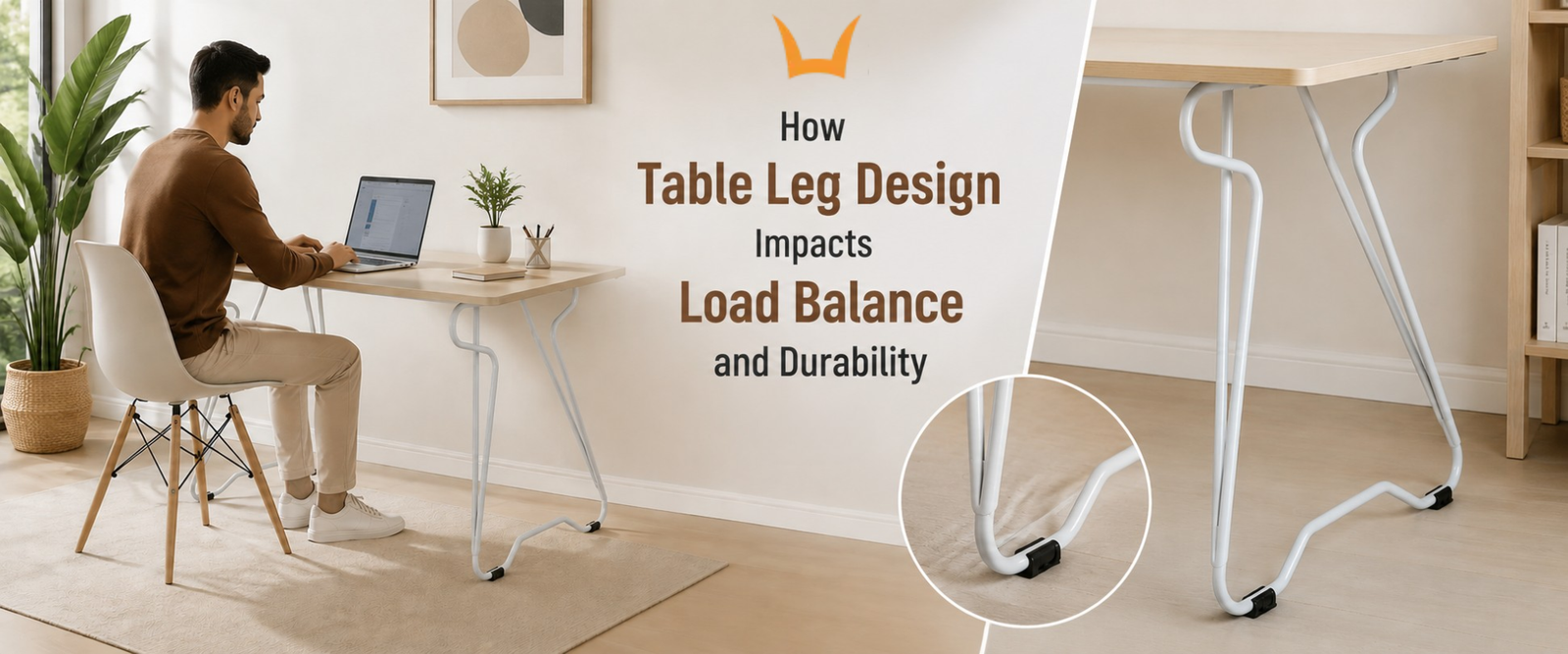
Our Syona WFH Table uses a cross-frame leg design. Instead of four separate vertical legs, the structure forms a connected cross underneath the table top.
This design changes how weight moves through the structure. On a regular four-leg table, each leg carries roughly one-quarter of the load. If you lean on one side, two legs end up carrying most of the weight while the other two barely contribute.
The cross-frame design distributes any load placed on the top across the entire connected structure. Pressure on one corner travels through the cross-bar and is shared with the opposite side. The table feels equally steady whether the weight is centred, off-centre, or shifting during use.
The curved cross-frame also gives the table its distinctive look, but the real value sits underneath the design choice. Load handling improves at every point on the surface.
Why Mild Steel Tube Is the Right Frame Material for Daily Use
Material choice is the second pillar of leg design. The frame must hold its shape under daily use for years without bending, twisting, or developing fatigue at joints.
Our WFH Table uses a mild steel tube frame. Mild steel offers the right balance of strength, weight, and cost for home and office furniture.
Steel tubes are significantly stronger than solid wood at the same dimensions. It does not warp in humid Indian conditions. It does not crack under impact. It does not loosen at joints over years of normal use.
The hollow tube structure is also lighter than solid metal alternatives. This reduces the total weight of the table without weakening the structure.
How Engineering Polymer Feet Bushes Complete the Stability Picture
The frame can be perfect, but if the feet do not connect to the floor properly, the table fails at the last step.
Our WFH Table uses engineering polymer feet bushes at the four ground contact points. These are engineered components, not generic plastic caps.
The first job is grip. Engineering polymer holds the floor without slipping during typing, writing, or leaning. The second job is floor protection. The feet do not mark or scratch tile, marble, wood, or laminate floors.
Together, these two functions complete what the frame above starts. A solid frame on poor feet still wobbles. A solid frame on engineered feet stays planted exactly where you place it, making long working hours more comfortable.
What the 90 kg Load Capacity Means in Real Use
The Syona WFH Table is rated for a 90 kg load capacity. Buyers see this number and often wonder what it means in practical terms.
Ninety kilograms covers far more than any normal home work setup requires. A laptop, a monitor, books, files, a printer, and personal items together rarely add up to more than 25 kg. The table is engineered to handle nearly four times this typical load.
The headroom matters because daily use is not always typical. Someone may sit on the corner briefly. A child may climb on it. A heavy item may be temporarily placed on it. A 90 kg capacity gives the table a clear safety margin for all of this.
The other side of this engineering is that the table itself weighs only 20 kg. A frame light enough to move easily, yet rated to carry more than four times its own weight. This ratio is the real engineering proof of the cross-frame and steel tube working together.
How Leg Design Affects Movement and Reconfiguration
A factor most buyers overlook: how the leg structure handles being lifted, folded, or moved.
A table that gets moved every few weeks needs a leg design that handles repositioning without stress. Single-leg designs flex when lifted from one side. Four-leg tables without a connecting frame loosen at the joints over time as the legs twist independently during movement.
What to Check Before You Buy Any Work Table
When evaluating any work table on the market, four practical checks separate the serious products from the surface-level ones.
Test the table physically in the showroom. Press firmly on each corner of the top. Listen for any creaking sound. Push the table sideways and observe how much it sways. A well engineered table responds with quiet rigidity. A poorly built one announces its weaknesses immediately.
Read the published load capacity number. Serious manufacturers test their tables and publish a load rating in kilograms. Vague claims like "supports heavy items" or "strong build" without a number suggest the table has not been formally tested. Always ask for the rated capacity before buying.
Check the warranty terms in writing. A real warranty specifies what is covered, for how long, and what voids it. A marketing promise of "lifetime durability" with no written terms is worth less than a one year warranty with clear coverage. Read the warranty before you read the price tag.
These three checks take ten minutes during a showroom visit but save years of regret on the wrong purchase.
Conclusion
A work table is judged on day one by its top and judged on day five hundred by its legs. The legs are the foundation that decides whether the table stays useful for years or becomes a problem before the second year is over.
At Syona Roots, the work from home table is the result of giving legs the same engineering attention as the top. The cross-frame, the steel tube, the polymer feet, and the 90 kg load capacity together create a table built for the long run.
Looking for a work table engineered to hold up under daily use?
The Syona Roots WFH Table combines a cross-frame steel structure, engineering polymer feet bushes, and a tested load capacity to deliver dependable stability for everyday work. Designed for long-term durability, it provides a solid foundation for home offices while remaining easy to move, store, and reposition whenever your workspace changes.