


How BLDC Fans Improve Energy Efficiency
- Fans Run Longer Than Any Other Appliance
- What Was Wrong With the Old Motor
- The Shift to BLDC
- What the Numbers Look Like in Practice
- Lower Watts Does Not Mean Less Air
- The Smart Features That Save Even More
- Where Syona Ultra Premium BLDC Fans Come In
- Why the Switch Makes Sense
Most people never think about how much their ceiling fan costs to run.
It is just there. Spinning quietly. Doing its job. But a ceiling fan running 12 hours a day, every day, across multiple rooms adds up to one of the biggest contributors to the monthly electricity bill in any Indian home or building.
The fan you ignore is the one costing you the most.
Fans Run Longer Than Any Other Appliance
An air conditioner gets switched off when the room cools down. Lights go off when you leave. But fans? Fans just keep running.
In homes, offices, schools and commercial buildings across India, ceiling fans operate through most of the day and often through the night. Multiply that across four fans in a home or forty in a school and the electricity consumption becomes genuinely significant, especially with tariffs climbing every year.
The problem was never the fan. It was always the motor inside it.
What Was Wrong With the Old Motor
Traditional ceiling fans run on induction motors. They do the job but they do it wastefully.
A conventional fan draws anywhere between 70 and 90 watts. A large portion of that electricity never actually moves air. It gets lost as heat generated by the motor during operation. The mechanical regulators used to control speed make it worse because they reduce speed without actually reducing power consumption.
During voltage fluctuations, which happen regularly across many parts of India, induction motors perform inconsistently. The fan slows down, the room becomes uncomfortable and the electricity keeps getting consumed regardless.
The Shift to BLDC
BLDC stands for Brushless Direct Current.
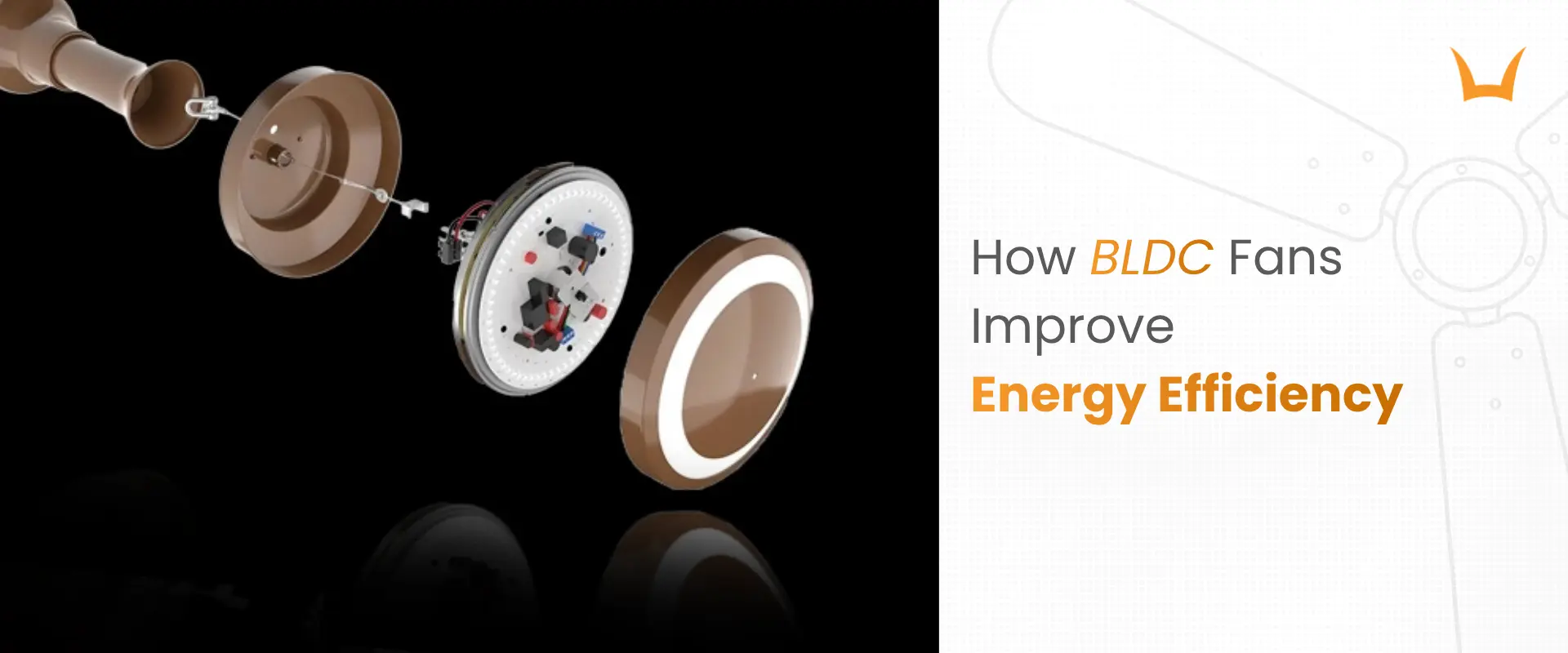
Traditional motors use carbon brushes to transfer electrical current. These brushes create friction, generate heat and wear down over time. BLDC motors remove the brushes entirely and replace them with an electronic controller that manages current flow with far greater precision.
No brushes means no friction. No friction means no unnecessary heat. No wasted heat means significantly less electricity used for the same output. BLDC fans deliver 50 to 65 percent energy savings compared to conventional fans. That is not a small improvement. That is a completely different category of product.
What the Numbers Look Like in Practice
A BLDC fan operates between 28 and 40 watts. A traditional fan runs at 70 to 90 watts for the same room.
For a single fan running 12 hours a day, the annual saving is several hundred units of electricity. For a building running 50 fans simultaneously, that saving becomes large enough to recover the cost of switching within a reasonable time.
The motor change alone accounts for most of this. Better electronics mean the fan uses only the power it actually needs at each speed setting instead of wasting energy at every level.
Lower Watts Does Not Mean Less Air
The first question most people ask is whether a lower wattage fan actually cools properly.
It does. Sometimes better than the old one.
BLDC fans are designed with aerodynamic blades that are engineered to move more air per rotation. The blade shape, pitch and sweep are calculated to deliver strong airflow even at lower RPM. The result is a fan that circulates air effectively while drawing significantly less power, not because it is doing less but because it is doing the same job more intelligently.
The Smart Features That Save Even More
Modern BLDC fans come with controls that take the efficiency further.
Remote operation means the fan gets adjusted without anyone having to walk across the room and leave it running at the wrong speed. Timer settings switch the fan off automatically. Sleep mode reduces speed gradually through the night when full cooling is not needed. Breeze mode mimics natural air movement.
Each of these reduces consumption without requiring any conscious effort. The fan simply stops wasting electricity during the hours when full performance is not needed.
Where Syona Ultra Premium BLDC Fans Come In
Syona Ultra Premium BLDC fans are available in 28W and 38W models, built around energy efficiency as the central design priority rather than an added feature.
The aerodynamic blade design ensures strong airflow performance at these low wattage levels. PMMA glossy blades resist dust accumulation, which means the fan maintains its efficiency over time without the blade coating degrading or requiring frequent cleaning.
The motor handles voltage fluctuations reliably, which matters in Indian conditions where power supply is not always consistent. Ultra silent operation at around 55 dB means the fan works without becoming a distraction in bedrooms, meeting rooms or classrooms.
These are design decisions that directly affect how the fan performs and how much it costs to run across years of daily use.
Why the Switch Makes Sense
Compared to a conventional fan, a BLDC fan uses roughly half the electricity, runs quieter, handles voltage variation better and lasts significantly longer because the motor has fewer components that wear out.
It is a straightforward upgrade with real, measurable returns on the electricity bill every single month.
For anyone choosing ceiling fans for a new home, a renovation or a commercial space, BLDC is not the premium option anymore. It is simply the practical one.
The fan keeps running. It might as well do it efficiently.
Are your ceiling fans delivering efficiency or just consuming more power?
Ceiling fans run for long hours every day, making energy efficiency an important factor in overall electricity consumption. Conventional fans often waste power through heat, friction, and outdated motor design, leading to higher running costs over time. BLDC fans address these issues with advanced motor technology that uses only the power required, ensuring efficient airflow without unnecessary energy loss.
At Syona, our BLDC ceiling fans are designed to provide consistent performance, lower power consumption, and reliable operation in real-world conditions. Whether for homes, offices, or large commercial spaces, choose a smarter solution that improves efficiency without compromising comfort.