


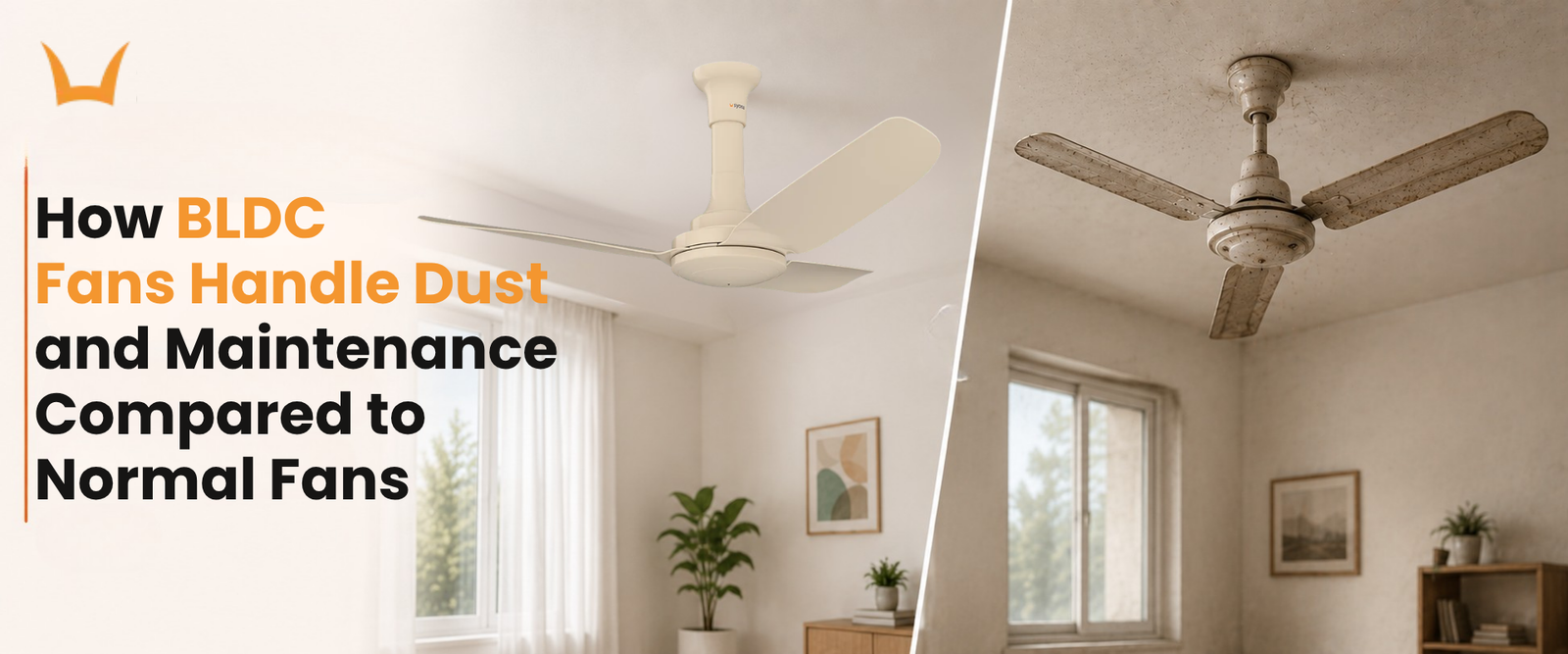
How BLDC Fans Handle Dust and Maintenance Compared to Normal Fans
- How Dust Behaves Differently on BLDC and Normal Fans
- Does Dust on a Fan Slow It Down?
- BLDC Fan vs Normal Fan Maintenance: What Is Different?
- Does BLDC Fan Have Bearings?
- Do BLDC Fans Need Cleaning More Often Than Normal Fans?
- A Simple Care Routine for BLDC and Normal Ceiling Fans
- How to Clean BLDC Fan Blades Safely
- BLDC Fan Care: Checking Noise, Vibration and Mounting
Most people choose a ceiling fan based on its price, design or electricity consumption. Maintenance rarely gets much attention until dust starts collecting on the blades or the fan begins making unusual noises.
While both BLDC and normal ceiling fans need regular cleaning, their motor designs and servicing requirements differ. BLDC fans offer energy-efficient operation with relatively little routine motor attention, making them an appealing choice for everyday use.
Understanding BLDC fan maintenance and how it compares with normal fan care can help you manage dust buildup, maintain airflow and recognise when professional servicing may be needed.
How Dust Behaves Differently on BLDC and Normal Fans
Dust accumulation is not determined by whether a ceiling fan uses a BLDC or conventional motor. Both types collect dust as they circulate air through a room.
The blade material, shape and surface finish can affect how easily dirt settles and how much effort is needed to remove it. Smooth blades are generally easier to wipe, while textured surfaces may hold onto dirt more firmly.
Syona HUSH BLDC fans feature precision-engineered aerodynamic blades designed to support efficient airflow. However, this design does not prevent dust from settling on the blades.
Some ceiling fans have anti-dust coatings that make dirt easier to remove. These coatings depend on the product's design and are not automatically present on every BLDC fan.
In kitchens, cooking grease can mix with airborne dust and leave sticky deposits. Regular cleaning helps prevent BLDC fan dust accumulation from becoming difficult to manage.
Does Dust on a Fan Slow It Down?
Heavy dust buildup does not necessarily reduce a fan's rotational speed, but it can interfere with airflow. Uneven deposits may also contribute to vibration.
This explains why dirty fan blades make a difference. A fan may continue spinning at its usual speed while moving air less effectively because of accumulated dirt.
If the airflow feels weaker than before, cleaning the blades is a sensible first check.
BLDC Fan vs Normal Fan Maintenance: What Is Different?
BLDC ceiling fans use electronically controlled brushless motors that generally need little routine servicing. Everyday upkeep mainly involves blade cleaning and checking for changes in operation.
Normal ceiling fans typically use AC induction motors. These also need little routine motor attention, but their electrical components and potential repairs differ.
| Maintenance Factor | BLDC Fan | Normal Ceiling Fan |
|---|---|---|
| Blade Cleaning | Regular wiping to remove dust | Regular wiping to remove dust |
| Motor Housing | Keep moisture away from the electronic controller | Keep moisture away from electrical components |
| Bearings | Sealed bearings generally need no external oiling | Lubrication depends on bearing design |
| Electrical Servicing | Electronic controller may need specialist repair | Capacitor or regulator may need replacement |
Repair costs can vary between BLDC and normal ceiling fans. A BLDC fan may need specialist attention if its electronic controller develops a fault, while a normal fan may require a capacitor or regulator replacement. The actual cost depends on the fan model, warranty coverage and availability of replacement parts.
For BLDC ceiling fan maintenance, keep moisture away from the electronic controller. While dust on the blades can be removed through regular cleaning, protecting internal components depends on the motor housing design.
Does BLDC Fan Have Bearings?
Yes. BLDC ceiling fans use bearings to support the rotating motor assembly. Some models use sealed bearings containing lubricant, which generally do not need regular external oiling.
Normal ceiling fans also use bearings, including sealed designs. The need for lubrication depends on the particular model rather than motor type alone.
For fan bearing maintenance, follow the manufacturer's instructions. Grinding sounds, rough movement or persistent vibration may indicate a problem that needs professional inspection.
Do BLDC Fans Need Cleaning More Often Than Normal Fans?
BLDC and normal ceiling fans generally need cleaning at similar intervals when used in the same room. The amount of dust and the blade finish are more useful guides than the motor type.
Inspect your BLDC fan blades every few weeks and wipe them when dirt becomes visible. Fans near open windows or in kitchens may need more frequent attention than those in cleaner bedrooms.
For BLDC fan cleaning, removing light deposits regularly is easier than waiting until thick layers form. The same approach works for conventional fans.
A Simple Care Routine for BLDC and Normal Ceiling Fans
Most routine ceiling fan maintenance involves cleaning accessible surfaces and checking for unusual movement or sounds. There is no need to open the motor housing for ordinary blade cleaning.
How to Clean BLDC Fan Blades Safely
Follow these steps for BLDC fan dust cleaning and normal ceiling fan cleaning:
- Switch off the fan and isolate its electrical supply.
- Wait until the blades stop completely.
- Use a stable platform to reach the blades safely.
- Wipe both sides with a soft microfibre cloth.
- For stubborn dirt, use a slightly damp cloth if the manufacturer permits it.
- Dry the blades before restoring power.
Avoid spraying water or cleaning products directly onto the fan. Moisture entering the BLDC controller or other electrical components may cause faults.
During fan blade cleaning, support the blades gently without bending them.
BLDC Fan Care: Checking Noise, Vibration and Mounting
Good BLDC fan care also involves paying attention to unusual sounds, movement or changes in speed.
Rattling, grinding or persistent wobbling may indicate loose fittings, uneven blades or bearing wear. If these problems occur, switch off the fan and arrange a professional inspection.
Check the fan canopy and mounting fittings periodically for signs of looseness. This is particularly important when installing BLDC fans on false ceilings, as the fan must be fixed to suitable structural support rather than the ceiling panel itself.
Changes in fan speed or operation may also be linked to unstable power supply conditions. If the fan behaves unusually during voltage fluctuations, have the electrical supply checked by a qualified technician.
Conclusion
BLDC and normal ceiling fans collect dust in much the same way. How easily the blades can be cleaned depends on their design and finish rather than the motor type.
The main difference lies in maintenance and servicing. BLDC fans generally need little routine motor attention, while their electronic controls have different repair requirements from those of conventional ceiling fans.
For homes and workplaces, choosing a fan with manageable upkeep and energy-efficient operation can make everyday use easier. Syona Roots, a BLDC ceiling fan manufacturer and supplier, offers BLDC ceiling fans designed for everyday use.
Choose a BLDC Fan Designed for Everyday Use
Syona Roots offers BLDC ceiling fans with brushless motor technology and electronic speed controls for residential and commercial spaces. Explore our range to compare available models, specifications and features for your space.