


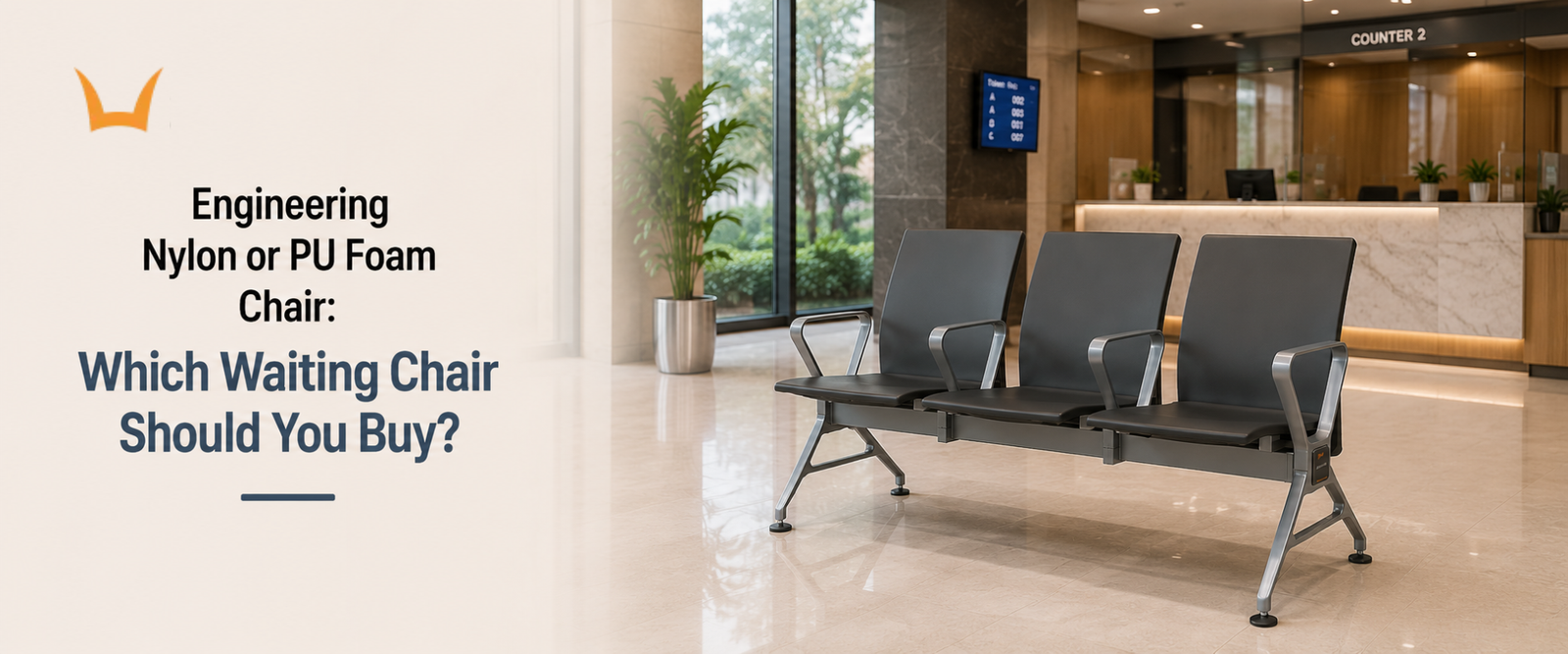
Engineering Nylon or PU Foam Chair: Which Waiting Chair Should You Buy?
- What the Two Materials Actually Are
- Waiting Chair Material Compared
- Where Each One Suits
- Where Our Own Range Lands
- Choosing for Your Space
- Specifying Seating for a Project?
- Frequently Asked Questions
Two waiting chairs can look near enough identical across a lobby and behave quite differently a year later. The difference is usually the seat material, and it tends to be the thing buyers think about last.
If you are weighing a PU foam chair against a moulded nylon one, both are genuine options and both are used across Indian public spaces. They simply suit different rooms. Foam gives a softer landing. Nylon gives a shaped shell that takes constant turnover without much fuss.
We build both across our waiting chair range, so the useful question is not which material is better in the abstract. It is which one matches the room you are furnishing.
What the Two Materials Actually Are
The names get used loosely, so it helps to be precise about what you are buying.
PU foam
A PU foam waiting chair uses moulded polyurethane, usually self-skinned, which means the foam forms its own tough outer surface as it cures rather than needing separate upholstery stretched over it. Many are formed around a steel insert for rigidity.
The appeal is immediate. It gives under you, it feels softer than a hard shell, and there is no fabric seam or cover to work loose.
Engineering nylon
Engineering nylon is a moulded polymer shell, chemically a polyamide, chosen for tensile strength and wear resistance. It carries you on a shaped contour rather than on give.
There is no skin, no foam and no cover. The part you sit on is the structure itself, which is what allows perforations through the seat and a wide colour range across a production run.
Waiting Chair Material Compared
| Factor | PU Foam Seat | Engineering Nylon Seat |
|---|---|---|
| Feel on Sitting | Soft, gives under weight | Firm, shaped to the body |
| Surface | Self-skinned, no separate cover to work loose | Moulded shell, nothing to stretch or sag |
| Airflow | Holds body heat | Perforations let air move through |
| Colour Choice | Set by the moulding | Wide range across the production run |
| Cleaning | Damp wipe | Damp wipe |
| If a Seat Is Damaged | Replace the seat unit | Replace the affected shell |
| Suits | Rooms where comfort leads and waits run longer | Rooms with constant turnover and mixed users |
Where Each One Suits
Buyers often ask what the best material for waiting chairs is. The more useful question back is how many people sit in that row on a busy day.
Foam suits spaces where the seat is used gently and comfort is doing more work than turnover. A calmer reception, a consultation area, a room where people settle in for a longer wait and the chair is not fighting for its life every hour.
Nylon suits everywhere the seat has no quiet moments. A hospital OPD where a row fills and empties all day, a college corridor, an airport lounge, a bank at month end. In those rooms the question is less about how soft the seat felt on day one and more about how the row looks in year three.
Airflow tends to decide it in tropical conditions. A perforated shell lets heat move away from the sitter, which matters in a room without constant air-conditioning and in a chair someone occupies for half an hour in the middle of the afternoon.
Where Our Own Range Lands
Our three-seater models, Venus Gang, Jupiter Awe and Jupiter Ace Mid Back, all use an engineering nylon seat. Those tend to go into hospitals, colleges, offices and airports, where a row rarely gets a quiet hour.
Our waiting chair range includes both moulded nylon and PU foam armrest options, allowing you to choose the most suitable material for your environment. Nylon is ideal for high-traffic areas, while PU foam offers greater comfort for longer waiting times.
What stays constant is the rest of the build. The armrests are die-cast aluminium with PBT, the nylon seats are perforated for airflow, and the chairs are tested to BIFMA standards and made in-house at our Coimbatore facility. Whether a chair with armrests is the right fit for every seat in a row is its own question, worth considering separately from the seat material.
As gang chair manufacturers supplying projects across India, that is the choice we would rather have a buyer make deliberately than by default.
Choosing for Your Space
Count the hours the seat is occupied and the variety of people using it. A row seating a hundred strangers a day is a durability question wearing a comfort costume, and a shaped shell answers it. A quieter room can afford to lead with softness.
Then think about what happens when one seat gets damaged. On a long gang run, being able to swap a single seat rather than deal with a whole bank of them is the difference between a morning’s work and a project.
And check the frame and fixings as closely as the seat, because on linked seating those are what keep a long row rigid and safe.
Specifying Seating for a Project?
Tell our team the space, the footfall and how long people tend to wait, and we will help you match material, model and seat count to it. Start with a bulk enquiry with your room sizes and we will take it from there.
Frequently Asked Questions
Is an engineering nylon chair uncomfortable compared to foam?
Not if it is shaped properly. Comfort in a hard-shell seat comes from the contour rather than from give, so a shaped seat and a backrest curved to the lower back do the work padding does elsewhere. The difference is more noticeable over long sits than short ones, which is part of why the material suits waiting areas better than it would a desk chair.
How do you clean moulded waiting chairs?
Blot a mark with a damp cloth and a little liquid soap until it lifts. Avoid abrasive scrub pads and chemicals, which can dull the surface, and keep seating out of direct sunlight and extreme weather, both of which age any seating material over time.
Can I mix nylon and foam seating in the same building?
Yes, and it often makes sense to. A busy OPD and a quiet consultation room are not the same problem, so matching material to each room is reasonable. Keeping the frame style and colour family consistent across both is what stops a mixed order looking accidental.
Can I get gang seating in colours other than grey and black?
Yes. Grey and black are the usual choices for corporate and healthcare rooms, but the range runs considerably wider, which helps in colleges and children’s areas where colour-coding rows makes a row easier to find.
Need Help Choosing the Right Waiting Chair Material?
The right waiting chair depends on how often the seating is used, how long people wait and the environment where it will be installed. Syona Roots offers both engineering nylon and PU foam options for different commercial and institutional spaces. Explore our waiting chair range or send us a bulk enquiry to discuss the right seating solution for your project.