


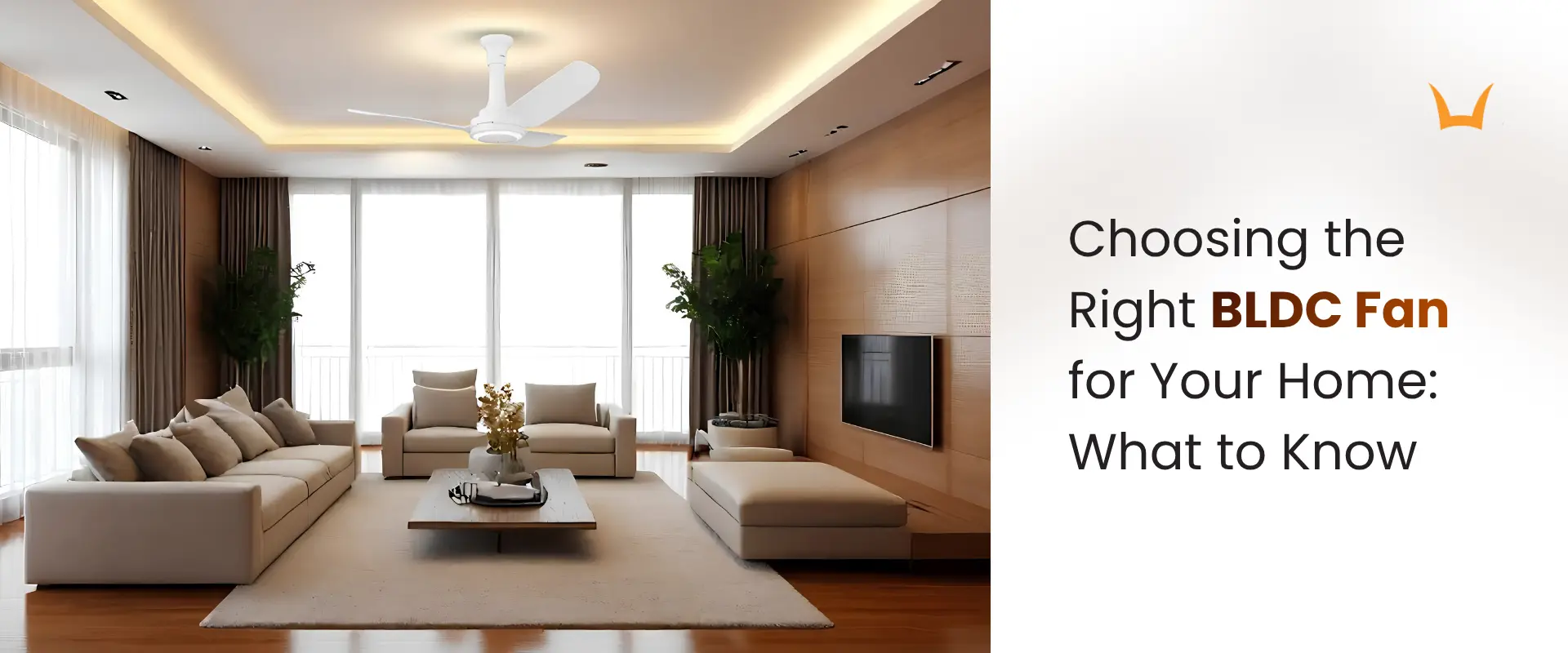
Choosing the Right BLDC Fan for Your Home: What to Know
- What Most People Miss When Buying a Ceiling Fan
- Why Wattage Matters When Choosing a Ceiling Fan
- BLDC Fan Specification: Airflow and Real-World Performance
- Are All BLDC Fans Silent? What Affects Fan Noise
- Smart Features in BLDC Fans
- Why Fan Blade Material Matters
- Why Ceiling Fan Warranty Matters
- How Syona BLDC Fans Fit Into This Decision
- How to Choose a BLDC Fan: Quick Buying Checklist
Most people think of a ceiling fan as a simple appliance. You switch it on, choose a speed, and get on with your day. But once you start using one for several hours every day, the small differences between models become much easier to notice.
That is why choosing a BLDC fan should not be based only on how it looks or what it costs at the time of purchase. The right choice depends on how well the fan fits the way you actually use your home.
With so many brands claiming to offer the best BLDC ceiling fan in India, knowing what actually matters can make the difference between choosing a fan that simply works and one that continues to perform well for years.
What Most People Miss When Buying a Ceiling Fan
The typical fan buying process goes like this.
Walk into a shop. Look at what is on display. Pick something that looks right and fits the budget. Done.
What never gets asked is how the fan will actually perform six months from now. Whether it will still feel adequate in year three. Whether the electricity bill will reflect a smart purchase or an impulsive one.
The shop shows you the fan on a good day under ideal conditions. Nobody shows you the fan at peak summer, running fourteen hours straight, on a day when the supply voltage is low.
Buying for that day separates a good purchase from one you quietly regret. That is why understanding the real value behind a higher upfront cost matters before making a final choice.
Why Wattage Matters When Choosing a Ceiling Fan
It is the number that determines what the fan costs to run every single month.
A fan's wattage tells you exactly how much electricity it draws per hour of operation. Multiply that by daily usage hours, by the number of fans in your home, by twelve months and you have the actual cost of owning that fan beyond what you paid in the shop. This is also how long-term savings from efficient ceiling fans add up without any change in usage.
Most buyers never ask about wattage. It sits on the specification sheet unread while everyone focuses on the finish and the remote control design.
Before anything else, check the wattage. It is the single most financially relevant number on the box.
BLDC Fan Specification: Airflow and Real-World Performance
Fan specifications often mention airflow in cubic metres per minute or similar measurements.
These numbers are useful but they do not tell the complete story. A fan with impressive airflow at maximum speed may not deliver the same practical benefit if you need to run it at that speed constantly.
What you actually want is a BLDC fan with good airflow at mid-range speeds. This means the blades are doing their job efficiently rather than relying on brute rotational force to move air. Ask specifically how the fan performs at lower speed settings, not just at maximum.
Are All BLDC Fans Silent? What Affects Fan Noise
BLDC fans are generally quieter than conventional ones. But not all BLDC fans are equally quiet.
Noise in a fan comes from two places. The motor and the blades. A quiet motor paired with poorly balanced blades still produces vibration. A well balanced fan with good blade construction eliminates both sources.
For bedrooms specifically, check the decibel rating if stated. For work from home setups where background noise affects concentration, this matters through every working hour of every day.
Do not assume quiet just because the product is labelled BLDC.
Smart Features in BLDC Fans
Remote control is genuinely useful. Not needing to get up to adjust the fan is something you appreciate immediately and every day after.
Sleep mode is worth having if you run fans through the night. The fan adjusting speed gradually as the room cools means nobody wakes up cold at three in the morning because the fan is still running at the speed set before sleeping.
Timer mode has limited daily value for most households but comes in useful occasionally.
If you are wondering what is breeze mode in a BLDC fan, it varies the airflow to create a more natural-feeling breeze. Some people value it, while others may rarely use it.
Be honest about which of these you will actually use before treating them as a reason to choose one product over another.
Why Fan Blade Material Matters
Fan blades accumulate dust. Every set of blades does.
The difference is how quickly they accumulate it and how easily it comes off. Blade materials that resist dust adhesion stay cleaner between cleaning sessions and maintain their aerodynamic performance over time. Blade materials that attract and hold dust need more frequent attention and gradually become less effective as accumulation builds.
This is not a visible difference at the point of purchase. It shows up months later in how the fan performs and how much maintenance it needs. Ask about blade material specifically rather than assuming all fan blades are equivalent.
Why Ceiling Fan Warranty Matters
A manufacturer willing to offer a five year warranty on a ceiling fan is making a statement.
They believe the product will perform without significant issues across that period. A short warranty on a product expected to run daily for a decade is the manufacturer quietly communicating their own level of confidence in what they have built.
Warranty length is not a guarantee of quality but it is a signal. A short warranty on a fan you intend to use daily for many years is worth questioning before purchase.
How Syona BLDC Fans Fit Into This Decision
Syona Ultra Premium BLDC fans address the buying considerations above directly.
Low wattage consumption across 28W and 38W models keeps running costs predictable. Aerodynamic blade design delivers consistent airflow at mid-range speeds without needing maximum rotation. PMMA blade material resists dust accumulation and maintains performance over time. Ultra silent operation suits bedrooms and focused work environments. Remote control and smart modes improve daily usability without overcomplicating operation. A multi-year warranty reflects confidence in long-term reliability.
For anyone working through the checklist above, Syona covers it without requiring compromise across categories.
How to Choose a BLDC Fan: Quick Buying Checklist
- Wattage clearly stated and below 40 watts
- Airflow performance confirmed at lower speed settings
- Noise level checked for bedroom or work from home use
- Blade material specified and dust resistant
- Smart features matching actual daily requirements
- Voltage stability confirmed for your supply conditions
- Warranty period clearly stated
- Brand reputation for after sales support
If you are wondering which BLDC fan is best, start with these points rather than looking at the brand name alone.
Are you choosing the right BLDC fan or just the most visible one?
Selecting the right ceiling fan goes beyond appearance or price. Factors like wattage, airflow efficiency, noise levels, and long-term reliability play a key role in how the fan performs in daily use. A well-chosen BLDC fan for home or office use ensures lower electricity consumption, consistent airflow, and minimal maintenance over time.
At Syona, our BLDC ceiling fans are designed to meet these essential requirements, combining efficient performance, quiet operation, and durable build quality. Choose a fan that delivers comfort, efficiency, and reliability from day one and continues to perform across years of use.