


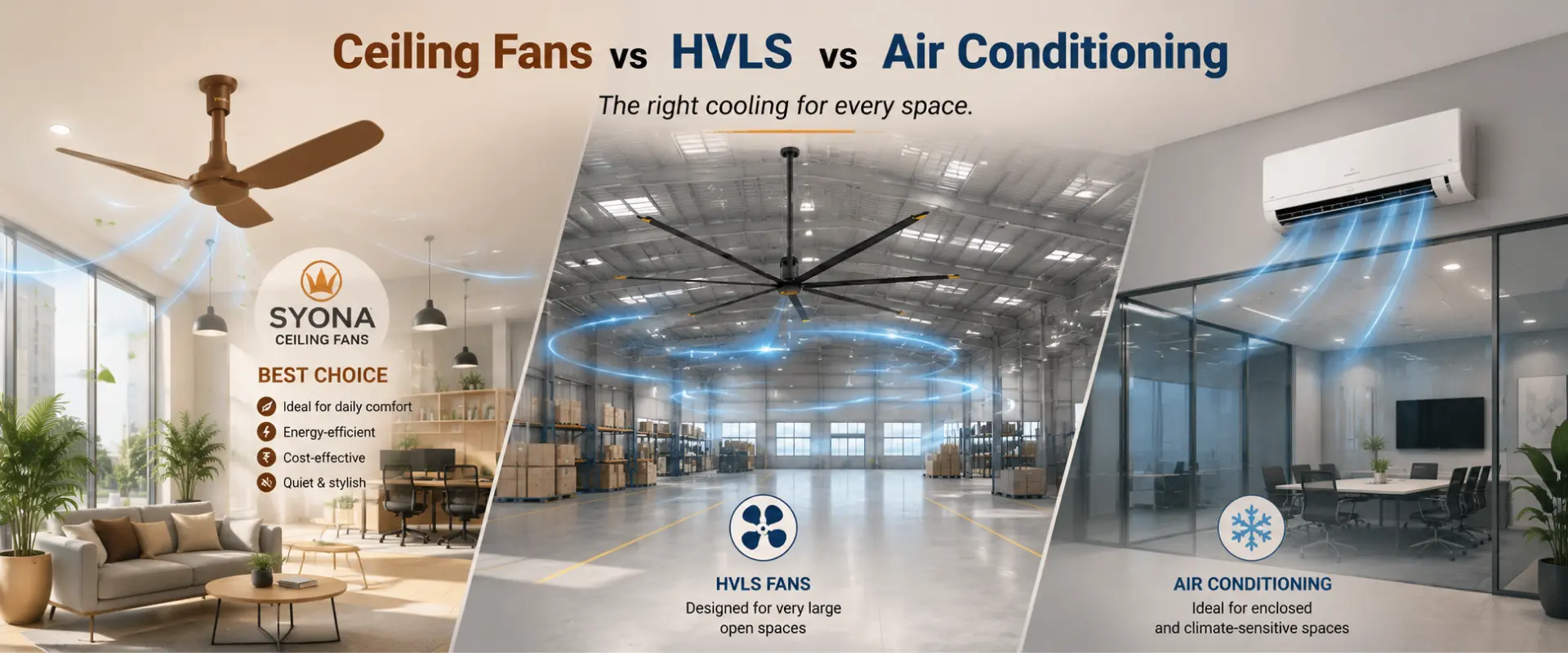
Ceiling Fans vs HVLS vs Air Conditioning for Large Halls
- What Each Option Actually Does
- Compared on Cost, Coverage and Comfort
- What to Install Where
- How Many Fans a Hall Needs
- Why the Motor Decides the Running Cost
- Cooling a Hall Without Overpaying
Cooling a small room is a solved problem. Cooling a large hall is not. Once a space opens out into a banquet hall, a showroom, a factory bay or a school assembly area, the easy answers stop working, and the wrong decision shows up on the electricity bill every month for years.
Ceiling fans, HVLS fans and air conditioning each suit different spaces and working conditions. This guide compares them on cost, coverage and comfort, explains where each works best, and looks at how many fans a large hall may need.
What each option actually does
The three are not interchangeable, and the difference is not size. It is whether they cool the people or the space.
Ceiling fans move air across a room so that people feel cooler through breeze and evaporation. The air temperature does not change. Moving air makes a space feel several degrees cooler than the thermostat reads, which is the whole basis of fan comfort.
HVLS fans, meaning high volume low speed, do the same thing at a much larger scale. A blade span of several metres turns slowly and pushes a gentle sheet of air across a wide floor, covering ground that would otherwise need dozens of ordinary fans.
Air conditioning is different in kind. It removes heat and moisture and lowers the actual temperature, which is why it is the only option that works in a sealed, temperature critical space.
Compared on cost, coverage and comfort
| Ceiling fans | HVLS fans | Air conditioning | |
|---|---|---|---|
| What it cools | People, through airflow | People, through airflow | The space itself |
| Running cost | Lowest | Very low for the area covered | Highest by a wide margin |
| Coverage per unit | A zone beneath each fan | A large open floor | Whatever it is sized and sealed for |
| Installation | Simple, flexible, easy to add to | Large fixed fitting, needs ceiling height | The most involved of the three |
| Works in an open hall | Yes | Yes | Poorly, cool air escapes constantly. |
| Best used | Alone in medium spaces | Alone or with cooling on big floors | With fans, rarely alone |
What to install where
Match the tool to the space, and both overspending and underperformance take care of themselves.
Offices, showrooms, classrooms, clinics and medium halls. A set of BLDC ceiling fans spaced across the ceiling is usually the whole answer. Quiet, even, and cheap enough to run that the cost barely registers against the rest of the building.
Warehouses, factory floors, large gyms and exhibition spaces. HVLS is the category built for the scale, since a standard fan cannot reach across that much open floor. In extreme heat these are usually paired with some cooling rather than relied on alone.
Server rooms, healthcare areas and premium hospitality. Air conditioning is not optional. These spaces need a controlled temperature, not a breeze.
Large halls used intensively in peak summer. The cheapest workable setup is cooling supported by fans. Air movement lets the system run at a higher, cheaper setting while people still feel comfortable, and it stops cool air pooling in the middle while the far corners stay stuffy. The fans add almost nothing to the bill, so they reduce the total rather than increasing it.
How many fans a hall needs
This is the question that decides whether a fan installation works, and it gets skipped more often than any other.
Fans cool the zone beneath them, so coverage is about spacing rather than raw power. A 1200 mm fan serves roughly ten to twelve square metres of floor, and units should be spaced so their coverage overlaps slightly. Gaps between fans become the dead spots that make a hall feel stuffy no matter how strong each individual unit is.
Mounting height matters just as much. Standard ceiling fans are designed for normal room heights, and as the ceiling rises the airflow reaching people at floor level drops away. Above roughly three and a half metres, a longer downrod brings the fan back into useful range, and beyond that the space has moved into HVLS territory.
Two practical points follow. Work out fan positions from the floor plan before ordering rather than after, and plan for the layout the room is actually used in, since a hall arranged for seated dining needs different coverage from the same hall used for standing events.
Why the motor decides the running cost
In a large space the fans stay on for most of the day, for most of the year. That makes the motor the single biggest factor in what they cost to own.
A conventional fan motor loses a large share of its power as heat. A BLDC motor does not, which is how the Syona HUSH range delivers full airflow on 28 watts and cuts energy use by up to 60 percent against a conventional fan. One fan saving that much is a rounding error. Twenty fans running ten hours a day through an Indian summer is a line item.
The practical extras matter at this scale too. The HUSH fans keep running on inverter supply, so a hall does not empty the moment the power drops, and the Premium Plus has an LED light built into the fan, which takes a separate fitting out of the ceiling plan.
Frequently asked questions
Do ceiling fans still help in a hall that already has air conditioning?
Yes, and this is where they pay back fastest. Circulating the cooled air lets the thermostat sit higher for the same comfort and evens out the temperature across the floor, so the expensive equipment works less hard.
Is evaporative cooling a better option than fans?
It depends on the climate and the space. Evaporative cooling lowers air temperature and costs far less to run than air conditioning, but it raises humidity and needs a constant flow of fresh air, so it suits dry regions and open sheds rather than humid coastal areas or enclosed halls.
Can BLDC fans replace existing fans without rewiring?
In most cases they fit the same ceiling hook and supply, so a retrofit across a hall is straightforward. Confirm the mounting and downrod requirement for your ceiling height before ordering in quantity.
Cooling a hall without overpaying
The pattern across every large space is the same. Let cheap, efficient air movement carry as much of the comfort load as it can; reserve air conditioning for the spaces that genuinely need a lower temperature, and choose a motor that costs almost nothing to run, because in a hall the fans are never off.
If you are planning cooling for a hall, our ceiling fan manufacturers can help once you send your floor dimensions, ceiling height and how the space will be used.
Find the Right Cooling Solution for Your Large Hall
Cooling a large hall efficiently is not simply a matter of installing the biggest fan or the most powerful air conditioner available. The right solution depends on the hall's size, ceiling height, ventilation, occupancy and how the space is used.
Syona's BLDC ceiling fans provide efficient air movement for offices, showrooms, classrooms, halls and other large spaces, while HVLS fans can help circulate air across much larger open areas. Where temperature control is essential, combining efficient fans with air conditioning can improve air distribution and comfort without relying entirely on mechanical cooling.
If you are planning cooling for a new hall or upgrading an existing space, choosing the right combination from the start can help avoid unnecessary installation and running costs.