


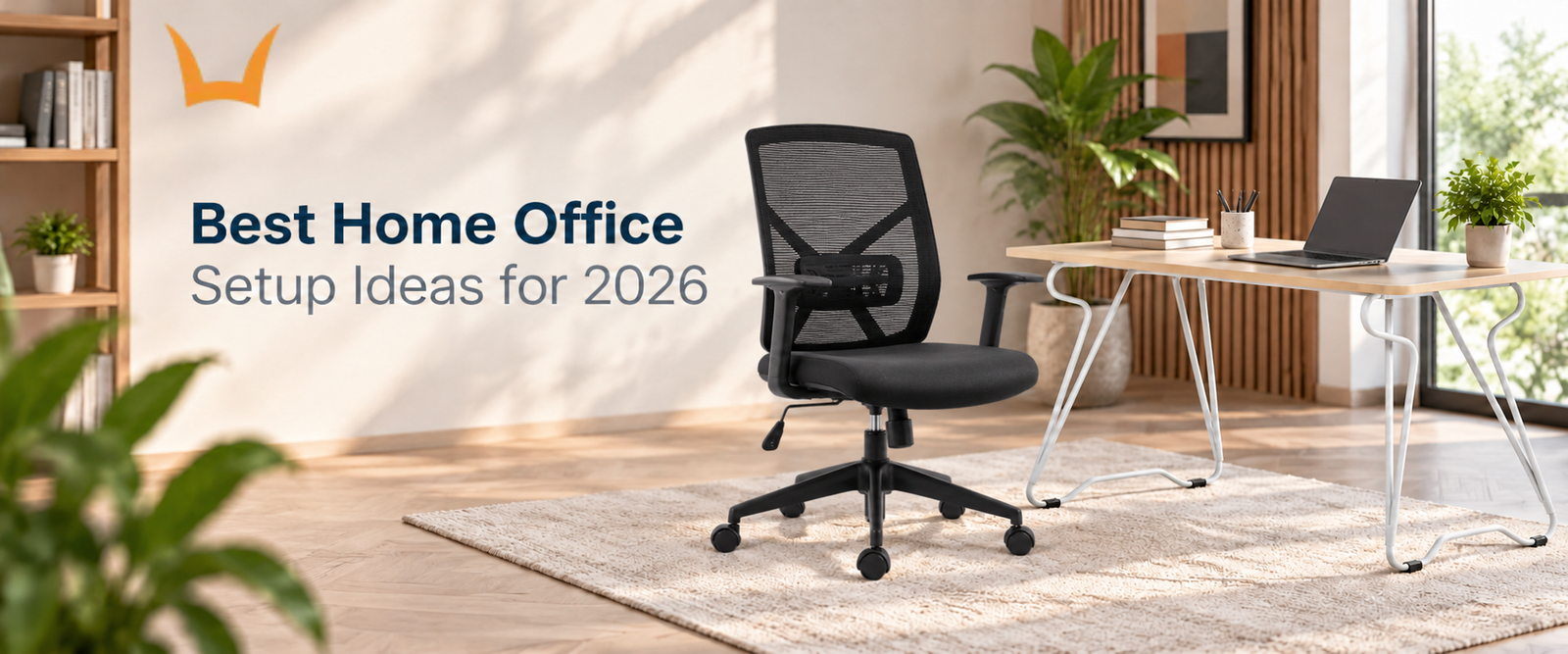
Best Home Office Setup Ideas for 2026
- A Compact Desk and Adjustable Chair for Small Spaces
- A Full Workstation for Regular Home Working
- A Desk with Built-In Storage for a Clearer Workspace
- Matching Desks and Individual Chairs for a Shared Office
- Office Furniture That Belongs in Your Home
- A Flexible Workstation for Work and Study
- Find Your Home Office Chair with Syona
A desk gives you somewhere to put your laptop. A home office needs to make room for everything you do around it: typing, reading, taking calls and keeping work organised.
The best home office setup ideas bring together a desk with enough usable space, a chair that fits you and storage that keeps essentials close. A compact desk and adjustable chair can suit a small corner, while a larger workstation or shared arrangement supports different working needs.
For your 2026 setup, start with the furniture combination that suits your day. Here are six ways to put the pieces together.
1. A Compact Desk and Adjustable Chair for Small Spaces
A small workspace can feel complete with just a desk, a comfortable office chair and one nearby storage unit. The key is giving each piece enough room to work properly.
Choose a desk that accommodates your equipment without forcing the keyboard onto its front edge. Slim legs and an open area underneath can leave more room for your chair and feet than a desk with bulky cupboards on both sides.
Pair it with a chair whose adjustments suit your height and the work surface. Check that its armrests allow you to move close to the desk and that the base has room to move.
For small home office setup ideas, consider this combination:
- A straight desk with sufficient depth for your screen.
- An adjustable office chair.
- A shallow wall shelf for occasional supplies.
- A compact task lamp.
Keep the shelf high enough to avoid obstructing the screen, but place everyday items within easy reach. This arrangement leaves the desktop available for work without filling the floor with storage.
2. A Full Workstation for Regular Home Working
If you work from home most days, a permanent workstation lets you leave essential equipment ready for use.
Start with a desk wide enough for your usual tasks. Computer work and paperwork may need separate areas, especially if you regularly move between the two. An L-shaped desk can provide that division where there is enough space, while a wider straight desk keeps everything facing forwards.
Give the chair equal attention. Its seat and backrest should support you comfortably, with controls you can use to adjust your position. Try the chair at a work surface rather than judging it from a quick sit alone. Workstation guidance recommends assessing the chair alongside the desk and equipment.
Add a drawer pedestal or low cabinet beside the desk for documents and accessories. Keep the space beneath your working position clear.
A monitor arm may free up surface space if the desk supports the fitting. For laptop use, a stable stand with a separate keyboard and mouse allows the screen and hands to be positioned independently.
3. A Desk with Built-In Storage for a Clearer Workspace
Storage built into a desk can reduce the number of separate pieces you need. This is useful when work materials otherwise end up on dining tables, shelves or nearby chairs.
Think about the contents before choosing the layout. Shallow drawers suit stationery and small accessories. Deeper compartments may accommodate files, while shelves can hold reference books.
Position matters as much as capacity. Drawers should open without hitting the chair, and cupboards should not take away the legroom you need.
A practical arrangement could combine one shallow desk drawer with a storage unit at the outer end. This keeps frequently used items close while leaving the central area open.
Among simple office setup ideas for home, this is an effective way to make clearing up easier. Give unfinished work a dedicated drawer or tray so you can put it away without having to sort every sheet at the end of the day.
4. Matching Desks and Individual Chairs for a Shared Office
Two people can share a coordinated workspace without using identical seating.
Matching desks help establish a consistent appearance. Each person can then choose a chair with dimensions and adjustments that suit them. The same chair settings are unlikely to work equally well for everyone.
A long wall may accommodate two desks side by side. Separate desks on opposite walls can offer more individual space. Either way, make sure both people can pull back their chairs without blocking each other.
Give each workstation its own storage. Shared cabinets can hold general supplies, but personal work materials should remain accessible without reaching across another person’s desk.
Lighting should also be adjustable independently. One person may need a lamp for reading while the other works mainly on screen.
If calls frequently overlap, account for that before settling on the arrangement. A desk divider can provide visual separation, but it does not make conversations private.
5. Office Furniture That Belongs in Your Home
A home workspace can look comfortable alongside the rest of your furniture while still serving as a proper place to work.
Start with an existing finish or colour in the room. A desk can relate to nearby shelving through its wood tone, while the chair’s upholstery can pick up a colour already used elsewhere.
You do not need a fully matching set. Similar proportions and a limited selection of finishes can bring separate pieces together. Bespoke furniture can also help you achieve a look that suits your room and workspace requirements.
Closed storage is particularly useful in living rooms and bedrooms because it keeps work materials out of view after use. A cabinet beside the desk can also provide a surface for a lamp or a few personal items.
Keep decorative objects away from the area needed for typing and writing. The furniture should still accommodate your equipment comfortable, even when the workspace forms part of a carefully decorated room.
6. A Flexible Workstation for Work and Study
A desk shared at different times needs to accommodate each user without a lengthy rearrangement.
An adjustable chair helps, provided its adjustment range suits the people using it. Seat height, back support and access to the work surface need checking whenever the user changes.
An adult office chair may not fit a younger child adequately. Where necessary, use separate seating suited to each person rather than expecting one chair to accommodate everyone.
Choose a desk with enough open space to switch between computer work and books. Keep cables organised towards the back, and give each user a separate drawer, shelf or portable organiser.
This keeps the furniture useful across different activities. One person can put their materials away and leave the surface ready for the next.
Find Your Home Office Chair with Syona
Syona offers office seating in your home or desired workspace with different dimensions and adjustment options. Once you have chosen your desk arrangement, share your available space and seating preferences with our office chair suppliers. Compare suitable models and confirm their features before selecting a chair for your home office.
Conclusion
Choose the office furniture combination that makes your daily work easier. A compact setup may need only three well-chosen pieces, while a shared or permanent office may need more. Allow enough space to move your chair and open drawers, and choose furniture that complements the rest of the room.
Make Your Home Workspace Work Better
Create a dedicated place for focused work with office seating from Syona. Explore available chair designs and compare dimensions, adjustment features and finishes to find an option that suits your home workspace and daily routine.