


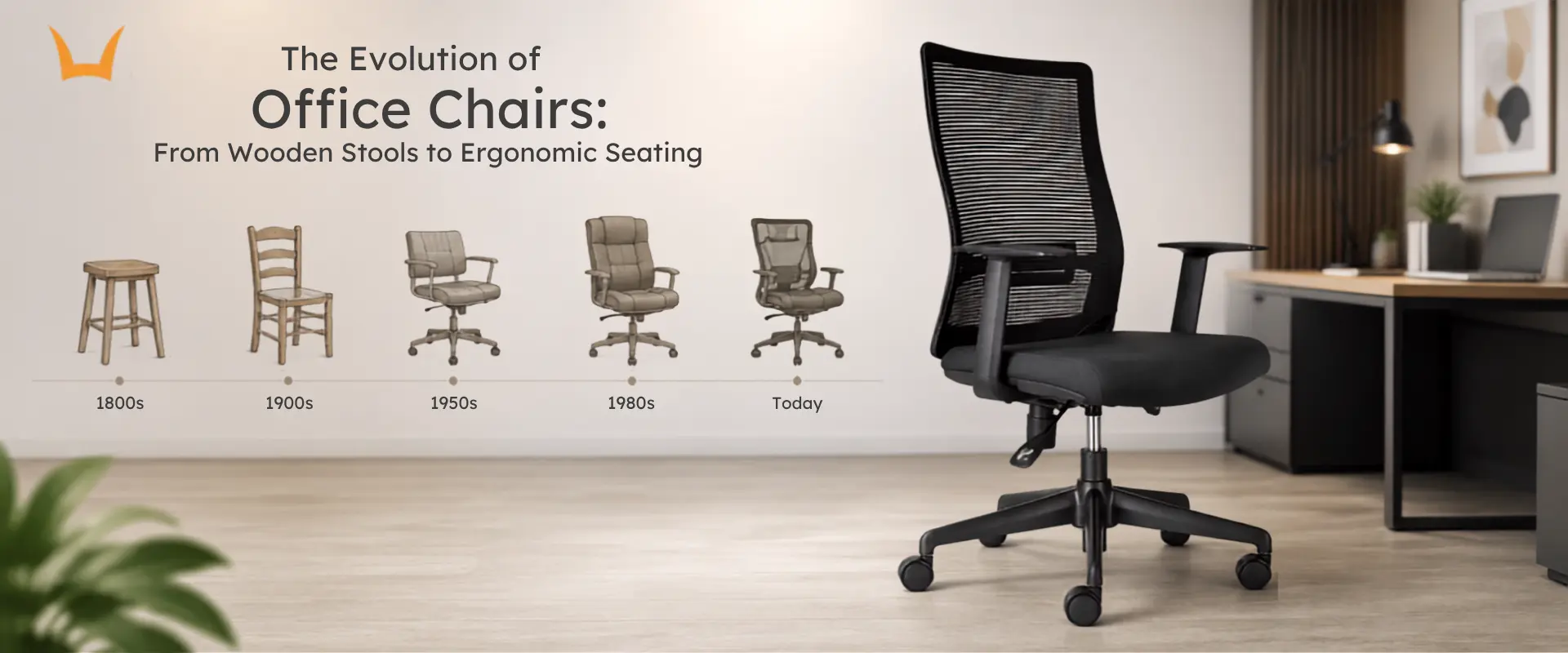
The Evolution of Office Chairs: From Wooden Stools to Ergonomic Seating
- Generation One: The Functional Chair
- Generation Two: The Moving Chair
- Generation Three: The Comfort Chair
- Generation Four: The Ergonomic Chair
- Generation Five: The Configurable Chair
- Office Chairs Become More Specialised
- Performance Becomes Part of Chair Design
- What Could Generation Six Look Like?
- Five Generations, One Direction of Travel
Sitting through a full working day is much easier today than it would have been for office workers generations ago. We can adjust our seat height in seconds, move around a workstation, lean back between tasks and sit in chairs designed with the human body in mind. These features feel ordinary now, but earlier workplace seating offered almost none of them.
For a long time, a wooden stool or straight-backed chair was considered perfectly adequate for work. As offices expanded and people spent more time at desks, that began to change. Chairs became mobile, cushioning became common, ergonomics entered the picture, and eventually almost every part of the chair became adjustable.
The evolution of office chairs can be viewed through five generations, each reflecting a major shift in what people expected from workplace seating.
Generation One: The Functional Chair
The earliest workplace chairs were designed around one basic requirement: providing a sturdy place to sit.
Wooden stools, benches and straight-backed chairs were practical, durable and simple to manufacture: a solid seat on four legs, sometimes with a backrest or armrests.
There was little distinction between a desk chair and ordinary furniture. Height, seat dimensions and back angle were fixed at manufacture and could not be changed.
The user adapted to the chair.
That mattered less when most occupations mixed standing, walking and sitting. But clerical and administrative work put more people behind desks for longer, and the general purpose chair began to look inadequate.
Generation Two: The Moving Chair
The next generation introduced a feature that fundamentally changed the office chair: movement.
Swivel mechanisms let workers turn between areas of a desk without repositioning the whole chair. Castors made short movements possible while seated, and office seating began to take on an identity of its own.
The traditional four-legged structure evolved towards a central support and mobile base, creating the silhouette we still associate with office chairs today.
Height adjustment also appeared through mechanical systems. Early versions were stiff and slow, but they introduced an important principle: a chair no longer had to stay at the dimensions its manufacturer chose.
The office chair had started changing from static furniture into working equipment.
Generation Three: The Comfort Chair
With mobility established, manufacturers turned to the experience of sitting for longer periods.
Hard wooden seats gradually gave way to cushioning. Foam, fabric, vinyl and leather allowed seats and backrests to become softer and more substantial.
Seating also started to signal hierarchy as well as function. High backs, broad seats and generous upholstery became associated with managerial and executive offices, communicating status alongside comfort.
For a time, the formula appeared simple: more cushioning meant a better chair.
But prolonged desk work exposed the weakness in that idea. A deeply padded chair can feel comfortable in the first ten minutes without supporting the body over several hours. Designers therefore began looking beyond softness to the relationship between the chair and the person in it.
That shift created the foundation for ergonomic seating.
Generation Four: The Ergonomic Chair
Ergonomics changed office chair design considerably.
Instead of beginning primarily with appearance or upholstery, designers worked from human body dimensions, posture, spinal support and movement.
Backrest shape and lumbar support received far more attention, and seat dimensions were worked out around the seated user. Reclining systems evolved to allow controlled movement rather than keeping the chair rigid.
As computers became central to office life, employees worked at one workstation for most of the day, and chairs had to suit sustained screen-based work rather than occasional sitting.
Gas-lift height adjustment made it far quicker to set the seat in relation to a desk. Adjustable armrests gave control over arm and shoulder positioning, while improved tilt mechanisms let the body change position through the day rather than holding one posture.
Generation Five: The Configurable Chair
Today's ergonomic office chair builds on all the earlier generations, but its defining feature is not one mechanism or material. It is the number of points at which the chair can be set to fit its user.
Synchronised mechanisms coordinate the backrest and seat as the user leans back, so the chair follows the body instead of tipping as one block. Seat-depth adjustment sets the distance between the back of the knee and the front edge of the seat, which matters for taller and shorter users. Lumbar systems often move up and down as well as in and out, and headrests and recline tension add further control.
Materials changed alongside the mechanisms.
Mesh has become particularly common. Rather than a thick padded backrest, tensioned mesh provides a flexible supporting surface while allowing airflow across the back.
Chairs can also combine engineering polymers, steel, aluminium, moulded foam and technical fabrics, allowing structures and mechanisms that earlier construction methods could not achieve.
Office Chairs Become More Specialised
Office chair evolution has also moved in another direction: specialisation.
Ergonomic task chairs suit regular workstation use. Executive chairs combine different proportions, materials and features. Conference and meeting chairs serve shorter sittings, while training areas may need lightweight seating that can be rearranged easily.
Commercial environments vary further still: an office, hospital, educational institution or reception area may each need a different approach to seating.
The question has therefore shifted from simply choosing an office chair to choosing a comfortable office chair for the specific person and task.
Performance Becomes Part of Chair Design
Commercial seating today is expected to do more than look good and feel comfortable.
An office chair may be used for hours every day, rolled across the floor and adjusted countless times over its working life, so strength, stability and durability matter as much as the initial feel of the seat.
Furniture testing standards, including those associated with BIFMA, provide established methods for assessing commercial seating performance.
That gives buyers something earlier generations never offered: a way to separate two chairs that look similar by how each one behaves under load, cycling and impact testing.
What Could Generation Six Look Like?
The next generation may not be defined by adding more controls.
The shift could instead be towards chairs that are quicker to set up, with mechanisms that respond more naturally to different users. That matters most in shared and flexible workplaces where several people use the same chair in a week.
Material choices are also likely to be judged differently. Repairability, replaceable components, material efficiency and recyclability could have a greater influence on how future chairs are designed and manufactured.
Five Generations, One Direction of Travel
The evolution of office chairs has been a gradual expansion of what we expect a chair to do.
The first generation provided function. The second introduced mobility. The third brought greater comfort. The fourth placed ergonomics at the centre of design, while the fifth made office seating configurable.
At Syona, an office chair manufacturer in Coimbatore, Tamil Nadu, we make ergonomic mesh chairs, executive chairs and seating built around the varied requirements of today's commercial workplaces.
Across all five generations, one thing has changed above all else. We no longer adapt ourselves to the chair. We expect the chair to adapt to us.
Choose Seating Built for Modern Workplaces
The right office chair should do more than provide a place to sit. It should support how your team works, moves and spends time at a desk. From ergonomic mesh chairs to executive and specialised commercial seating, Syona offers office seating designed for today's workplaces.