


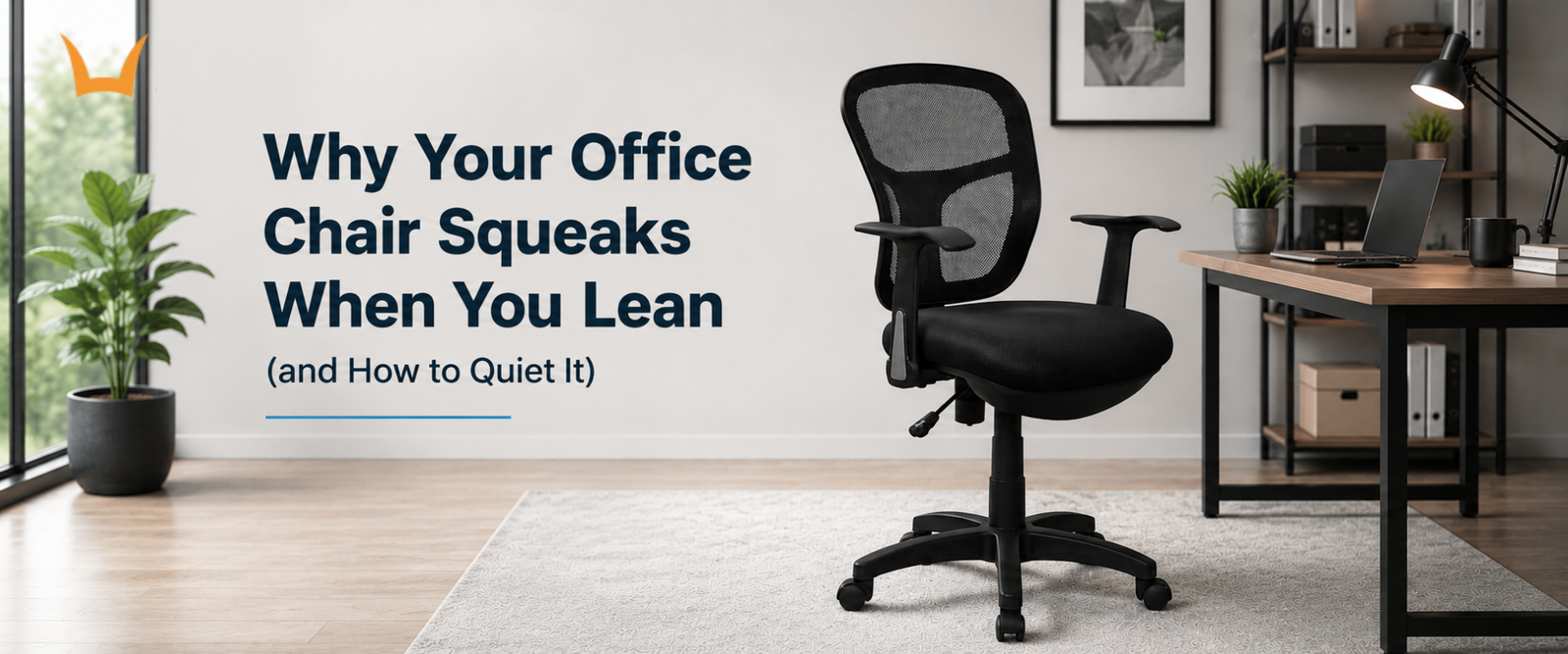
Why Your Office Chair Squeaks When You Lean (and How to Quiet It)
- How to Find Where Your Office Chair Squeaks
- Why a New Office Chair Keeps Squeaking
- When Several Office Chairs Are Making Noise at Once
- Choosing Office Chairs That Stay Quiet
- The Bottom Line on a Squeaky Office Chair
- Common Questions About a Squeaky Office Chair
Key Takeaways
Most office chair squeaks are caused by loose bolts, dry moving parts or friction in the tilt mechanism. In most cases, the problem is quick to identify and easy to fix with a little maintenance. This guide explains the common causes, simple solutions and tips to help keep your office chair seating quiet and comfortable.
How to find where your office chair squeaks
The mistake is to flip the chair over and start loosening bolts at random. Every squeak has a location, and you can find it in under a minute. Sit down and make one movement at a time: lean back slowly, then swivel, then rock, then roll across the floor. The sound will tie itself to a single action, and that tells you which joint has dried out or worked loose.
Most squeaks live in one of four places. Match the noise to the movement, then treat that spot.
When your office chair squeaks as you lean back
The joint under the seat that lets you recline is the busiest on the chair, so it is the first suspect for a lean-back creak. Its grease dries with age and its spring bolt can loosen. A little lubricant on the tilt mechanism pivots, plus a gentle check of the tension knob underneath, usually settles it. If the seat also sinks while you sit, the gas cylinder is more likely to be the problem than the tilt joint, and it needs a different fix.
A squeak when you swivel or stand up
A squeak that shows up as you turn often comes from the central column, where the seat post meets the base. Drop the seat to its lowest point, wipe the exposed post clean, and add a thin film of lubricant around the collar. Raise and lower it a few times to spread it evenly.
When the chair makes noise as it rolls
If the noise only appears as you move across the floor, the wheels are the place to look. Hair and grit wind around the axles and turn a smooth roll into a squeal. Pick the hair out by hand, clean the axle, and add a small amount of lubricant to each wheel.
Creaks from the armrests and seat
A creak as you sit down or stand up is usually loose hardware rather than a dry joint. Turn the chair over and firm up the bolts on the seat plate and the armrest posts. Keep it gentle, because a forced bolt can strip its thread and leave you worse off.
Use a silicone or PTFE spray to lubricate moving parts, and always clean the joint before applying it. Avoid solvent sprays and household oils, as they can remove grease or attract dust, causing the squeak to return. Well-built office chairs with quality tilt mechanisms, gas lifts and durable construction are also less likely to develop squeaks, even with regular daily use, helping them stay quieter for longer.
Why a new office chair keeps squeaking
A new chair that squeaks straight out of the box throws people, but the reason is almost always harmless. During assembly a few bolts may sit slightly loose, so parts move against each other under your weight.
New joints also need a short bedding-in period, and a scrap of packing film caught in a moving part can chirp until it is removed. Go back over every assembly bolt and clear anything trapped. If the noise holds after that, the supplier's support team should look before any part is changed.
When several office chairs are making noise at once
A single creaky chair is a two-minute job. A dozen of them going at once across the same office is a different message, and it is worth reading.
As above, lighter mechanisms dry out and loosen sooner, so a batch bought together tends to turn noisy around the same age, and constant daily use only brings that day forward.
Seen from a facilities or procurement desk, that pattern is a hardware-quality signal rather than bad luck. Seating built and tested for real commercial duty holds its quiet far longer, which is the kind our team supplies to offices, colleges, hospitals, and large projects.
Choosing office chairs that stay quiet
Many chair noises can be avoided by choosing a well-built office chair from the start. Look for a durable tilt mechanism, reliable gas lift and sturdy frame, as these components experience the most movement during daily use. BIFMA-tested chairs are designed to withstand regular use, making them a dependable choice for long-term performance. Select a chair that suits your workspace, whether it's an office, home office or reception area, to ensure lasting comfort and durability.
The bottom line on a squeaky office chair
A squeaky office chair can be distracting, especially in a busy workplace. Fortunately, the noise is usually a sign of minor wear rather than a serious fault. By identifying where the sound is coming from and carrying out a few simple checks, you can restore smooth, quiet movement and extend the life of your chair.
If a run of chairs in your workplace has turned noisy, or you are fitting out a new space and want seating that stays quiet under daily use, Syona Roots is a commercial office chair supplier offering seating suited to demanding workplace environments. We can help you choose chairs suited to how your space is used.
Common questions about a squeaky office chair
Is a squeaky office chair unsafe to sit on?
A light, steady squeak is usually just friction and is safe to use. Treat it as a warning only when the sound comes with a wobble, a tilting seat, or a visible crack in the base or arms, in which case stop using it until it is checked.
Why does my office chair squeak more in cold or humid weather?
Metal and plastic parts expand and contract with temperature, and damp air can stiffen joints, so a chair that is quiet in summer may creak in winter. A clean and a fresh touch of lubricant on the moving parts usually evens this out through the seasons.
Could the floor or mat be making the noise, not the chair?
Yes, and it is easy to miss. A loose floorboard, a hard caster on a bare floor, or a dry chair mat can all squeak in a way that sounds like the chair, so test the chair on a different surface before you take it apart.
When is it better to replace a squeaky chair than keep fixing it?
If the noise returns quickly after cleaning and lubricating, and the chair also feels loose, leans, or has cracked parts, the mechanism is likely worn rather than just dry. At that stage a replacement is the sounder choice, especially for a chair in heavy daily use.
Want Office Chairs That Stay Quiet?
Choose seating built for the demands of daily office use, with durable mechanisms and reliable construction designed for long-term performance. Whether you're replacing a few noisy chairs or furnishing an entire workplace, Syona Roots can help you find seating suited to your environment. Explore our office chair range or send a bulk enquiry for your project.