


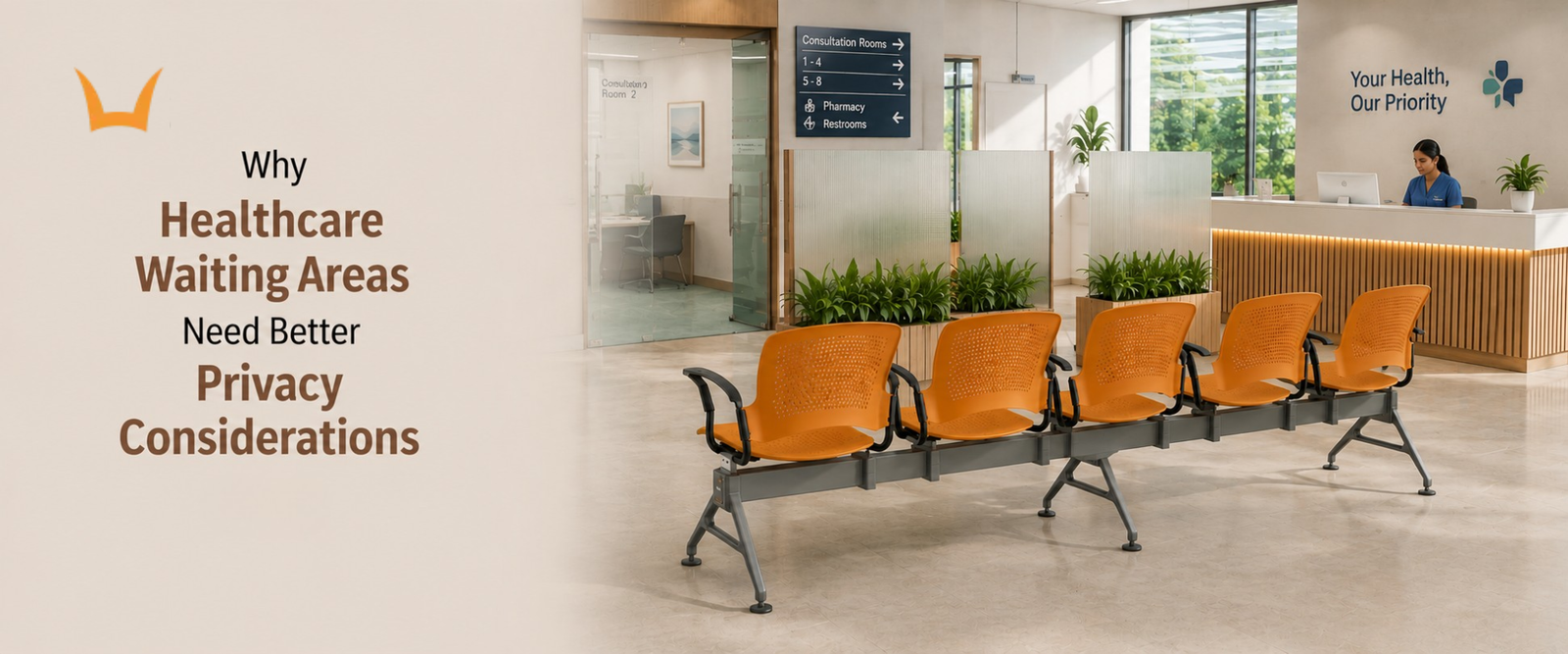
Why Healthcare Waiting Areas Need Better Privacy Considerations
- Why Privacy Is a Real Concern in Indian Healthcare Waiting Areas
- What Privacy Actually Means When People Wait for Medical Care
- How Seating Layout Shapes the Patient Experience
- Why Multi-Seater Gang Chair Configurations Matter for Layout Planning
- How Patient Privacy Needs Change by Medical Speciality
TLDR
- Healthcare waits involve sensitive personal moments
- Seating layout decides how much privacy patients get
- Distance and visual barriers protect patient dignity
- Multi-seater configurations enable flexible layout choices
- Privacy needs vary by medical speciality
Introduction
Most healthcare waiting areas are designed to maximise seating capacity. Rows are added wherever space allows, with little thought given to how patients experience the environment while they wait.
For healthcare facilities, this can create an overlooked problem. Patients often discuss symptoms, speak with family members, or process sensitive medical information while sitting close to strangers. The way waiting area seating are arranged plays a major role in how comfortable and private these moments feel.
This article explores how seating layouts and waiting chair configurations can help healthcare facilities create a more respectful patient experience.
Why Privacy Is a Real Concern in Indian Healthcare Waiting Areas
Indian healthcare waiting areas tend to be crowded. The patient load is high. The space available is often limited. Hospitals try to fit as many hospital visitor chairs as possible into the rooms they have.
This creates a problem. Patients sit shoulder to shoulder with strangers during emotionally vulnerable moments. A phone call to a spouse about a diagnosis happens with three strangers within earshot. A conversation between a daughter and her elderly father about symptoms gets overheard by the entire row.
The result is not just discomfort. Some patients delay their next visit. Some choose not to bring family along. Some hold back important details when speaking to their doctor because they are still in the mental zone of being watched. The waiting area becomes an obstacle to good care instead of a support for it.
What Privacy Actually Means When People Wait for Medical Care
Privacy in a waiting area is not one single thing. It works through three different layers.
Physical Distance From Strangers
The simplest layer is physical space. Patients should not have to sit so close to strangers that their elbows touch. They should not have to step over someone's legs to reach an empty seat. Enough personal room lets a patient feel they have their own territory in the waiting area.
Visual Privacy From Other Patients
Visual privacy is what stops strangers from constantly looking at each other. When chairs face directly into one another, or sit in a tight U-shape, patients cannot avoid eye contact with people across the room. A well planned layout uses chair direction to give patients somewhere to look that does not put them face-to-face with another visitor.
Conversational Privacy During Phone Calls and Family Discussions
This is the layer most affected by seating. When patients talk to family on the phone, or discuss symptoms with someone next to them, the conversation needs to stay between the people involved. Seating that places strangers within listening distance breaks this layer.
How Seating Layout Shapes the Patient Experience
The layout of chairs in a waiting area is one of the most powerful tools available to healthcare planners, yet often the least considered.
A long unbroken row of seats packed wall-to-wall may fit more patients per square metre, but it forces every visitor into the same vulnerability. A thoughtful layout with breathing room, varied directions, and smaller groupings does the opposite.
Our team at Syona Roots has walked through hundreds of Indian hospital waiting areas over the years. The ones that feel calm share one trait. The seating was planned, not just installed.
Why Multi-Seater Gang Chair Configurations Matter for Layout Planning
Layout flexibility depends on having the right chair configurations available. This is where multi-seater gang chairs become useful planning tools.
The Syona Roots Venus Gang Chair range is available in 2, 3, 4, and 5 seater configurations. The Jupiter Reception Chair range, including both the Jupiter Awe and Jupiter Ace models, is also available in multiple seating configurations to provide the same flexibility.
A clinic that needs cluster seating uses 2-seater or 3-seater Venus models grouped strategically. A large hospital that needs broken linear rows uses 4-seater and 5-seater models with planned gaps.
How Patient Privacy Needs Change by Medical Speciality
A blanket privacy approach does not fit every healthcare setting. The right layout depends on the kind of medical work happening at the facility.
General OPD waiting areas serve mixed visitors with routine concerns. Standard linear rows with modest buffer gaps usually work well. Patients here mostly want comfort during long waiting periods and order, not deep visual privacy.
Gynaecology and obstetrics waiting areas need stronger privacy. Patients here often arrive with personal concerns and may be accompanied by partners or family. Smaller cluster seating works better, giving each family group their own visual zone.
Oncology and chemotherapy waiting areas need the deepest privacy. Patients here are managing serious diagnoses, often dealing with emotional weight that affects their willingness to be observed. Back-to-back layouts and smaller groupings of 2-seater or 3-seater chairs work best.
Paediatric waiting areas need a different approach again. Children need supervision space, parents need to be close to them, and other patients need protection from the noise. A mix of cluster seating near a play area, with quieter zones further away, balances these competing needs.
The Venus and Jupiter ranges support each of these speciality-specific layouts because of the seater configuration options available.
Conclusion
A hospital or clinic does many things to support its patients. The medical care, the diagnostic accuracy, the staff training. The waiting area is one part of the support system that is rarely given the attention it deserves.
A patient who feels respected in the waiting area arrives for their appointment in a better emotional state. They communicate more openly. They follow advice more readily. The right seating decision contributes to better care outcomes in a small but real way.
Planning a healthcare waiting area where patient privacy matters?
The Syona Roots Venus Gang Chair and Jupiter Reception Chair ranges, including the Jupiter Awe and Jupiter Ace models, come in 2, 3, 4, and 5 seater configurations. Built by healthcare seating manufacturers for hospitals, clinics, and diagnostic centres where patient experience is part of the design.