


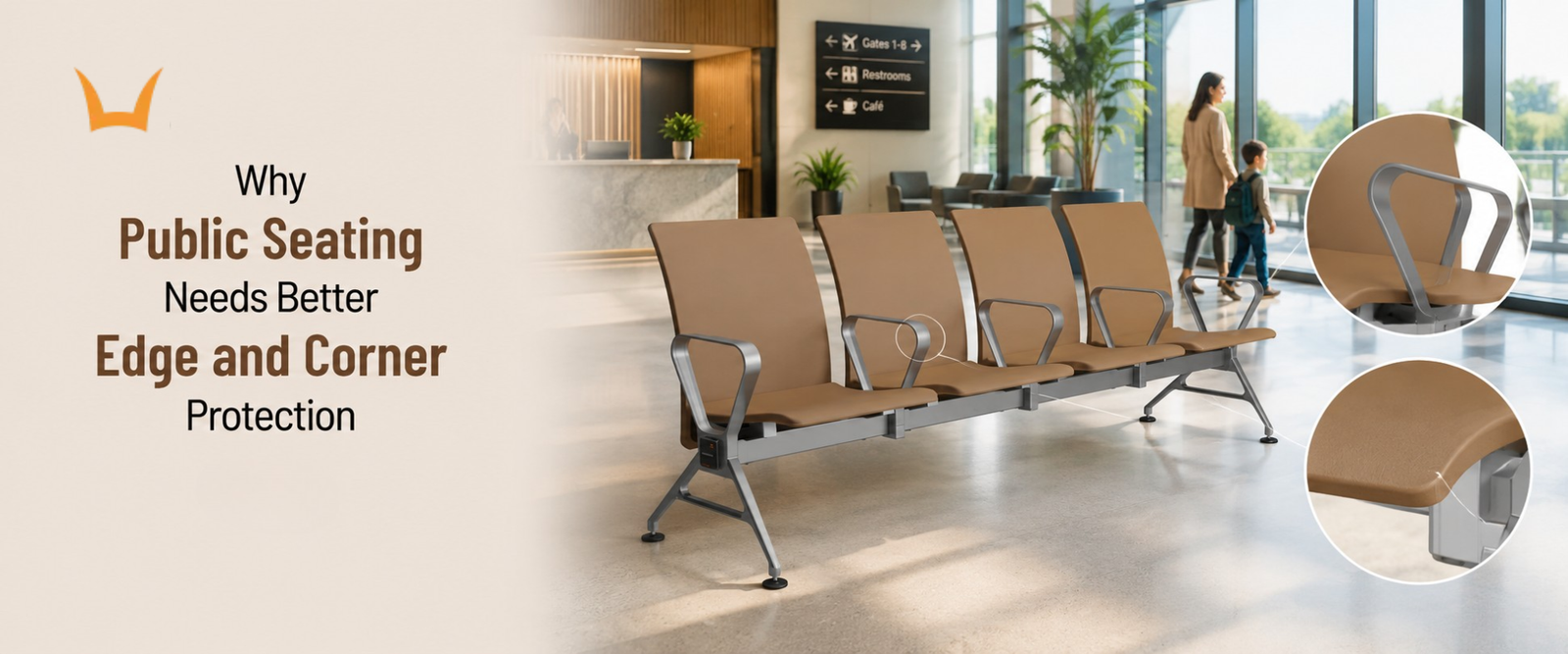
Why Public Seating Needs Better Edge and Corner Protection
- Why Edge and Corner Protection Is a Real Problem in Public Seating
- Who Gets Hurt First in Public Waiting Areas
- The Three Zones Where Edge Design Matters Most
- How Engineering Polymer Bodies Solve the Edge Problem
- Why Edge Protection Must Be Built In, Not Added On
- Why Cleaning and Hygiene Improve With Better Edge Design
TLDR
- Sharp edges and corners cause real injuries
- Children and elderly users are at most risk
- Three chair zones need careful edge design
- Engineering polymer allows safer edges by default
- Smooth edges also improve cleaning and hygiene
Introduction
Public seating gets used by everyone. Children running between rows in a clinic waiting area. Elderly visitors moving slowly with a walking stick. Patients in distress trying to find a place to sit. Office visitors carrying bags, files, and phones, not always looking where they are going.
In this mix of users, the waiting chair itself becomes a safety factor. Sharp edges or rough corners on a basic chair can cause real harm.
At Syona Roots, we design our waiting chair range with this reality in mind. This blog explains why public seating edge protection deserves serious attention from anyone buying chairs for hospitals, clinics, banks, government offices, and public spaces.
Why Edge and Corner Protection Is a Real Problem in Public Seating
In a home or office, the same person uses the same chair every day. They know the chair. They avoid its rough spots without thinking.
In public seating, every user is new to the chair. Hundreds of different people sit on the same row across a single day. None of them know where the sharp parts are. This is why edge and corner protection matters more in public seating than in any other furniture category.
Who Gets Hurt First in Public Waiting Areas
Children in Crowded Waiting Areas
Hospitals and clinics have children moving between seats while parents check in. They are at chest or face height for the lower seats. Anything sharp at that level becomes a real risk.
Children also climb on chairs, slide off them, and bump into the corners. The Syona Venus Gang Chair range, available in 2, 3, 4, and 5 seater configurations, is moulded with rounded contours specifically because of how children behave in our customer environments.
Elderly Visitors With Limited Vision and Balance
Older visitors often have reduced peripheral vision and slower balance reactions. They reach for the chair before fully looking at it. They lean on its edges while sitting down or standing up.
A poorly finished edge can cut, bruise, or scrape the forearm. For older patients with thin skin or blood thinning medication, even small cuts can become real medical concerns. This is one of the reasons many healthcare facilities choose better hospital waiting chairs.
Patients in Medical Distress
Some visitors to clinics and hospitals are unwell when they arrive. They sit down quickly, sometimes off-balance.
A chair with rough seat edges can dig into the back of the thigh. A backrest with hard corners can hit the spine in the wrong spot. Our customers in healthcare have made it clear to us, as hospital seating suppliers, that public seating must handle these unplanned seatings without harming the user.
The Three Zones Where Edge Design Matters Most
Seat Pan Edges
The front edge of the seat is the most touched part of any chair. Users contact it every time they sit or stand. They drag their thighs across it during the day.
Backrest Edges
The sides and top of the backrest are zones that users contact when adjusting their position, reaching back, or settling in. The edges of these surfaces interact with the user's clothing, neck, and upper back throughout any visit.
Frame and Base Corners
The metal beam frame that holds gang chairs together has multiple corner points. Where the beam meets the floor, where level adjusters help provide stable footing on uneven floors. Where the beam joins the chair body. Where the support legs angle out.
These corners are at shin height for adults and at head height for crawling toddlers. The protection at these zones is non-negotiable for public use.
How Engineering Polymer Bodies Solve the Edge Problem
Traditional wood and metal chairs require separate edge finishing work. Routing, sanding, sealing, and capping all add cost and still leave weak points where finishes wear off over time.
Engineering polymer changes the approach. Our Syona waiting chair range uses moulded engineering polymer for the seat and back. The moulding process creates continuous smooth edges as part of the chair body itself. There are no joints, no separate edge bands, no glued caps that can come loose.
The seat is moulded with a contoured front edge that supports the thigh without cutting into circulation, supporting comfort during long-hour use. The backrest is moulded with smooth tapered sides and a curved top that has no sharp transitions anywhere a user touches.
Why Edge Protection Must Be Built In, Not Added On
There are two ways to protect chair edges. The first is to build safe edges into the chair structure from the start. The second is to add protective guards, caps, or edge bands to a chair that was not originally designed for safety.
The second approach fails in public seating.
Added-on edge guards peel off after months of cleaning chemicals. Plastic caps crack and fall off after impact. Adhesive edge bands lift at the corners and create new sharp points where the user did not expect them. Every failed guard becomes a fresh hazard.
The maintenance team then has to replace these guards regularly. The cost adds up. The chair never stays safe consistently.
A chair with safety designed into its structure carries none of these problems. The Syona waiting chair range is moulded with smooth edges as part of the chair material itself. There is nothing to peel, crack, or fall off because there is nothing added on. The protection is built into the chair the day it leaves the factory and stays that way.
Why Cleaning and Hygiene Improve With Better Edge Design
Hospitals, clinics, and public spaces clean chairs daily, sometimes multiple times a day. The cleaning quality depends heavily on the chair design.
Sharp edges and tight corners trap dust, dirt, and biological residue. Cleaning staff cannot reach these zones with normal wipes. Over weeks, these traps become hygiene problems.
Smooth, continuous edges allow a single wipe to clean the entire surface. There are no traps, no hidden zones, no places where bacteria collect. The engineering polymer body of our Syona waiting chair range handles disinfectant wipes daily without losing its finish.
Conclusion
Public seating carries a responsibility that home or office furniture does not. The user is always new to the chair. The chair must be safe for that first encounter, every single time, for every kind of visitor who walks through the door.
At Syona Roots, our waiting chair range is built around this principle. Moulded edges, continuous surfaces, and engineered frame corners create chairs that protect every user without anyone needing to notice the design at all.
Looking for waiting chairs designed with real edge and corner safety?
The Syona Roots Venus and Jupiter waiting chair ranges feature moulded engineering polymer bodies with continuous smooth edges, designed for hospitals, clinics, and public spaces where safety is the baseline. Built for high-traffic environments, these waiting chairs combine user safety, long-term durability, and easy maintenance to deliver reliable performance for visitors of all ages.