


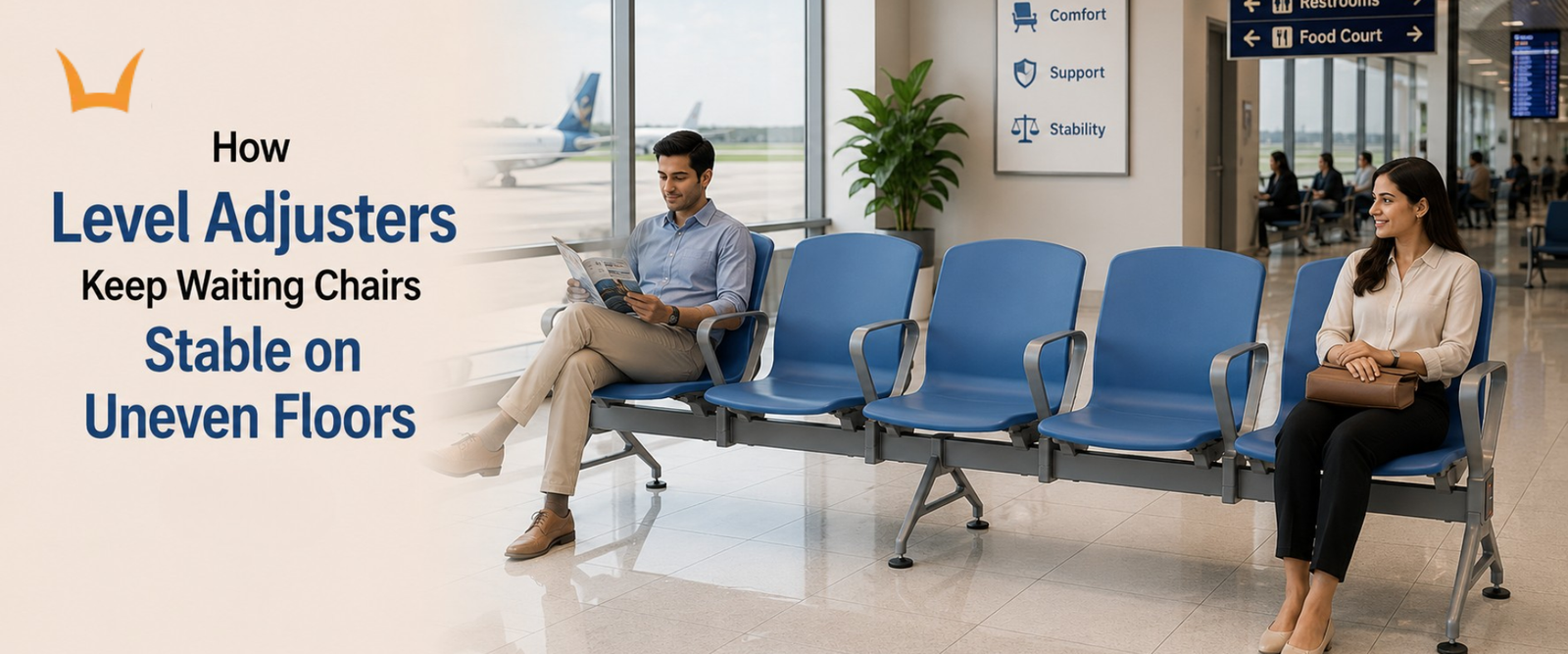
How Level Adjusters Keep Waiting Chairs Stable on Uneven Floors
- Why Most Public Floors in India Are Not Truly Level
- What Goes Wrong With Waiting Chairs Without Level Adjusters
- Why Multi-Seater Gang Chairs Need Level Adjusters More Than Single Chairs
- How the Jupiter Awe Level Adjuster System Solves the Problem
- How Level Adjusters Affect the Chair's Working Life
TLDR
- Most public floors are not perfectly level
- Wobbling chairs are a safety risk for visitors
- Level adjusters compensate for floor variation
- Multi-seater chairs need more stability points
- Built-in adjusters beat aftermarket DIY fixes
Introduction
A patient sits down in one of the waiting room chairs and feels it rock under their weight. A family member shifts in the next seat and the entire row of connected chairs moves with them. An elderly visitor stands up using the armrest, relying on proper armrest support, and the chair tilts because one leg is not making full floor contact.
These are not rare incidents. They happen every day in waiting areas across India.
At Syona Roots, we design our Jupiter Awe and Jupiter Ace waiting chair ranges with this reality in mind. The aluminium die cast frame includes level adjusters that solve the floor unevenness problem at the chair itself. This blog explains why level adjusters for waiting chairs matter so much in public spaces.
Why Most Public Floors in India Are Not Truly Level
Walk into any large hospital, clinic, government office, or airport in India and look at the floor carefully. The surface is rarely flat across its full length. Tiled, marble, and concrete floors all develop small height variations over years of use and settlement. Most of these are too small to notice when walking, but large enough to affect any piece of furniture sitting on multiple contact points.
What Goes Wrong With Waiting Chairs Without Level Adjusters
A chair without level adjusters sits where the floor places it. If one leg lands on a slightly higher patch than the others, that leg carries less weight while the surrounding legs carry more. The chair wobbles when anyone shifts position.
For multi-seater gang chairs, this becomes a bigger problem. The shared beam frame transfers movement from one seat to all the others, making overall chair safety even more important. When the chair rocks under one user, the people sitting in adjacent seats feel it too.
The impact extends beyond the movement itself. Visitors notice instability immediately, even when the wobble is minor. A chair that shifts under weight feels poorly maintained and creates doubt about the overall environment. In healthcare settings, where comfort and reassurance matter, stable hospital waiting seating helps visitors feel more relaxed while they wait.
Why Multi-Seater Gang Chairs Need Level Adjusters More Than Single Chairs
A multi-seater gang chair has ground contact points spread across a much wider span than a single chair. A 4-seater covers more floor than a 2-seater. A 5-seater spreads even further. The wider the span, the more likely the floor underneath shows height variations across its length.
This means longer gang chairs face the floor unevenness problem more often. Level adjusters become more important the longer the chair gets.
How the Jupiter Awe Level Adjuster System Solves the Problem
The Syona Roots Jupiter Awe range uses level adjusters built into the aluminium die cast frame at each floor contact point of the base.
The mechanism is a threaded screw design. The adjuster screws up or down in small increments. Each contact point can be tuned independently of the others. When one leg sits on a slightly raised patch of floor, the adjuster on that leg is lowered until the leg matches the others in vertical position. When a leg sits in a small dip, its adjuster is extended to bring it up to the same level as the rest. The chair sits flat across all its contact points and the wobble disappears.
The Jupiter Awe frame is designed to stay rigid, so the adjustment made at installation continues to hold the chair stable across regular use. This is different from aftermarket DIY fixes like shims. Shims slip out of position, get kicked away by cleaning staff, or break down under repeated weight. Built-in level adjusters stay in place because they are part of the chair structure itself.
How Level Adjusters Affect the Chair's Working Life
A wobbling chair is not just uncomfortable for the user. It puts uneven stress on its own structure every time someone sits down. Over months and years of daily use in a public space, this uneven load adds up.
The leg that carries extra weight develops fatigue in its joint to the frame. The contact point that bears repeated stress can loosen over time. The shared beam frame on a multi-seater chair flexes asymmetrically with every movement. None of this happens visibly, but it shortens the working life of the chair from the inside.
Level adjusters change this. When the chair sits flat, the user weight distributes evenly across all contact points as the frame was designed to handle. Each leg carries its intended share. The shared beam frame flexes uniformly. The chair structure stays balanced.
For facilities investing in waiting chairs that need to last across years of daily public use, the level adjuster system protects more than the visitor experience. It protects the chair itself.
Conclusion
Floor unevenness is one of those quiet realities that most facility planners do not think about until a wobbling chair becomes a complaint from a visitor. By that point, the problem has been creating discomfort for some time.
The right answer is not to repair the floor or to use aftermarket fixes. The right answer is to choose waiting chairs that handle the floor as it actually is. Level adjusters built into the chair structure deliver exactly that.
Looking for waiting chairs that stay stable on real public space floors?
The Syona Roots Jupiter Awe range features an aluminium die-cast frame with built-in level adjusters, designed to deliver stable performance across demanding healthcare, corporate, and public environments. Engineered for long-term durability and reliable stability, these waiting chairs help reduce wobbling, improve visitor comfort, and perform consistently even on uneven floors in high-traffic facilities.