


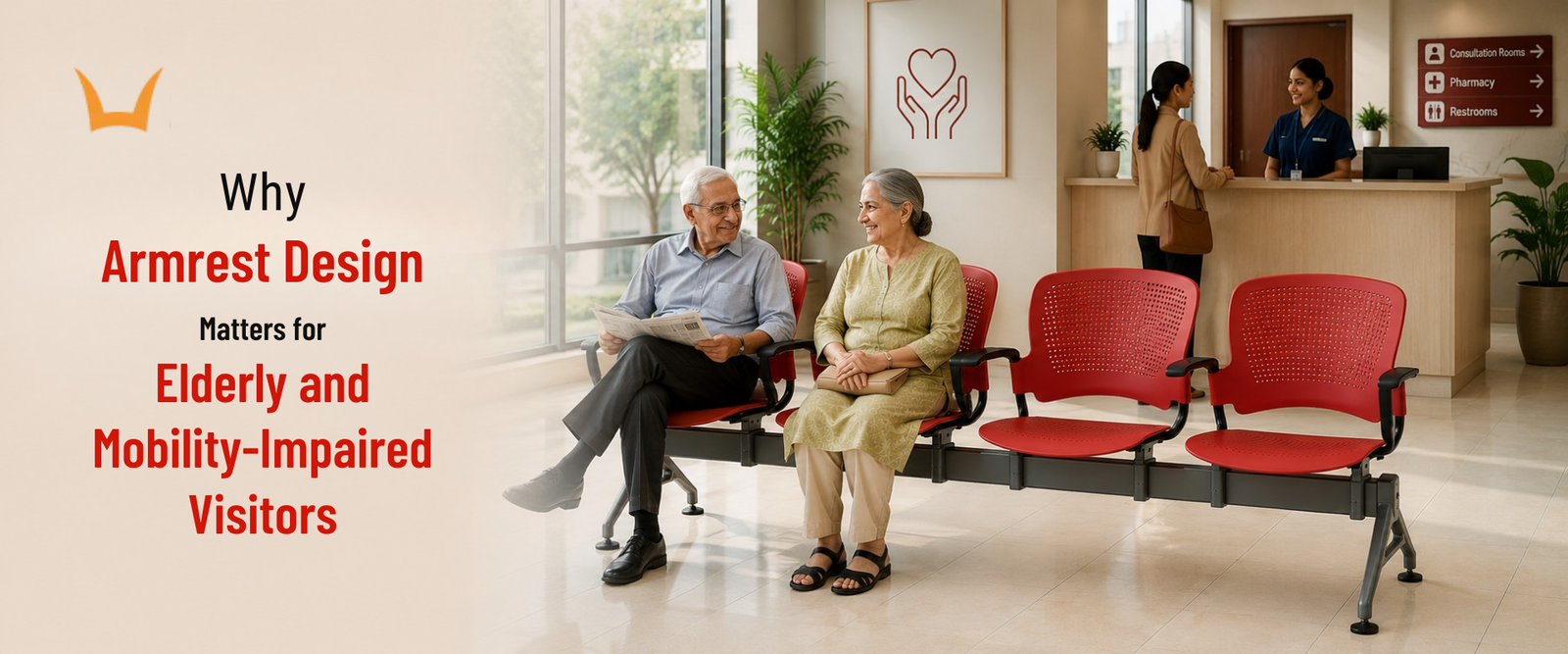
Why Armrest Design Matters for Elderly and Mobility-Impaired Visitors
- Why Armrests Are Not Just a Comfort Feature for Elderly Users
- The Three Critical Things an Armrest Must Do for Elderly Visitors
- Bear the User's Body Weight Safely
- Provide a Confident Grip Surface
- Stay at the Right Height for Sit and Stand Motion
- Real Situations Where Armrest Design Makes the Difference
- Why Die-Cast Aluminium and PBTE Are the Right Armrest Materials
TLDR
- Armrests carry real weight during sit and stand
- Grip surface decides confidence for elderly users
- Wrong armrest height causes falls and strain
- Material choice affects warmth, grip, and durability
- The right armrest supports independence
Introduction
Walk into any hospital or clinic waiting area in India and watch how older visitors interact with the public waiting chairs. A grandfather grips the armrest with both hands before slowly lowering himself onto the seat. A woman with arthritis pushes up against the armrest to stand, the small muscles in her hands working to hold steady. A visitor recovering from knee surgery uses the armrest as a balance point while shifting weight from sitting to standing.
For these visitors, the armrest is not a comfort feature. It is the part of the chair they trust with their balance and their dignity.
At Syona Roots, we design our waiting chair armrests with this reality in mind. This blog explains why armrest design for elderly seating matters so much, and what good design actually looks like for visitors who depend on it.
Why Armrests Are Not Just a Comfort Feature for Elderly Users
For a healthy adult, armrests are optional. The user rests their arms on them or leaves them alone. The chair works either way.
For elderly users and visitors with mobility issues, armrests are not optional at all. They are structural support equipment built into the chair. Every time the user sits down, the armrests bear part of the load as the body lowers. Every time the user stands up, the armrests transfer the body's weight from the seat to the legs through a controlled push-up motion.
Without armrests, many older visitors cannot sit down or stand up safely on their own. They drop into the seat heavily, sometimes hurting their back or knees on the way down. They strain trying to rise, sometimes losing balance and risking a fall.
This is why the armrest deserves serious design attention in public waiting chairs, not the afterthought it often becomes.
The Three Critical Things an Armrest Must Do for Elderly Visitors
Bear the User's Body Weight Safely
When an elderly user pushes down on the armrest to stand up, the armrest carries a significant portion of their body weight. Not just static weight, but dynamic force as the user pushes up against gravity.
A weak armrest flexes or wobbles under this force. The user feels the instability and hesitates. Confidence drops. Some users give up the standing attempt and call for help. Others push harder and risk losing balance.
A well engineered armrest stays completely rigid under push-up force. Combined with a stable chair base, it gives the user solid resistance. Their body responds to that resistance with controlled motion. The standing process becomes confident and predictable.
Provide a Confident Grip Surface
The contact between the user's hand and the armrest surface decides how the user feels about the support.
Cold, slippery surfaces fail elderly users. A polished metal armrest feels uncomfortable to grip, especially for hands with thin skin or arthritis. A smooth plastic surface offers no friction when the hand presses down. The user grips harder, which strains the joints further.
A warm, slightly textured surface gives the hand something to hold. The grip is natural and firm without requiring crushing pressure. The user trusts the surface and uses normal grip strength to complete the sit or stand motion.
Stay at the Right Height for Sit and Stand Motion
The armrest height must match where the user's elbow naturally sits when seated. Too high and the shoulder is forced up uncomfortably during sitting, and the user cannot push down with full force during standing. Too low and the user has to lean over to reach the armrest, straining the back during the sit and stand motion.
A standard height that works for the broadest range of adult users is what public seating needs. Adjustable armrests sound good in theory but rarely survive heavy public use. A fixed standard height built around average elbow position is the practical answer.
Real Situations Where Armrest Design Makes the Difference
In a hospital waiting area, an elderly patient with a walker arrives. She parks the walker beside the chair, holds the armrest with one hand to balance herself, then lowers slowly onto the seat. The armrest carries her partial weight through the entire transition. The chair next to her also has armrests, so when her son sits beside her, she does not have to share his armrest space.
In a clinic reception area fitted with proper clinic waiting chairs, a man recovering from hip surgery cannot bend his hip past a certain angle. He uses both armrests to lower himself with controlled arms, keeping his hip from flexing too far. When the doctor calls his name, he pushes up against both armrests in a slow rise that protects the recovering joint.
In an airport waiting area, an elderly couple sits together for a delayed flight. After two hours, the wife stands up to walk around. She uses the armrest to push herself up smoothly. Her husband stays seated, comfortable, knowing he can stand the same way when he needs to.
These are not extreme cases. They are the everyday reality of public waiting areas across India. The armrest design either supports these visitors confidently or fails them at the moment they need it most.
Why Die-Cast Aluminium and PBTE Are the Right Armrest Materials
At Syona Roots, our Venus Gang Chair armrests use a specific material combination: pressured die-cast aluminium for the structural core, with polybutylene terephthalate (PBTE) for the contact surface.
This combination solves the two critical demands of an elderly support armrest at the same time.
Die-cast aluminium provides the rigid structural backbone that bears user weight without flexing. When a user pushes down to stand, the aluminium carries the load directly to the chair frame. There is no creak, no wobble, no movement. The armrest feels like part of the chair itself.
PBTE provides the contact surface where the user's hand actually touches. PBTE is a high-grade engineering polymer with several properties that matter for elderly users.
It feels warm to the touch, even in air-conditioned waiting areas. The hand does not contact a cold metal surface that flinches the joints. It offers natural grip without being sticky or rough. Elderly hands with reduced grip strength can hold the surface with normal pressure and feel secure. It resists wear from constant hand contact, hand sanitizer, and routine cleaning chemicals. The surface stays consistent across years of public use.
The aluminium and PBTE combination is not a cost-cutting choice. It is the engineering answer to what an elderly support armrest actually has to do every day.
Conclusion
Public waiting chairs serve everyone, but they are tested most seriously by the visitors with the least physical ease. Elderly users, post-surgery patients, and visitors with mobility challenges depend on the armrest as a working part of their independence.
At Syona Roots, we design our armrests to meet this responsibility, not to fill out a product feature list. When an older visitor walks into a waiting area and sees a Syona chair, the armrest is ready to do its job from the first contact.
Looking for waiting chairs with armrests designed for elderly and mobility-impaired visitors?
Syona Roots offers waiting chairs engineered to provide reliable support, comfort, and long-term durability in healthcare and public spaces. With sturdy armrests, robust construction, and low-maintenance materials, our seating helps hospitals, clinics, and institutions create safer and more accessible waiting areas for every visitor.