


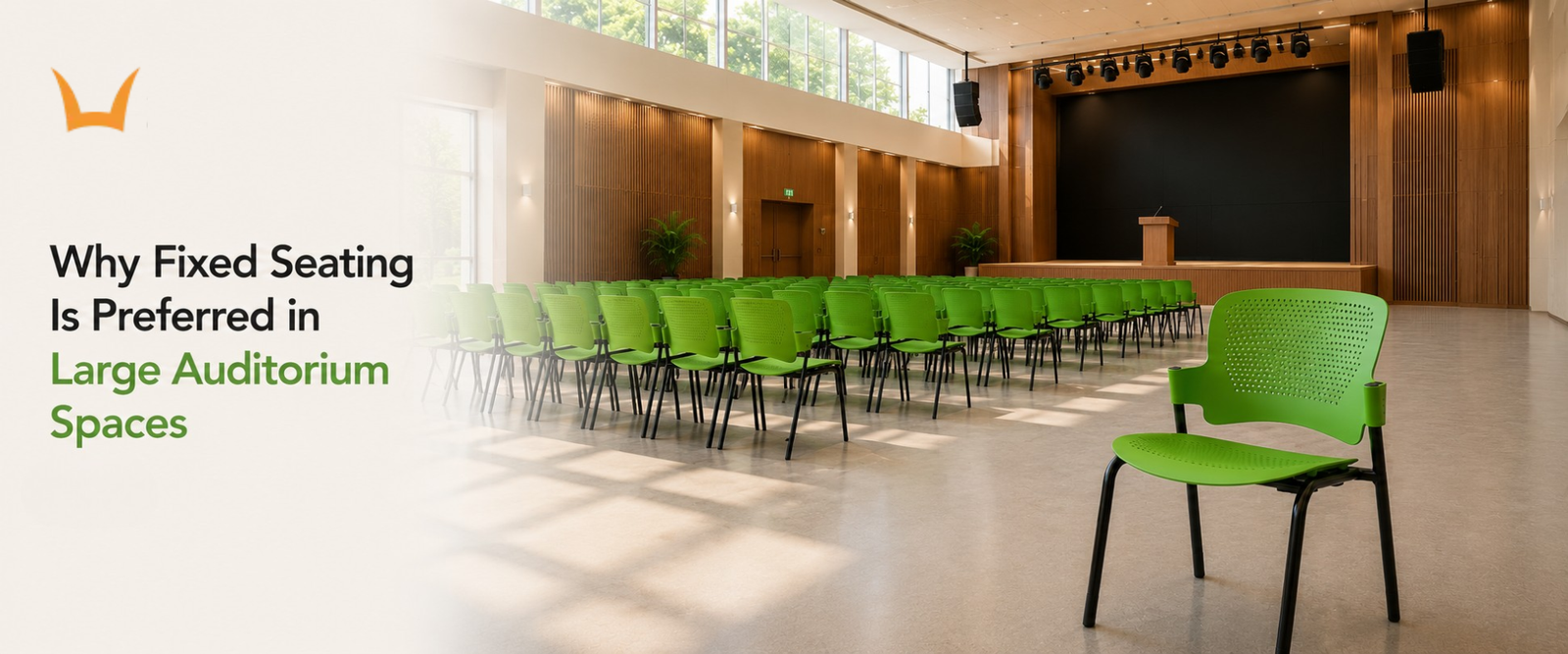
Why Fixed Seating Is Preferred in Large Auditorium Spaces
- Why Traditional Auditoriums Rely on Fixed Seating
- Where Fixed Seating Falls Short
- How Fixed Seating Costs Add Up Over the Years
- The Reality Most Institutional Halls Face Today
- What Modern Institutional Halls Need
- How to Choose the Right Seating for Your Hall
TLDR
- Fixed seating works for true auditoriums
- Sightlines, permanence, and look are its strengths
- Cost, rigidity, and storage are its weaknesses
- Most modern halls are multi purpose
- Flexible seating fits today's institutional needs
Introduction
Walk into a large traditional auditorium and you will see one thing every time. Long rows of seats bolted firmly to the floor, all facing the same stage, all built for one purpose.
fixed auditorium seating has been the default for theatres, lecture halls, and ceremonial spaces for decades. It looks formal, holds its layout, and supports very large audiences without strain.
But is it the right choice for every hall? At Syona Roots, we work with institutions across India who are weighing this exact question. This blog explains why fixed seating still rules traditional auditoriums, where it falls short, and what modern halls actually need from their seating today.
Why Traditional Auditoriums Rely on Fixed Seating
Sightlines, Rows, and Capacity Control
Large auditoriums depend on every audience member having a clear view of the stage. Fixed seating, installed on tiered or stepped flooring, locks every seat into the right height and angle, protecting seat alignment and clear sightlines for the whole row. The same row layout is guaranteed for the life of the hall, with no shifting or drift over time.
Permanent Installation for Safety
Because fixed seating is bolted to the floor, there is no risk of chairs tipping, rocking, or moving during use. This safety advantage matters in halls where children, students, or very large audiences gather. The installation also meets formal building safety codes more easily than removable alternatives.
Durability for Heavy Daily Audiences
Fixed seats are engineered for thousands of users across decades. Heavier frames, denser upholstery, and reinforced structures handle daily traffic without showing quick wear. This is why true cinemas, theatres, and large universities still choose fixed seating without hesitation.
A Professional Look for Formal Events
Graduation ceremonies, university convocations, prize distributions, and major performances all benefit from a formal hall. Uniform rows, matching upholstery, and clean geometry create the kind of environment that visiting parents, dignitaries, and sponsors take seriously.
Where Fixed Seating Falls Short
Fixed seating is excellent for its specific purpose, but it carries real limitations that buyers often discover only after installation.
No Flexibility for Multi-Format Use
Once installed, the hall can only host events that match the fixed row layout. Theatre style audiences fit. Workshops with group discussions do not. Examinations needing individual desks do not. Classroom style training does not.
This rigidity becomes a serious problem for institutions that did not plan their hall around a single use.
High Installation and Tiered Flooring Costs
Fixed seating is significantly more expensive than movable alternatives. The chairs themselves cost more. The tiered flooring construction adds another major cost layer. Professional installation adds yet more. The upfront budget for a traditional fixed auditorium runs much higher than most institutions expect.
Why Repairs Are Harder Than People Expect
This is the part most planners do not consider until something goes wrong. Replacing a single damaged seat in a fixed installation often requires removing surrounding seats, working under bolted brackets, and matching original upholstery from a decade ago.
Service calls take longer. Spare part availability becomes an issue after the manufacturer updates designs. What looks like a small repair on day one becomes a major service event five years later.
How Fixed Seating Costs Add Up Over the Years
The price tag at installation tells only part of the story. The long term cost of fixed auditorium seating includes ongoing maintenance, upholstery refurbishment, and eventually full system replacement when individual repairs become uneconomical.
Tiered flooring also limits future renovation options. Any layout change requires structural work, not just furniture swap outs. The hall becomes harder to modernise over its lifetime.
For institutions that genuinely need a traditional auditorium, this cost is worth carrying. For institutions that need flexibility, the same money invested in modern movable seating buys more functional space and more long term value.
The Reality Most Institutional Halls Face Today
Many new educational, corporate, and institutional projects now favour multi-purpose halls that can support a wider variety of events.
Schools want one hall that hosts assemblies, training, exams, and cultural events. Colleges need lecture halls that double as seminar rooms and assembly spaces. Companies want venues that switch between town halls, training sessions, and product launches in the same month.
Fixed seating cannot serve any of this. Institutions that install it in multi-purpose halls find themselves locked into a single use for the next twenty years. Halls that started as auditoriums end up underused because they cannot adapt.
The right seating decision today is no longer about installing fixed rows. It is about choosing chairs that hold the formal feel of an auditorium without locking the hall into one purpose.
What Modern Institutional Halls Need
Modern halls need three things from their seating.
Stability that feels solid even though the chair is not bolted to the floor. Strong metal frames, wide base feet, and balanced weight give modern institutional chairs the same planted feel as fixed seating without the permanent installation. Our Syona Roots chairs are built to this standard.
Build quality that handles heavy institutional use. Perforated polymer backs and seats support better airflow around seating while remaining durable and easy to maintain. The chairs do not lose their look across years of regular events.
Easy reconfiguration when the hall needs to change format. Stackable design means a team of two can reset the room in minutes for the next event. The hall serves its institution across many uses instead of one.
For institutions building multi-purpose halls, this combination of stability, durability, and flexibility is the actual modern requirement.
How to Choose the Right Seating for Your Hall
The decision comes down to one honest question. Will this hall serve one specific function for the next thirty years, or will it serve many functions in changing combinations?
For halls with a single fixed function, traditional fixed auditorium seating remains the right choice. Cinemas, dedicated theatres, and pure lecture halls fit this category.
For halls that serve multiple functions, fixed seating becomes a costly mistake. Modern institutional chairs from manufacturers focused on this category deliver far better long term value.
At Syona Roots, we encourage every planner to assess their hall's real use across years, not just the first event they plan to host. The right call protects the value of the hall for the long run.
Conclusion
Fixed auditorium seating continues to deliver value in spaces where audience layouts rarely change and long-term consistency matters. Its strengths in sightlines, permanence, and presentation remain difficult to match.
The challenge for many institutions is that their halls now serve a wider range of activities than they once did. When flexibility becomes as important as audience capacity, seating decisions need to support both present requirements and future changes.
Taking the time to assess how the space will be used over the coming years is often the difference between a seating investment that continues to perform and one that quickly becomes restrictive.
Planning seating for an institutional hall that needs to serve many purposes?
Syona Roots is an institutional chair manufacturer making modern chairs with perforated polymer backs, sturdy metal frames, and stackable design. Built for halls that need the formal feel of an auditorium without locking into one purpose for decades.