


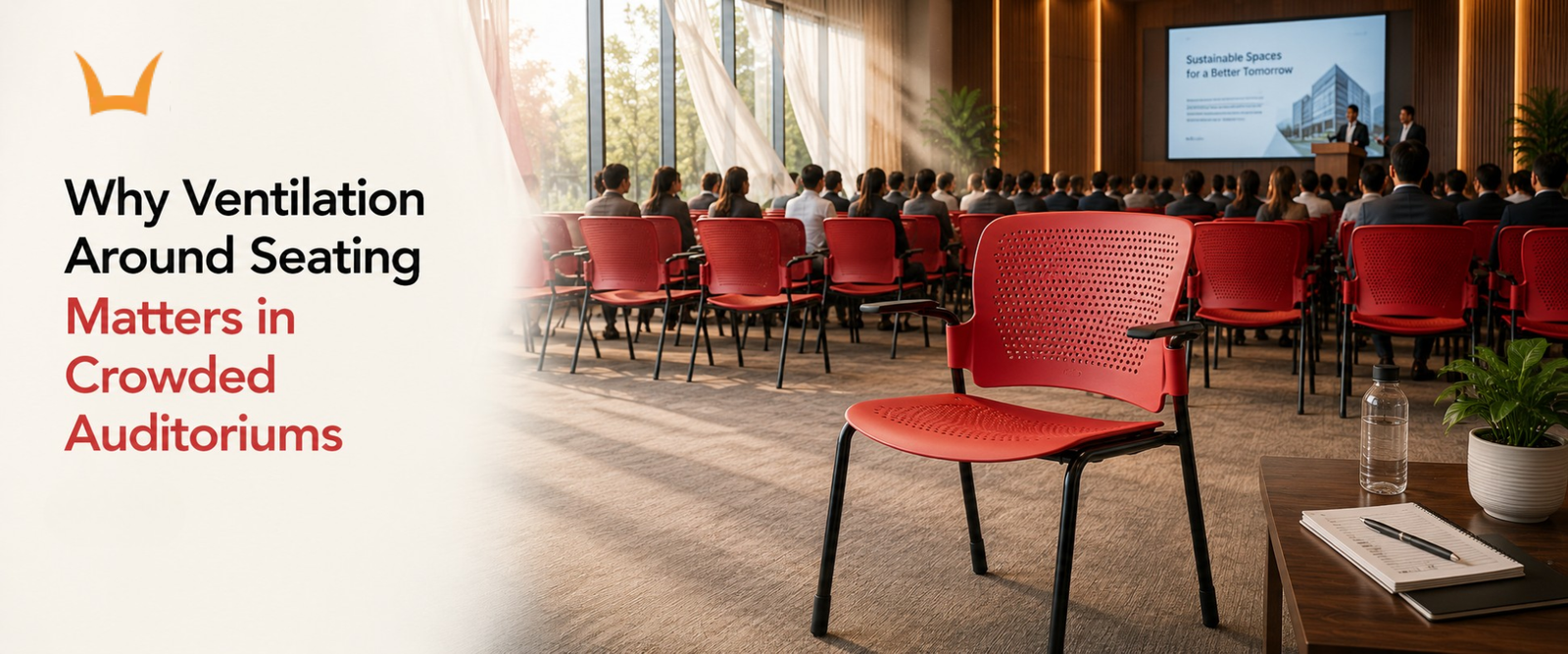
Why Ventilation Around Seating Matters in Crowded Auditoriums
- What Goes Wrong With Air Around Seating in Crowded Halls
- Why the Seating Itself Matters
- How Syona Roots Chairs Are Built for Ventilation
- Which Syona Seat Type Helps Air Move Best
- Where Each Audience Member Sits Affects What They Breathe
- The Row Spacing Decision
- Matching the Right Choice to Your Hall
TLDR
- Tip up seats win for ventilation in crowded halls
- Mid section aisle seats get the best airflow
- HDF writing pads handle humid Indian air well
- Open frame designs suit very large capacity halls
- Layout decisions matter as much as seat choice
Introduction
A crowded auditorium has a quiet enemy. The air at audience level.
Most planners assume the HVAC system handles it. It does not. The seating itself plays a bigger role than most buyers realise.
At Syona Roots, we have supplied auditorium chairs to venues across India for years. The halls that struggle with air quality usually share one mistake. The seating was chosen without thinking about ventilation.
This blog explains why ventilation around seating decides the success of a crowded event, and which Syona Roots chair choices solve it.
What Goes Wrong With Air Around Seating in Crowded Halls
A full auditorium holds hundreds of bodies in close range. Each person releases heat, exhales carbon dioxide, and adds moisture to the air. All of this collects at audience height, not at ceiling height where the vents sit.
Within thirty minutes of a packed event, the air around the seating becomes warmer, thicker, and lower in oxygen. The audience starts shifting. Concentration drops. Centre rows feel it first because they have less direct airflow.
The HVAC system at the ceiling cannot fix this alone. The air it pushes from above must reach the seating layer to do its job. Whether it gets there depends on the chair design, the row spacing, and the upholstery choice. This is the part most venues underestimate.
Why the Seating Itself Matters
A chair is either part of the ventilation solution or part of the problem. The structure, the materials, and the mechanism all decide which side it lands on.
A heavily built chair with closed sides and a sealed base traps warmth against the user. Cool air from the ceiling cannot reach the lower back, the legs, or the floor zone. The user feels uncomfortable without knowing why.
A well designed auditorium chair does the opposite. It uses openings, breathable materials, and a structure that lets air move around and through it. The cool air from above completes its journey to the audience instead of stopping short.
This single design difference separates auditorium seating built for crowded events from seating designed without ventilation in mind.
How Syona Roots Chairs Are Built for Ventilation
Three engineering choices shape our auditorium chair range.
The first is the chair body. We use an engineering polymer body across our auditorium seating. The material is light, stable, and shaped to allow vertical airflow under and around each seat. It also resists humidity and does not warp during monsoon months, which makes it suited to Indian conditions.
The second is the writing pad on our seminar and conference variants. We use HDF, which is high density fiber. HDF stays stable in humid air, does not absorb moisture, and holds up to continuous use without deforming. This material choice matters especially for coastal venues and halls that host long sessions.
The third is the seat mechanism. We manufacture three options, and each handles air movement in its own way.
Which Syona Seat Type Helps Air Move Best
Fixed Pad Seats
Fixed pad seats keep the seat pan in place at all times, giving the seating a fixed and organised layout, which is one reason many venues choose fixed seating in large halls. They are a good choice for venues that prefer a clean, professional appearance and do not need to change the seating arrangement regularly.
Open Frame Designs
Open frame designs leave more space around each chair in all directions. Air moves freely even when the hall is full.
These suit very large capacity halls, ceremonial spaces, and venues with high ceilings where natural air movement does more of the work than HVAC.
Where Each Audience Member Sits Affects What They Breathe
The seat type is half the answer. The position is the other half.
Front rows often have the worst airflow. Stage lighting adds heat. Air from the front side gets blocked by the stage itself. Long events make this worse for those rows.
Rear rows usually do better because HVAC vents at the back pull air toward them. The middle section tends to receive the best balance from both directions.
Aisle seats consistently get better airflow than centre seats. Air moves freely along aisles. Centre seats depend on whatever air filters between adjacent users. For long events, aisle seats are the smarter choice for VIPs and guests who will sit through the full programme.
The Row Spacing Decision
The gap between rows is a corridor for air to move horizontally. Tight rows kill that corridor. Wider rows protect it.
Many venues squeeze rows tighter to push capacity higher. This works for short events. It fails badly during long conferences, ceremonies, or summer functions when the audience sits for hours.
Our Syona Roots range includes standard and slim profiles, which gives planners flexibility. The slim profile lets you maintain capacity while keeping wider row gaps. The standard profile maximises comfort when the row count allows.
The team always advises generous spacing over maximum capacity. The small loss in seat count is outweighed by audience comfort and easier exit during emergencies.
Matching the Right Choice to Your Hall
For halls that host long conferences, ceremonies, or full day events, add the HDF writing pad variants. The combination handles long sittings in humid air without compromise.
For very large capacity or ceremonial halls, open frame designs handle the air movement role better. They also reduce HVAC load, which lowers running costs over the venue's lifetime.
For coastal cities and high humidity zones, the engineering polymer body is the deciding factor. It is the only material in our range that handles those conditions without warping or weakening over time.
If your project sits somewhere in between these categories, our team works directly with venue planners to recommend the right combination. There is no single answer that suits every hall.
Conclusion
Ventilation around seating matters in crowded auditoriums because the air your audience breathes depends on the chair they sit on, the row they are in, and the space around them. The HVAC system can only do so much. The seating decides whether that work reaches the audience or not.
At Syona Roots, our auditorium chair range is built with this reality in mind. The right chair, the right material, and the right layout turn a difficult ventilation challenge into a solved one.
Planning auditorium seating that supports proper ventilation in your hall?
Syona Roots is an auditorium seating manufacturer offering tip up, fixed pad, and open frame auditorium seating built with engineering polymer bodies and HDF writing pads designed for real Indian conditions. We help you match the right seat to your venue size, event style, and climate.