


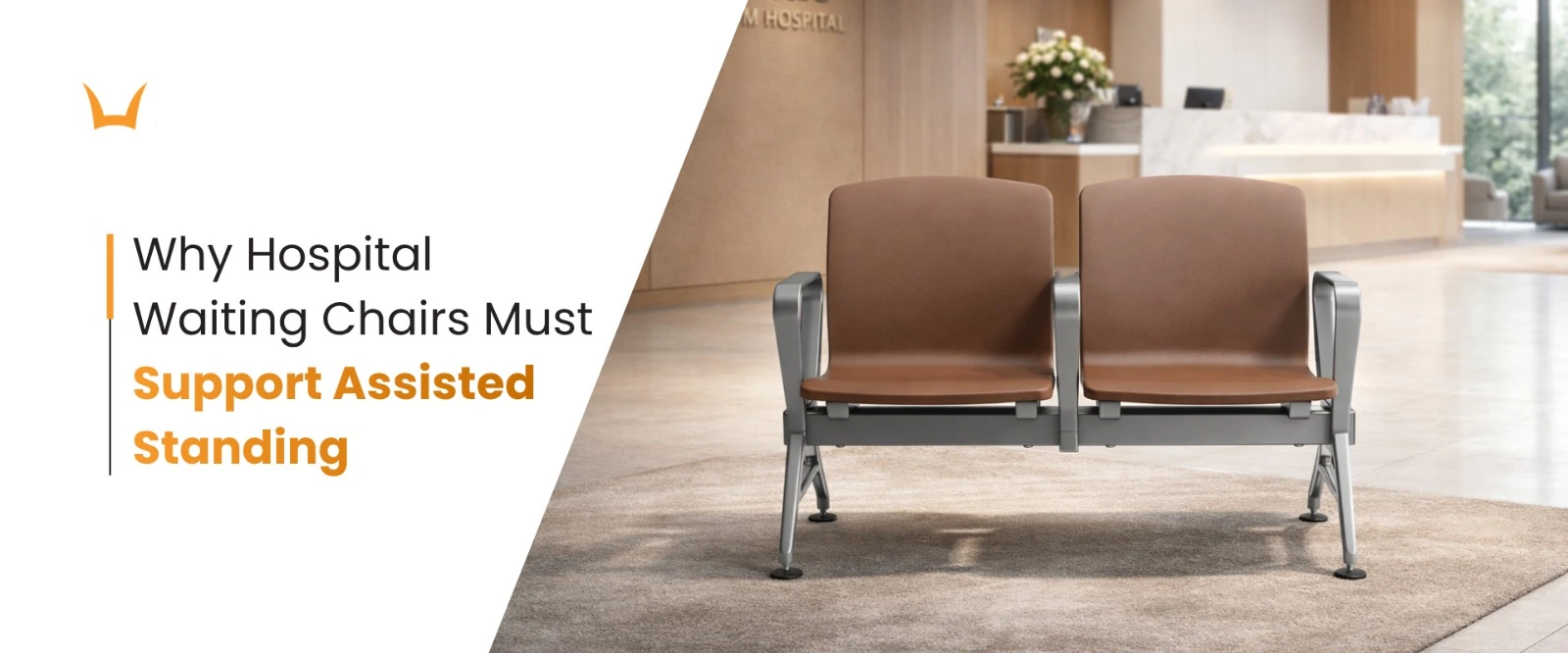
Why Hospital Waiting Chairs Must Support Assisted Standing
- The People Using Hospital Waiting Chairs Are Not Always Well
- Getting Up From a Chair Takes More Than People Realise
- Most Waiting Chairs Were Not Designed for This
- There Is Usually No One Nearby to Help
- What Makes an Armrest Actually Useful for Standing
- When One Side Is Weaker, the Chair Needs to Stay Put
- How Syona Waiting Chairs Are Built for This
- The Chair Has to Help Patients Stand
For hospital administrators, facility planners, architects and clinic managers
But for a large number of patients in hospital waiting areas, standing up is one of the harder things they do during the entire visit. Patients with knee pain, lower back problems, those who just had a procedure, elderly patients, pregnant women for all of them, rising from a seat takes real effort and carries real risk.
Most hospital waiting chairs are designed to be durable and easy to clean. Whether a patient can actually get out of the chair safely is rarely part of the conversation. A quality hospital waiting chair manufacturer considers ease of sitting and standing just as important as durability, hygiene, and long-term performance.
The People Using Hospital Waiting Chairs Are Not Always Well
The people in a hospital waiting area are dealing with something. Some are in pain. Some just had a scan or a procedure done and their body is not quite back to normal yet.
Elderly patients, people with knee or hip problems, those using walking aids, pregnant women in their later months — for all of them, standing up from a seat is not easy.
Many of them are also alone. Their attendant may be inside with the doctor. When the nurse calls their name, they have to get up by themselves. The chair is the only help they have.
For many patients in a hospital waiting area, the chair is the only thing they can push against to stand up. It has to be designed to actually help with that.
Getting Up From a Chair Takes More Than People Realise
When you stand up, you lean forward, your feet take your weight and your legs push you up. Your arms press down to help. For a healthy person this happens without thinking.
When the knees are bad, the leg push is painful or weak and the arms have to do more. When the lower back is stiff, even leaning forward is difficult. When one leg is weaker after surgery, the other side carries all the effort.
The chair either helps with all of this or makes it harder. The right armrest gives something solid to push against. The right seat height reduces how much effort is needed. A chair that stays still gives a stable base to push from.
Getting up from a seat is not one simple movement. It is several small movements in a row. And at each step, the chair can either help or get in the way.
Most Waiting Chairs Were Not Designed for This
The armrest is where most chairs let patients down. On most waiting chairs, the armrest is there to separate seats, not to help anyone stand. It is positioned at the middle or back of the seat, which is exactly where it is least useful when you are leaning forward to get up.
When the armrest is too far back, pushing on it gives very little help. The patient ends up relying on the legs anyway, which is exactly the part that hurts.
Then there is the chair moving. When someone pushes to stand, the chair gets pushed the other way. A light standalone chair slides back. The patient is halfway up with the chair going the wrong direction. That is when falls happen.
A low seat makes everything harder. The lower the seat, the more effort it takes to rise. For a patient with painful knees, a seat that is too low turns every single stand-up into a struggle.
There Is Usually No One Nearby to Help
In a busy OPD, two or three staff manage fifty or sixty patients. They cannot be beside every chair when someone needs to stand. Most patients who struggle to rise do so completely alone.
A hospital cannot put a staff member next to every chair. So the chair itself has to do the job. This is why durability in waiting area seating becomes just as important as comfort.
What Makes an Armrest Actually Useful for Standing
A good armrest for standing needs to be at a height where the patient can push down properly without hunching the shoulder or reaching too high.
It also needs to reach far enough forward. When a patient leans to stand, the hand goes forward naturally. If the armrest ends in the middle of the seat, there is nothing to hold at the moment they need it most.
It also has to be solid. If the armrest gives slightly when pushed, the patient pulls back instinctively. They push less, the legs do more work, and it hurts more. A wobbly armrest is worse than no armrest.
When One Side Is Weaker, the Chair Needs to Stay Put
Patients who have had surgery on one knee or hip often push harder on one side when standing. A light standalone chair tends to slide sideways under that uneven pressure.
Gang seating handles this because the whole row holds together. A single standalone chair needs a frame that is heavy and wide enough to stay firm when someone pushes harder on one side.
This is not obvious in a catalogue. It is very obvious to any patient who has had a chair slide away from them halfway through standing up.
How Syona Waiting Chairs Are Built for This
Syona waiting chairs are built with the standing movement in mind, not just the sitting part. The armrests are positioned for pushing down when rising, not just for separating seats. They are solid under full bodyweight and extend far enough forward to actually be useful when the patient leans to stand.
The seat height and shape reduce the effort needed to get up. Patients stay well positioned rather than sliding forward or sinking too deep into the seat.
Gang seating keeps the whole row stable when any patient rises. Engineering polymer construction gives the frame enough weight and strength to stay put.
The Chair Has to Help Patients Stand
A hospital waiting chair has to do more than support patients while they sit. It has to help them get back up safely, on their own, without the chair moving.
Most hospitals do not think about this when buying chairs. But in a hospital where many patients are managing pain or recovering from procedures, it is exactly the right thing to think about.
Most hospitals do not think about this when buying chairs. But in a hospital where many patients are managing pain or recovering from procedures, it is exactly the right thing to think about. A reliable hospital waiting chair manufacturer understands that patient safety depends not only on durability but also on how easily patients can sit down and stand up.
If your hospital is reviewing its waiting area seating, talk to Syona's team. We can help you choose chairs that actually support your patients when they need it most.
Are your waiting chairs helping patients stand up safely or making it harder?
For many patients, especially the elderly or those in pain, standing up from a chair is one of the most difficult parts of a hospital visit. Poorly designed seating can increase discomfort and even create safety risks. Waiting chairs should provide proper armrest support, stable structure, and the right seat height to assist patients during every movement.
Explore Syona’s waiting chairs designed to support safe sitting and standing, with strong armrests, stable gang seating, and user-focused design. For bulk requirements, connect with our team to get the right solutions and pricing tailored to your facility.