


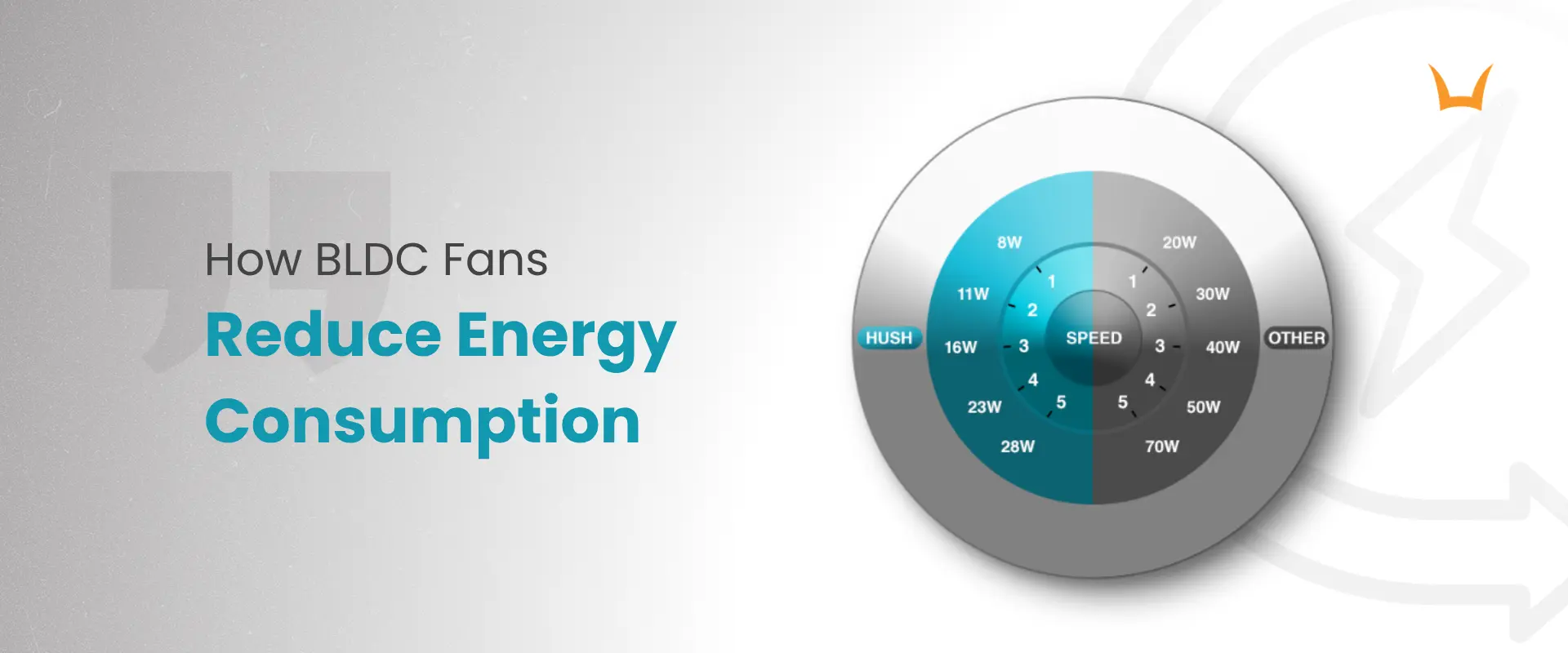
How BLDC Fans Reduce Energy Consumption
- The Appliance That Never Stops
- The Motor Was Always the Weak Link
- BLDC Does Not Improve the Old System. It Replaces It.
- Indian Summers Are Not Getting Any Shorter
- Lower Speed Settings That Actually Work
- Holds Up When the Power Supply Does Not
- Syona Ultra Premium BLDC Fans
- The Switch That Costs You Nothing in Comfort
Go check your electricity bill right now.
Somewhere in that number is the cost of running fans you forgot were even switched on. The fan in the guest room. The one in the corridor. The kitchen fan that runs while cooking and somehow stays on long after the food is done.
Fans do not feel expensive. That is exactly why they are.
The Appliance That Never Stops
An AC gets switched off once the room cools. A geyser runs for fifteen minutes and stops. Fans just keep going.
Through the morning, through the afternoon, through the night and into the next day. Nobody thinks about it because fans feel cheap to run. But cheap per hour multiplied by thousands of hours a year stops being cheap very quickly.
Most Indian households are not running one fan. They are running four, five, sometimes more. Every room, every floor, often all at the same time. Offices run dozens. Schools and commercial buildings have fans going in every corner from the moment doors open to the moment the last person leaves.
That steady, continuous power draw is where a significant portion of your electricity bill disappears. Not all at once, but gradually over time, hour after hour, day after day, often going unnoticed until the bill arrives. This is why switching to energy-efficient ceiling fans can make a meaningful difference in the long run.
The Motor Was Always the Weak Link
Here is what most people do not know about a conventional ceiling fan.
A large chunk of the electricity it consumes never moves a single blade. It gets burned off inside the motor as heat. The motor runs warm, the room gets no benefit from that warmth and the electricity meter counts every bit of it anyway.
You are paying for electricity that is doing absolutely nothing for you. It is not cooling the room. It is not helping the blades spin better. It is simply warming up a piece of metal inside a casing that nobody ever opens.
And the regulator on the wall? It looks like it is saving power when you turn the speed down.
It mostly is not.
A mechanical regulator reduces voltage but the motor continues drawing current at levels that do not match what you see. The fan slows down visibly. The consumption stays stubbornly higher than it should. You feel like you are being efficient. The electricity bill tells a different story every single month.
BLDC Does Not Improve the Old System. It Replaces It.
Forget refinement. BLDC technology is a completely different way of running a fan.
An electronic controller takes over from the mechanical components. It reads exactly what the motor needs at each speed setting and delivers precisely that. Not approximately. Not with a margin of waste built in. Exactly what is needed and nothing beyond it.
Lower speed means genuinely lower consumption. Higher speed costs only what higher speed actually requires. The motor stops wasting electricity because the system stops sending electricity that would be wasted in the first place.
No heat generated by unnecessary friction. No current drawn beyond what the setting demands. No mechanical inefficiency baked into every hour of operation.
That is the core of why BLDC fans consume less power than regular ceiling fans. Not a marketing claim. Just better engineering solving a problem that the old design was never equipped to address.
Indian Summers Are Not Getting Any Shorter
Fans that used to run six months a year now run eight or nine.
The heat arrives earlier. It stays later. October is warm in cities where it used to cool down weeks before. November no longer guarantees relief across large parts of the country.
With every extra month of operation the difference between an efficient motor and an inefficient one gets larger. A conventional fan running additional months at high wattage is a cost that quietly grows year after year without anyone making a conscious decision to spend more.
A BLDC fan running those same extra months does not create the same problem. The efficiency advantage compounds with every additional hour of use. The longer the fan runs the more the difference matters on the actual bill
Lower Speed Settings That Actually Work
This is the part that genuinely surprises people after they switch.
On a BLDC fan running at a lower speed through the night, the motor draws only what that speed actually requires. The savings are real and it shows up on the bill consistently.
On a conventional fan this barely happens. The regulator creates the appearance of saving power without delivering the actual reduction. Countless households run their fans on lower settings every night believing they are being careful with electricity when the actual consumption difference is far smaller than they imagine.
For a home where fans run at reduced settings for several hours every night, this single difference adds up across a year. It does not require a calculation to notice. It just shows up as a consistently lower number on the monthly bill.
Holds Up When the Power Supply Does Not
Voltage fluctuations are a daily reality across most Indian cities.
Supply dips during peak hours. Older residential areas see inconsistent current through evenings. Many cities deal with unpredictable voltage through entire seasons without any warning.
Conventional motors struggle with this. They slow down under low voltage, draw inconsistent current and deliver uneven performance through exactly the hours when people need them most.
BLDC controllers adapt to what is available. The fan stays stable. Performance does not drop when supply gets inconsistent. The efficiency holds up not just in ideal conditions but in the actual conditions that most Indian homes and buildings deal with every single day across every season.
Syona Ultra Premium BLDC Fans
Syona's BLDC range is built around one clear idea.
A fan should cool the room properly without consuming more electricity than the job genuinely requires.
The motor construction delivers consistent performance across long daily operating hours without degrading over time. The blade design works with the motor so that strong airflow is maintained without pushing wattage higher to compensate. Voltage fluctuation tolerance means the efficiency shows up in real Indian conditions and not just on a specification sheet presented at the time of sale.
For anyone running multiple fans across a home or managing dozens across a school, office or commercial facility, Syona BLDC fans make the running cost of ceiling fans something that stops being a concern every time the electricity bill arrives.
The Switch That Costs You Nothing in Comfort
Nobody has to change anything to benefit from BLDC technology.
Same ceiling. Same hours. Same comfort. No adjusted routines. No compromise on airflow. No new habits to build or old ones to break. The only thing that is different is what it costs to keep the fan running. And in a country where fans truly never stop, that difference is long overdue.
Are your ceiling fans increasing your electricity bill without you noticing?
Ceiling fans run for long hours every day, quietly adding to your electricity consumption. Conventional fans waste energy through heat, inefficient motors, and outdated speed control systems. BLDC fans are designed to eliminate these losses, ensuring that every unit of electricity is used efficiently to deliver consistent airflow.
At Syona, our BLDC ceiling fans are built for real-world conditions, offering reliable performance, lower power consumption, and stable operation even during voltage fluctuations. Whether for homes, offices, or commercial spaces, upgrade to a solution that keeps your comfort high and your energy costs under control.