


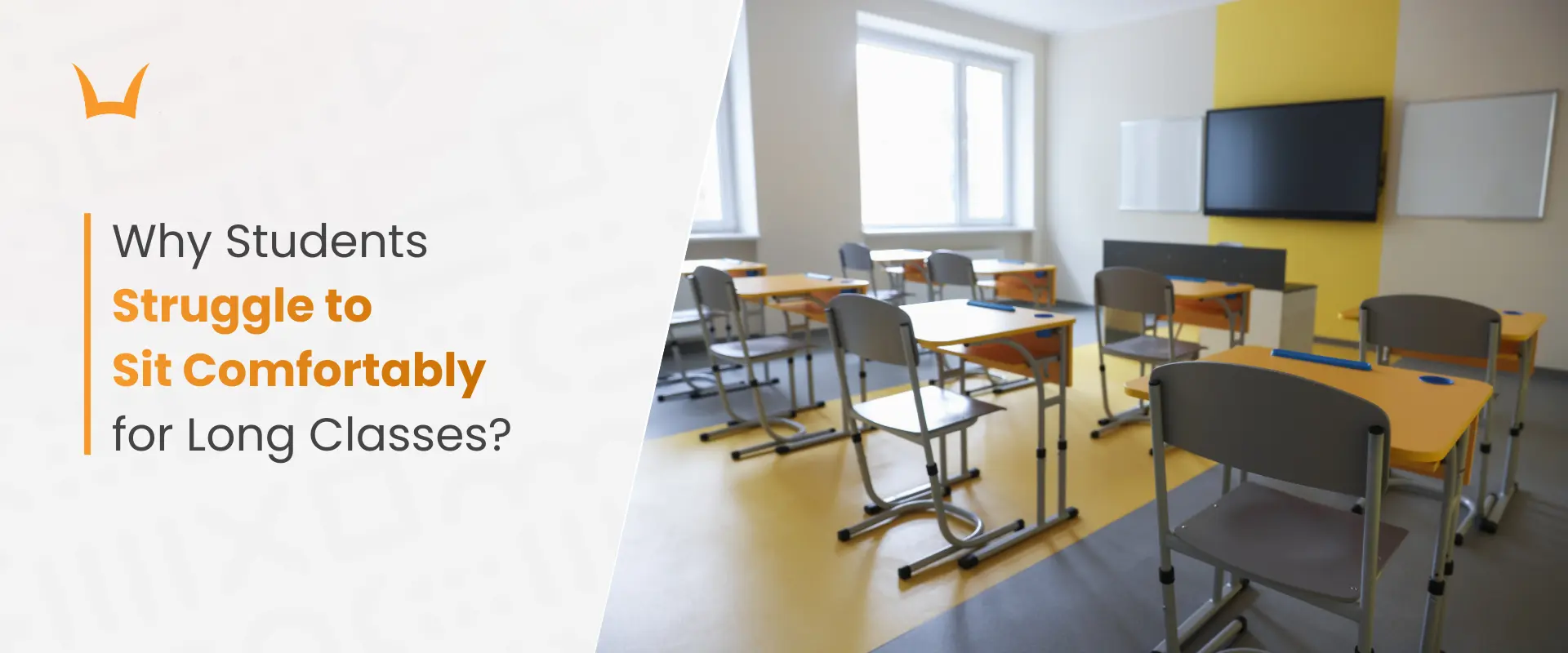
Why Are School Chairs So Uncomfortable for Long Classes?
- The Chair Is the Wrong Size for the Student
- Flat Seats Are More Tiring Than They Look
- No Back Support Means the Student Does All the Work
- The Writing Surface Makes a Bigger Difference Than Expected
- Six Hours of Sitting Has a Real Effect on the Body
- What Happens When the Chair Actually Fits
- The Classroom Chair Is Not a Small Decision
For school management, college administrators, academic directors and parents
Ask any student what makes a long school day hard.
Most will not say the subject is difficult. They will say their back hurts. Their legs feel stiff. They cannot focus after a point.
We often blame this on phones, distractions or short attention spans. But there is something more basic going on.
A student sitting in the wrong chair for six hours is not going to learn as well as one sitting in the right chair. It is that simple.
So why are school chairs so uncomfortable? In most classrooms, the problem comes down to four common design issues that affect posture, movement, focus and long-term comfort.
The Chair Is the Wrong Size for the Student
Most schools buy one size of chair and use it across multiple age groups.
This seems practical. In reality it creates a daily problem.
A student whose feet do not touch the floor is not just uncomfortable. The pressure building at the back of their thighs cuts off circulation. Fifteen minutes in, the legs start to feel heavy. Half an hour in, the fidgeting begins.
A student who is too big for a small chair ends up hunching forward because there is nowhere else to go.
When the chair does not fit the student, the student spends energy managing the chair instead of following the lesson.
Age-appropriate sizing is not extra. It is what makes it possible for a student to actually sit still.
Flat Seats Are More Tiring Than They Look
When you sit on a flat surface for long periods, the pressure concentrates at the base of your spine and the back of your thighs. Your body starts looking for relief. You shift. You slouch. You lean sideways.
Teachers see this as inattention. But the student is not being careless. Their body is simply reacting to pressure it cannot sustain.
Compare a basic seat with one from a proper school and college chair supplier and look at the difference. A well-designed seat often includes subtle contours and a gentle front-edge slope that improve comfort during long study periods.
A seat with a gentle slope at the front edge distributes pressure more evenly. The student stays still longer because the chair is not actively making them uncomfortable.
No Back Support Means the Student Does All the Work
Sitting upright sounds easy. It is not.
When a backrest does not follow the curve of the spine, the lower back muscles have to hold the student up on their own. This works fine for the first period. By the third or fourth, those muscles are tired.
So the student slouches. Not because they want to. Because their back is exhausted.
This is where student posture support earns its name.
A contoured backrest that matches the spine's natural shape takes that load off the muscles. The student's back is supported rather than strained. This is exactly what lumbar support classroom chairs are designed to do. They can stay upright through a longer class without effort.
Healthy sitting posture stops being a daily struggle when the chair does most of the work.
Good back support does not just improve posture. It extends how long a student can focus before fatigue takes over.
The Writing Surface Makes a Bigger Difference Than Expected
Students spend a lot of time writing. Notes, classwork, tests.
When the writing pad is too far away, they lean forward. When it is at the wrong angle, they twist their wrist or hunch their shoulder to compensate. When it wobbles, they grip the pen harder to control the surface.
None of this seems serious in isolation. But it happens every single day across every class.
Over weeks and months, writing on a poorly positioned or unstable surface builds tension in the wrist, shoulder and neck that students carry without realising where it comes from.
A well-positioned, stable writing surface is one of the smallest changes a school can make with one of the biggest impacts on how comfortable a student feels through a writing-heavy school day.
Six Hours of Sitting Has a Real Effect on the Body
A school day is long.
Six to eight hours of sitting with few breaks is genuinely hard on the body, especially for children and teenagers whose bodies are still developing.
When circulation in the lower body slows from prolonged sitting, the legs feel heavy and numb. The brain gets less oxygen-rich blood. The student starts losing focus not because they are bored but because their body is signalling that something is wrong.
Poor chair design makes all of this happen faster. A seat that restricts blood flow at the thighs, combined with no back support and a cramped writing position, turns an already long day into an exhausting one.
By the last class of the day, a student in a poorly designed chair is not just tired. They are physically drained from the effort of sitting.
What Happens When the Chair Actually Fits
Comfortable school chairs change everything. Student chair comfort is not about luxury, it is about removing daily friction from the school day.
Here is what changes when a student sits in a chair designed for their body.
They stop thinking about the chair. That is the clearest sign that furniture is working.
The pressure is distributed across the seat instead of concentrated in one spot. The backrest holds the spine rather than letting it collapse. The writing pad is close enough and stable enough that writing is just writing, not a physical negotiation.
The student is not spending energy managing discomfort. That energy goes toward the lesson instead.
Ergonomic does not mean expensive or complicated. It means the chair is designed around how a student's body actually works, not just how a chair is easy to manufacture.
Height variants for different age groups, a waterfall seat edge, a contoured backrest and a stable writing surface are not luxury features. These are the fundamentals of classroom chair ergonomics, the conditions that allow a student to sit comfortably through a school day.
The Classroom Chair Is Not a Small Decision
Schools invest in teachers, curriculum and technology. The chair a student sits in for six hours every day deserves the same thought.
Discomfort is not a character issue. It is a design issue.
When you fix the chair, you fix a problem most schools did not even know they had.
Syona's, a classroom seating supplier builds specifically around how students sit. Right-sized for each age group, with a waterfall seat, contoured backrest and stable writing pad, they take the physical burden off the student so the learning can actually happen.
Walk into any classroom in your institution and look at how students are sitting by the fourth period. If they are slouching, shifting or leaning in every direction, the chair is worth looking at.
Are Your Classroom Chairs Affecting Student Comfort and Focus?
If students are constantly shifting, slouching or struggling to stay comfortable during long classes, the issue may not be attention span but the chair itself. Classroom furniture plays a direct role in how long students can sit, focus and engage with their lessons.
Syona Roots designs classroom and writing pad chairs specifically for how students actually sit during a full school day. These ergonomic classroom chairs feature age-appropriate sizing, contoured back support, waterfall seat edges and stable writing pads, our chairs help reduce discomfort so students can stay focused in class.
If you are planning to upgrade classroom furniture for your school, college or educational institution, speak directly with our team to explore the most suitable seating solutions for your students.