


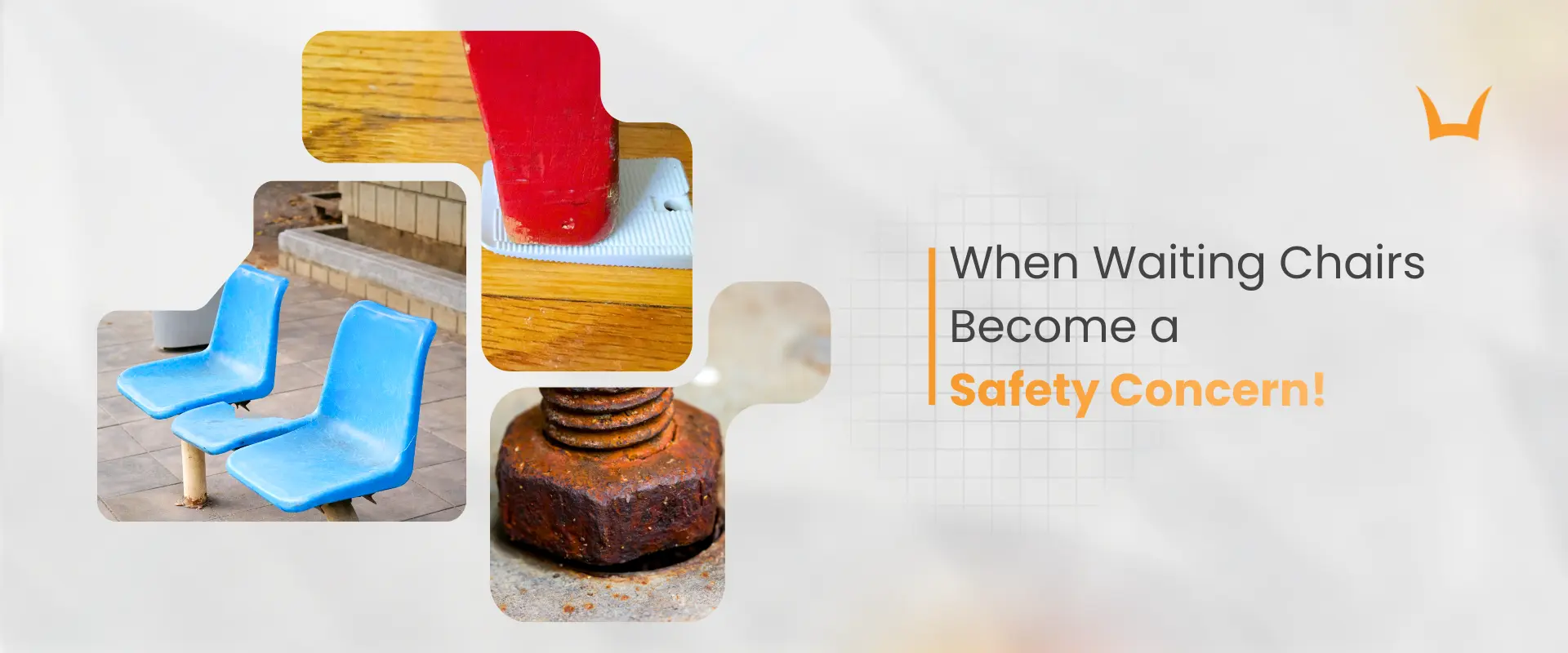
When Waiting Chairs Become a Safety Concern
- Structural Failure Is the Most Direct Safety Risk
- Rust and Surface Degradation Create Physical Hazards
- Unstable Chairs and Overcrowding Create Trip and Fall Risks
- Hygiene Failures in Shared Seating Are a Health Safety Issue
- Fire Safety Compliance Is Not Optional in Commercial Spaces
- How to Identify Whether Your Current Chairs Are Actually Safe
- Safety Is Not a Feature. It Is the Starting Point
For facility managers, procurement teams, school management, corporate admin heads and public infrastructure planners
A chair collapses under a visitor in a corporate lobby. An elderly person's arm goes through a rusted armrest in a government office waiting area. A child trips over a chair leg that has bent outward in a school reception.
These are not hypothetical situations. They happen. And when they do, the question that follows is always the same.
How did we let it get to this point?
Sourced from a dedicated waiting chair manufacturer, these chairs are among the most used furniture in any public or institutional space. They carry hundreds of people daily across years of use. But they are also the most overlooked when it comes to safety evaluation.
A waiting chair that has become structurally unsafe is not just a facilities management problem. It is a liability sitting in your reception area.
This blog walks through the specific ways waiting chairs become safety concerns and what to do before a small issue turns into a serious incident.
Structural Failure Is the Most Direct Safety Risk
Every chair has a rated load capacity. In commercial spaces, that number is often treated as a guideline rather than a limit.
Budget chairs use low-grade welds and lightweight frames that hold up in controlled conditions. Under real-world commercial use, joints loosen, welds crack and legs begin to shift.
By the time a chair visibly wobbles, the structural damage is already significant. The next user may feel nothing. Or they may be the one sitting on it when it finally gives way.
In a school, a mall, a government building or a corporate campus, a chair that fails under a user is an injury event and a potential legal liability for the organisation that placed it there.
Reinforced joints and high load capacity frames are not premium specifications. They are the baseline for any chair placed in a shared public space.
Rust and Surface Degradation Create Physical Hazards
Metal frames that are not properly treated start corroding. In India's coastal cities and humid inland regions, this happens faster than most facility managers expect.
Rusted armrests develop sharp edges. Corroded legs can splinter under pressure. Chrome plating that has started peeling creates rough surfaces that nobody notices until someone gets cut.
This is not dramatic. It is gradual. And that is exactly what makes it dangerous.
A chair that looks usable from a distance can have corroded edges and weakened joints that are only discovered when someone gets hurt.
Powder-coated frames and anti-rust treated steel help ensure waiting chairs in high-footfall areas do not become a hazard over time. That level of build quality is what separates a chair that lasts from one that fails.
Unstable Chairs and Overcrowding Create Trip and Fall Risks
UUneven legs are one of the most common yet often ignored issues in waiting area seating. These issues rarely appear overnight. Instead, they develop gradually through daily wear and tear on waiting chairs.
A chair with one leg slightly shorter than the others rocks and shifts when someone sits. On smooth flooring it slides. For an elderly visitor or someone carrying weight, it is a fall risk.
Overcrowding makes this worse. Chairs pushed into walkways, narrowed aisles and blocked movement paths are trip hazards during normal use. During an emergency evacuation, they are obstacles between people and the exit.
Fixed and linked seating systems address instability directly. Rows that are joined do not shift, tip or migrate into walkways regardless of how crowded the space gets.
Hygiene Failures in Shared Seating Are a Health Safety Issue
This point often gets filed under facilities management rather than safety. It belongs in both.
Fabric-upholstered chairs in shared spaces absorb moisture, trap bacteria and cannot be properly sanitised through routine cleaning. Foam beneath damaged upholstery absorbs spills and becomes a contamination source that no surface cleaning reaches.
In schools, government offices and retail centres where chairs are shared by hundreds of people daily, this is a real infection control concern.
A chair that cannot be properly cleaned is not just a hygiene issue. In a shared public space, it is a health risk for every person who uses it.
Non-porous, smooth surfaces that clean quickly and completely are the only practical option for high-contact shared seating. Not just to look clean. To actually be clean.
Fire Safety Compliance Is Not Optional in Commercial Spaces
Most facility managers think about fire safety in terms of exits, sprinklers and extinguishers.
Seating rarely comes up in that conversation. But it should.
Standard PU foam in budget cushioned chairs is combustible. In a commercial building, school or public facility, seating that spreads fire faster than code permits is both a compliance risk and a life safety issue.
Commercial and public spaces in India are increasingly subject to fire safety standards that specify materials permitted in occupant-facing furnishings. Seating that does not meet fire-retardant requirements puts the facility out of compliance.
Fire-retardant treated PU foam is the standard from any reputable hospital waiting chair manufacturer supplying public buildings, offices and institutions. It is not an upgrade. It is a safety requirement.
How to Identify Whether Your Current Chairs Are Actually Safe
You do not need a specialist audit to spot the warning signs.
Check the joints. If a chair wobbles when you press the backrest, the joint integrity is already compromised.
Check the frame. Rust spots, peeling coating or sharp edges at any contact point mean the chair is no longer safe.
Check the legs. All four should contact the floor evenly. If they do not, it is a stability risk.
Check the upholstery. Tears, exposed foam or cracked surfaces mean the hygiene barrier is gone and the padding underneath is exposed to moisture and contamination.
Any chair that fails one of these checks should not be in service. Not tomorrow. Right now.
For procurement teams, commercial grade build, powder-coated or stainless steel frames, verified load capacity, warranty support and modular replacement options are the baseline for any shared public environment.
Safety Is Not a Feature. It Is the Starting Point.
Waiting chairs are not a low-stakes purchase. They are a daily safety commitment to every person who sits in them.
Structural failure, surface hazards, instability, hygiene breakdown and fire risk are not distant possibilities. They are the predictable outcome of placing the wrong chairs in a demanding environment and not reviewing them.
At its core, Syona represents structured manufacturing, disciplined design and dependable delivery. The brand brings together technical expertise and practical insight to create commercial seating solutions that institutions can rely on with confidence. Every waiting area chair is developed with attention to proportion, finish and functional clarity, reflecting Syona’s commitment to professional standards.
For organisations seeking consistency, accountability and long-term partnership in their seating requirements, Syona stands as a trusted manufacturing brand built on capability, credibility and commitment.
Is Your Waiting Area Seating Safe Enough?
Ensuring the safety of your waiting area seating is not just about maintenance. It is about choosing the right commercial-grade chairs from the start. If your facility handles high visitor traffic in hospitals, schools, offices, or public buildings, explore Syona waiting chair solutions designed for durability, stability, and long-term safety. Our team can help you select seating that meets real-world usage demands while maintaining a professional and organised waiting environment.